Squat To Leg Extension
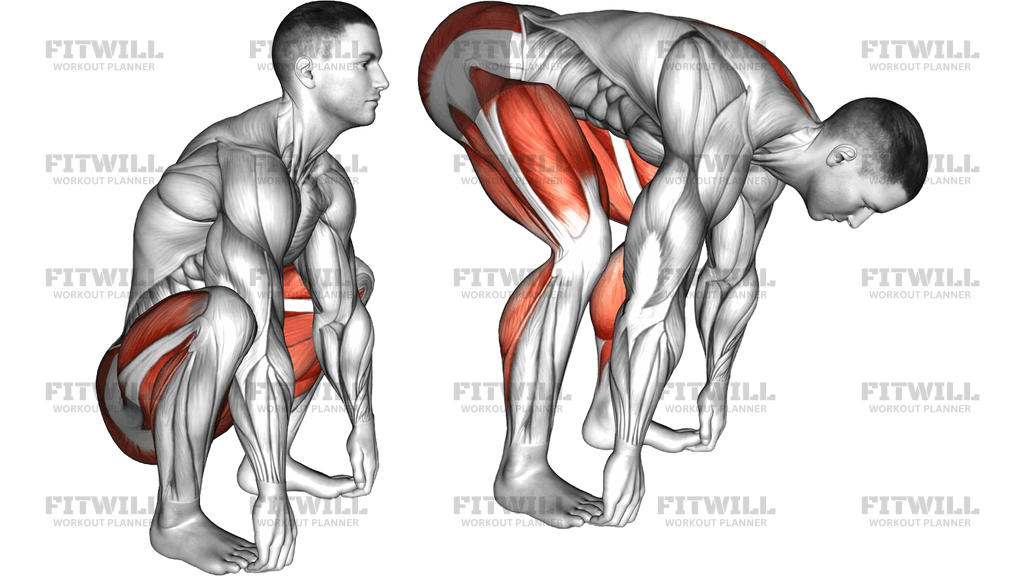
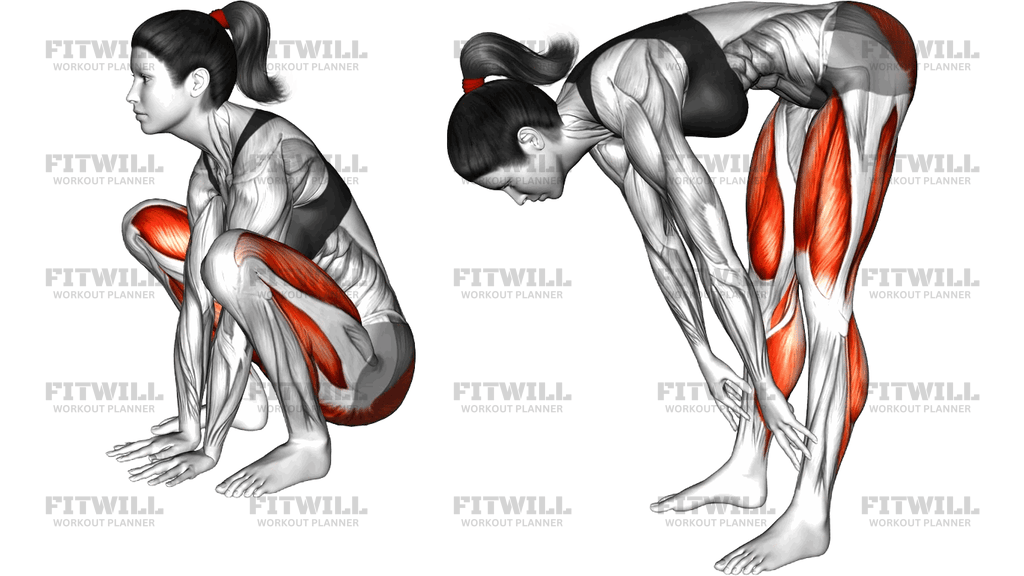
The Squat To Leg Extension is a bodyweight flow that moves you from a deep squat straight into a standing forward fold with the legs extended. You sink into a full squat with your hands available for balance, then drive through your feet to stand while keeping your hips high, letting the knees straighten and the hamstrings lengthen under load. The return trip reverses the path: hinge at the hips, bend the knees, and settle back into the bottom of the squat.
This movement is best thought of as dynamic mobility work rather than a strength lift. It trains the hamstrings, quads, glutes, and calves through two opposite ends of their range: the squat loads the quads and glutes in deep knee and hip flexion, while the leg extension at the top stretches the hamstrings and calves with the hips flexed and knees straight. That combination makes it a favorite warm-up before lower-body training, running, or any activity that asks the hips and thighs to move through a large range.
People with stiff hips, tight hamstrings, or achy knees from sitting tend to benefit the most. Because you move in and out of end ranges repeatedly without external load, the joints get lubricated and the tissues get lengthened at the same time. It is also a practical reset for lifters between heavy squat or deadlift sets, since it keeps the hips open without fatiguing anything.
Setup matters more than it looks. Your feet should be about shoulder-width or slightly wider so the knees can track over the toes in the bottom position, and your heels should stay glued to the floor the whole time. If ankle mobility limits your squat depth, a slight toe-out angle or holding onto a sturdy object can help you keep an upright torso. The hands can rest on the floor in the squat or simply hang as you fold forward.
Execution quality comes down to transitions, not positions. Move slowly enough that each rep takes several seconds, keep the spine long rather than rounding aggressively at the top, and let the knees bend as soon as the hips run out of room on the way down. Breathe steadily throughout, exhaling as you extend the legs and inhaling as you descend back into the squat.
A few safety points are worth respecting. Never bounce or lock the knees violently at the top, since a hard snap into extension is where hamstring strains happen. Keep the movement within a range that feels like a stretch, not pain, especially behind the knee and in the low back. If you have a history of hamstring injury or disc problems, reduce the depth of the fold and keep the knees slightly soft.
[ Workout Log & Planner ]
Put your next workout in Fitwill
Keep your plan and training log ready when you are.


Instructions
- Stand with your feet roughly shoulder-width apart, toes turned out slightly, and heels flat on the floor.
- Bend the knees and hips together to lower into a full squat, letting your arms reach forward or your fingertips touch the floor for balance.
- Keep your chest as upright as the squat allows and your weight spread across the whole foot, with the knees tracking in the same direction as the toes.
- From the bottom of the squat, press through your heels and begin to straighten the legs while pushing the hips up and back.
- As you rise, let your hands slide down toward your feet or the floor so the torso folds forward over the extended legs.
- Hold the extended position for one to two seconds at a comfortable stretch behind the thighs, with the knees straight but not locked hard back.
- Reverse the path by bending the knees first, then sinking the hips down and back until you are seated in the squat again.
- Exhale as you extend the legs into the stretch, and inhale as you lower back into the squat.
- Complete 8 to 12 smooth repetitions, pausing briefly in each position instead of rushing between them.
Tips & Tricks
- If your heels lift in the squat, widen your stance a few centimeters and turn the toes out slightly rather than rising onto the balls of your feet.
- Rounding the entire spine at the top of the extension turns this into a low-back stretch instead of a hamstring stretch; think about hinging at the hips and keeping the chest long.
- A hard knee lockout at the top is the most common fault with this movement. Straighten the legs fully but stop before the knee snaps back.
- Let the hands do real work. Pressing fingertips into the floor in the squat helps you sit tall and keeps balance from limiting your depth.
- If the hamstrings are too tight to extend the legs fully, bend the knees slightly on the first few reps and straighten them a little more each rep.
- Keep the whole rep slow and continuous. Jerking from fold to squat defeats the mobility benefit and invites a hamstring strain.
- Shifting the weight to the toes when standing up usually means the hips are rising before the chest. Push through the heels and think hips first.
- Use this before squats, deadlifts, or running rather than after maximum-effort lifting, when fatigued hamstrings are more prone to overstretching.
- Two or three sets of 8 to 10 reps with a short pause at the top is enough; more volume does not make the stretch better.
Frequently Asked Questions
Which muscles does the Squat To Leg Extension target?
The hamstrings and calves are stretched at the top when the legs straighten, while the quads, glutes, and hip muscles work through the squat portion. The low back also gets a gentle lengthening in the forward fold.
Is the Squat To Leg Extension a strength exercise or a stretch?
It is primarily a dynamic mobility drill. Your bodyweight provides light resistance through the squat, but the main goal is moving the hips, knees, and hamstrings in and out of end ranges.
Can beginners do the Squat To Leg Extension?
Yes, and it is actually a good early drill for learning a deep squat. Beginners can hold onto a doorframe or rack for balance and bend the knees more during the extension until hamstring flexibility improves.
Why do my heels lift off the floor in the squat position?
That usually points to limited ankle mobility or a stance that is too narrow. Widen your feet, turn the toes out slightly, and if needed place your heels on a thin, stable surface while you work on ankle range.
Should my knees be completely straight at the top of the extension?
Straight, yes; locked and snapped back, no. Extend the legs fully but stop just short of a hard lockout so the hamstrings lengthen without a jolt at the knee joint.
What is the most common mistake with this movement?
Rushing the transition and rounding heavily through the low back at the top. Slow the reps down, hinge from the hips, and let the stretch build gradually behind the thighs.
How does the Squat To Leg Extension differ from a simple standing toe touch?
The squat portion actively opens the hips, ankles, and knees between stretches, so each extension starts from a warmed, mobile position instead of a cold standing start. That makes the hamstring stretch easier to reach with less spinal rounding.
What can I substitute if I cannot get into a deep squat?
Elevate your heels slightly, hold a sturdy support for balance, or use a squat-to-stand variation where you grab the toes from the squat before extending the legs. All three keep the same flow with less mobility demand.
Is it safe to do this movement with a hamstring strain history?
Proceed cautiously: keep the knees slightly bent during the extension, shorten the range, and stay well below the point of pain. If any sharp sensation appears behind the thigh, stop and choose a gentler mobility option.
When should I include the Squat To Leg Extension in my workout?
It works best in the warm-up, a few minutes before squats, deadlifts, running, or sports. It can also serve as an active reset between lower-body sets, as long as you keep the reps controlled and unhurried.