Cable Seated Single Leg Extension
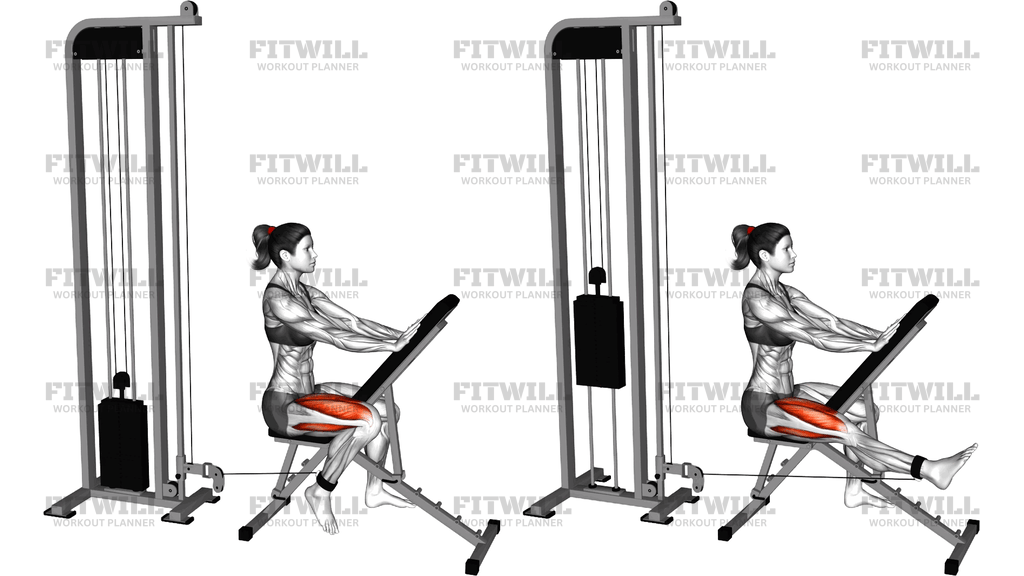
The Cable Seated Single Leg Extension is a single-leg knee extension exercise performed with an ankle strap attached to a low pulley. You sit sideways to the cable machine on a bench, lean forward to grip the top of an inclined backrest for stability, and straighten the working leg against the cable's resistance. Because the pulley provides tension through the entire range of motion, the quadriceps stay loaded even at the bottom of the rep, where a traditional leg extension machine often goes slack.
This movement targets the quadriceps, the group of four muscles on the front of the thigh responsible for straightening the knee. Working one leg at a time exposes left-to-right strength differences that bilateral machines can hide, and the cable's line of pull keeps steady tension on the muscle from start to finish. The hip flexors on the working side also assist as the leg lifts into the extended position.
The setup matters more here than in most quad exercises. Sitting sideways with the cable running directly toward your ankle means the resistance pulls the leg backward in a straight line, so the knee joint is never twisted. The forward lean with your hands braced on the bench locks your torso in place, which stops you from rocking backward to cheat the weight up. Without that brace, the low back and hip flexors tend to take over as fatigue sets in.
To perform it well, keep the movement slow and deliberate: pull the strap up by straightening the knee until the leg is nearly horizontal, squeeze the thigh at the top, then lower the leg back with control rather than letting the stack pull it down. Pause briefly at the bottom before starting the next rep so momentum never enters the set.
This exercise suits lifters who want to isolate the quads without a dedicated leg extension machine, people rehabbing or strengthening one knee at a time under guidance, and anyone addressing a weaker side. Because the load is light relative to squats or leg presses and the position is easy to adjust, it also works well as a pre-exercise activation movement before heavier lower-body training.
Keep the weight conservative at first. A strap around the ankle gives the cable a long lever arm, and even modest stacks feel heavy when the knee straightens fully. Stop short of locking the joint hard at the top, and never push through pain in the kneecap area.
[ Workout Log & Planner ]
Put your next workout in Fitwill
Keep your plan and training log ready when you are.


Instructions
- Set an adjustable bench sideways next to a cable machine's low pulley and attach an ankle strap to the working ankle, with the cable running straight back toward the pulley.
- Sit down facing away from the machine and lean forward onto the inclined top of the bench, resting your forearms and hands on it for support.
- Brace your trunk and keep your torso pressed into the bench so your hips and spine stay still throughout the set.
- Start with the working knee bent and the foot near the floor, letting the cable pull the leg slightly behind your body.
- Exhale and straighten the knee, pulling the strap up and forward until the leg is nearly level with your hip.
- Squeeze the front of the thigh hard at the top for a moment without slamming the knee into full lockout.
- Inhale and lower the leg back down slowly, resisting the cable's pull until the knee is bent again.
- Pause briefly at the bottom to kill momentum, then begin the next repetition.
- Complete all reps on one leg, then switch the strap to the other ankle and match the repetitions on the second side.
Tips & Tricks
- If your torso peels off the bench as the leg rises, the weight is too heavy — reduce the load so the brace stays intact.
- Keep the strap snug around the ankle but not so tight it restricts circulation; a loose strap slides down and changes the cable's pull angle.
- Avoid swinging the leg up with momentum from the hip; the knee should do the extending, not a hip flick.
- Do not let the knee cave inward as you extend — track the shin straight ahead toward the toes.
- Slower lowering phases (two to three seconds) make this exercise far harder than adding plates, since the cable keeps tension on the way down.
- If your kneecap aches at full extension, stop the rep a few degrees short of straight instead of forcing the lockout.
- Position the bench so the cable pulls the leg backward in a direct line; sitting too far from the machine angles the resistance and twists the knee.
- Point the toes of the working foot slightly up or keep them neutral — pointing hard down shifts tension toward the hip flexors.
- Match reps and load exactly between legs, always starting with the weaker side.
Frequently Asked Questions
Which muscles does the Cable Seated Single Leg Extension work?
The quadriceps on the front of the thigh are the primary movers, since they straighten the knee against the cable. The hip flexors assist slightly as the leg lifts into the extended position.
Why sit sideways to the cable machine instead of facing it?
Sitting sideways lets the low pulley pull the ankle straight backward, so the resistance opposes knee extension in a clean line without twisting the joint. Facing the machine would pull the leg across the body instead.
Is the Cable Seated Single Leg Extension good for beginners?
Yes, as long as the weight starts light. The seated position is stable and the cable provides smooth, even resistance, making it easier to learn knee control than on a heavy lever machine.
Why lean forward and grip the bench during this exercise?
The forward lean pins your torso so your hips and lower back cannot rock backward to help lift the weight. It keeps the work on the quadriceps and protects the low back.
What is the most common mistake with this movement?
Using too much weight and jerking the leg up with hip momentum, which lets the cable snap the leg back down. Fix it by reducing the load and controlling both the lifting and lowering phases.
Can I train both legs at the same time with this setup?
Not properly — the low pulley and single ankle strap are designed for one leg at a time, and trying to hook both feet up awkwardly angles the resistance. Treat it as a unilateral exercise and work each side separately.
What can I substitute if I don't have a cable machine?
A standard leg extension machine, a resistance band looped around the ankle and anchored behind you from a seated position, or body-weight seated leg extensions with a light ankle weight all train the same knee-extension pattern.
Should I lock my knee out at the top of each rep?
Extend fully but stop short of slamming the joint into a hard lockout. A firm squeeze at the top builds the quad without loading the end range abruptly.
Is it safe for someone with knee discomfort?
The smooth cable resistance and adjustable range make it joint-friendly for many people, but anyone with a current knee issue should get clearance from a qualified professional first and stay in a pain-free range.
Where should this exercise fit in a leg workout?
It works well as a finisher after squats or leg presses to isolate the quads, or as a lighter activation drill at the start of a session to wake up the knees before heavier loading.