Plate Push
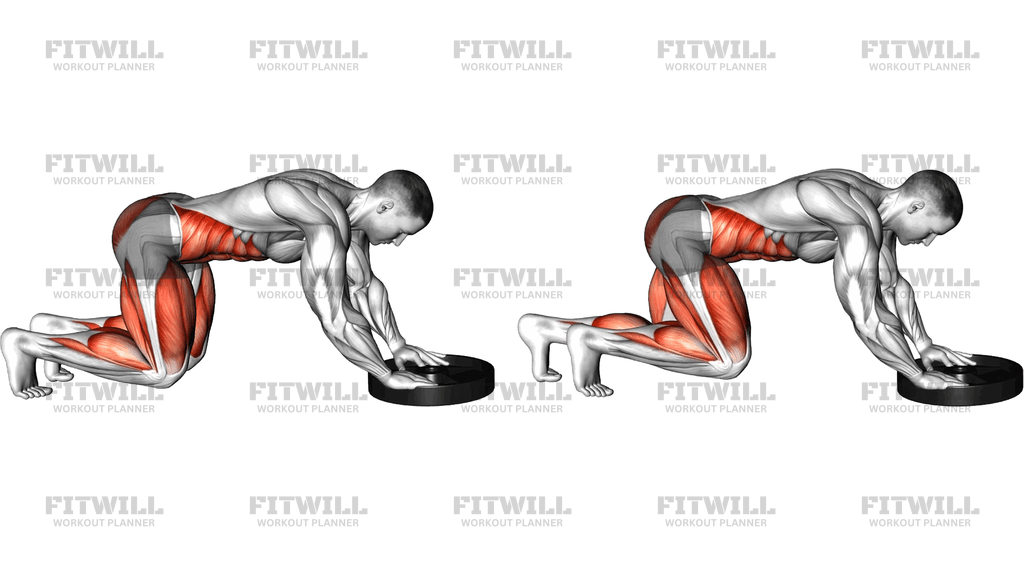
The Plate Push is a kneeling core slide performed with a single weight plate on a smooth floor. You kneel down, place both hands flat on top of the plate, and slide it forward and back in front of you. As the plate travels away from your knees, your body stretches from knees to shoulders into a long, low line, and your abdominals have to brace hard to keep your hips from sagging or your back from arching. Think of it as a budget-friendly alternative to an ab wheel rollout that uses equipment nearly every gym already has.
The main demand is anti-extension: your trunk has to stay rigid while your arms reach long overhead-ish and your hips drift toward the floor. The rectus abdominis and deep core do most of the bracing, while the lats and shoulders control the plate's path, and the hip flexors and quads stabilize the kneeling lower body. Because the resistance comes from your own bodyweight leveraged over a sliding surface, the difficulty scales naturally with how far you push the plate.
Setup details matter more than they first appear. The plate slides on the floor, so the surface under it must be smooth — rubber, tile, or wood — and the plate must sit flat so it does not rock or catch mid-slide. Your knees need a pad or folded mat, and your hands stay stacked over the plate's center with fingers spread for control. If your hips start low and your ribs flare, the slide turns into a lower-back exercise in the worst way, so the starting brace is where most of the quality is decided.
To execute it well, start with the plate just beyond your knees, hinge slightly at the hips, and push the plate forward in a smooth arc until your arms are extended and your body is nearly parallel to the floor. Pause briefly in that stretched position, then pull the plate back by driving your hips up and back toward your heels while dragging the plate through the same path. Exhale as you extend, keep breathing shallowly at the stretch, and inhale as you return. The whole rep should take three to five seconds — if the plate flies out and jerks back, the core is no longer doing the work.
This movement suits lifters who have outgrown plank variations, home trainees who own a single plate and have hard flooring, and anyone rebuilding core control after mastering dead bugs and kneeling planks. It also works well as a finisher: two or three sets of five to eight slow reps at the end of a session challenges the trunk without loading the spine with external weight. People with sensitive knees or acute lower-back issues should progress into it carefully, shortening the slide range until the position feels controlled rather than pulled apart.
[ Workout Log & Planner ]
Put your next workout in Fitwill
Keep your plan and training log ready when you are.


Instructions
- Place a smooth-surfaced weight plate flat on the floor and kneel behind it on a pad or folded mat, with the plate's edge a few inches beyond your knees.
- Set both palms flat on top of the plate, fingers spread wide, hands roughly shoulder-width apart and stacked over the plate's center.
- Tuck your pelvis slightly, squeeze your glutes, and brace your abs as if bracing for a light punch before the plate moves at all.
- Push the plate forward and slightly away from your knees, letting your shoulders travel ahead of your hips as your arms extend.
- Follow the plate until your arms are fully stretched out in front and your body forms a long line from knees to shoulders, hips staying high enough that your lower back does not arch.
- Pause for one breath at the fully extended position, keeping your ribs down and your core braced against the stretch.
- Pull the plate back along the same path by lifting your hips and drawing your knees back toward your heels, using your lats and abs rather than just dragging with the arms.
- Exhale as you push out, take short shallow breaths in the stretched position, and inhale as you return.
- Finish the set by guiding the plate to a complete stop close to your knees before releasing your hands, then reset your brace before the next rep.
Tips & Tricks
- If the plate catches or skids sideways mid-rep, it has drifted off-center — keep both hands stacked over the hub and reset the plate flat before each rep.
- Hips sagging toward the floor as you reach out is the most common fault; shorten the slide range and re-tuck the pelvis until you can hold a straight knee-to-shoulder line.
- Push the plate slightly forward in an arc, not straight down into your knees, or you will end up doing a rocking plank instead of a slide.
- Rest your knees on a thick pad — kneeling directly on hard flooring makes you rush the rep to escape the discomfort, and rushed reps lose all the bracing benefit.
- Grip the plate's face with spread fingers rather than pinching the rim, so your wrists stay neutral and the plate cannot spin under your palms.
- If your shoulders feel pinched at full extension, angle your reach slightly wider and stop the slide a few inches earlier — the stretch should feel active, not wrenched.
- Do not hold your breath through the extension; a long breath-hold plus a stretched trunk is what makes people dizzy on this one.
- Treat the return as the real work: pulling the plate back with your lats and abs builds more control than the push-out ever will.
- Progress by distance before adding reps — a full-extension slide done cleanly beats ten half-slides with a sagging lower back.
Frequently Asked Questions
What muscles does the Plate Push work?
The abdominals, especially the rectus abdominis and deep core, do the bracing, while the lats and front shoulders control the plate's path. The hip flexors and quads stabilize the kneeling lower body.
Is the Plate Push good for beginners?
It can be, if the range is shortened. Beginners should slide the plate only far enough to feel the abs working without the lower back arching, then extend the range gradually over several weeks.
What kind of plate and floor work best for the Plate Push?
A standard bumper or iron plate on a smooth surface like tile, wood, or rubber flooring slides best. On thick carpet the plate will drag and catch, which breaks the smooth arc of the movement.
How is the Plate Push different from an ab wheel rollout?
Both are anti-extension slides, but the plate sits lower and wider than an ab wheel, and the kneeling position with the plate pulled back toward the heels changes the return path. Most people find the plate version slightly easier to control at short ranges.
Why do my lower back and not my abs feel the Plate Push?
That means your hips are dropping and your ribs are flaring as the plate travels out. Re-tuck the pelvis, squeeze the glutes, and stop the slide at the point where your back position would start to break.
Can I substitute the Plate Push if I don't have a weight plate?
Yes — a towel on hard flooring, a furniture slider, or a small sandbag can replace the plate. Any object with a low-friction bottom that supports both palms works.
How many reps and sets of the Plate Push should I do?
Two or three sets of five to eight slow reps is a solid working dose. Because each rep takes three to five seconds, quality matters far more than hitting a high number.
Should my knees stay on the floor the whole time?
Yes, in this version the knees stay planted on the pad and act as the hinge point. Lifting them turns the exercise into a different, much harder full-body slide.
Is the Plate Push safe for people with knee problems?
The kneeling position puts direct pressure on the knee caps, so anyone with knee discomfort should use a thick pad or choose a non-kneeling core exercise instead. Stop if knee pain, not pressure, appears during the slide.