Brettzel With Head Turn
The Brettzel With Head Turn is a side-lying mobility stretch that folds the body into a pretzel-like shape, combining a deep quadriceps stretch with hip flexor lengthening and spinal rotation. The name comes from the original Brettzel, so called because the stacked leg and arm positions resemble a Bavarian pretzel. Adding the head turn takes the stretch one step further by rotating the neck and upper spine, encouraging mobility through the thoracic region rather than just the hips.
This movement works especially well for people who spend long hours sitting, since tight hip flexors and shortened quadriceps are two of the most common results of a chair-based day. It also suits runners, cyclists, and lifters who need to restore range of motion in the front of the thigh and hip after heavy training. Because it is performed lying on the floor with no load, the intensity is entirely controlled by how far you pull the ankle and how deeply you hug the knee, making it easy to scale for stiff or flexible bodies.
The setup matters more than it might appear. Lying on your side with the bottom knee hugged to your chest anchors the pelvis and flattens the lower back, which stops the lumbar spine from cheating the stretch. Reaching back to hold the top ankle isolates the quadriceps of that leg, particularly the rectus femoris, which crosses both the hip and knee. Without this anchor position, the torso simply rotates and the thigh never gets genuine lengthening.
To perform it well, keep the hips stacked and squared rather than letting the top hip roll backward. The stretch should feel strong along the front of the top thigh and through the side of the torso, with the head turn adding a gentle rotational pull through the neck and upper back. Breathe slowly and let the exhale soften the tension rather than forcing range.
Use the Brettzel With Head Turn as a cool-down after leg training, as part of a morning mobility routine, or before activities that demand combined hip extension and rotation. Avoid forcing the ankle grab if you cannot reach it comfortably, and never pull into sharp pain at the knee or lower back.
[ Workout Log & Planner ]
Put your next workout in Fitwill
Keep your plan and training log ready when you are.


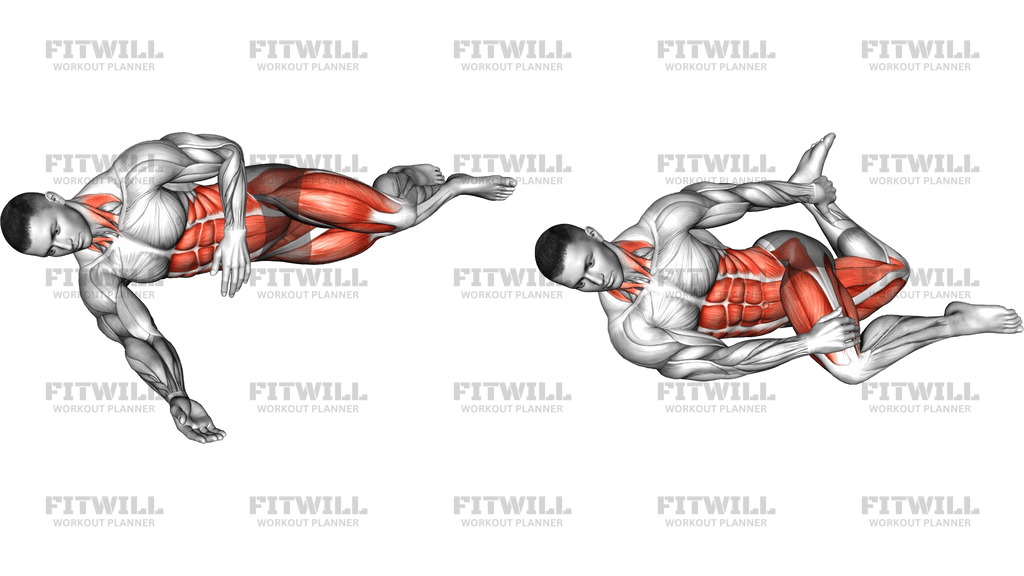
Instructions
- Lie on your right side on the floor with your body in a straight line and your head resting on your right arm or supported so your neck stays neutral.
- Bend your right knee and hug it toward your chest with your right arm, pulling it in until your lower back feels flat and anchored against the floor.
- Bend your left knee and reach back with your left hand to grasp the top of your left foot or ankle, letting the knee point down and slightly behind you.
- Gently pull the left ankle back to lengthen the front of the left thigh and hip, keeping both hips stacked on top of each other instead of letting the top hip roll open.
- Once you feel a steady stretch along the left quad and front of the hip, slowly turn your head to look over your left shoulder toward the ceiling, rotating through the neck and upper back.
- Hold the combined position for 20 to 40 seconds, breathing slowly and letting each exhale release a little more tension.
- Turn your head back to neutral first, then release the left ankle before letting go of the right knee.
- Roll onto your left side and repeat the full sequence on the opposite leg for an even stretch on both sides.
Tips & Tricks
- If you cannot reach your ankle behind you, loop a towel around the top of the foot and hold the ends instead of straining your shoulder to close the gap.
- The most common mistake is letting the top hip roll backward as you pull the ankle, which turns a quad stretch into a general twist; keep the hip bones stacked to preserve the stretch.
- If hugging the bottom knee pulls you off balance, place it slightly higher toward the chest rather than at mid-thigh so the pelvis stays anchored.
- Keep the top knee pointing down toward the floor; letting it flare up shortens the quad and removes most of the stretch you are working for.
- The head turn should come from slow rotation, not a snap; if you feel pinching in the neck, reduce the range and rotate only as far as feels smooth.
- Avoid yanking the ankle toward the glutes hard enough that the knee joint feels stressed; the stretch should live in the thigh muscles, not inside the knee.
- If your lower back arches when you grab the ankle, hug the bottom knee tighter to your chest before pulling back with the top hand.
- Do this stretch after training or a warm shower rather than cold, since warm muscle tissue tolerates the folded position far better.
- Expect one side to feel noticeably tighter; spend an extra round on the stiffer side rather than just matching the comfortable one.
Frequently Asked Questions
What does the Brettzel With Head Turn stretch?
It primarily stretches the quadriceps of the top leg, especially the rectus femoris, along with the hip flexors. The head turn adds rotation through the neck and thoracic spine, and the bottom-leg hug helps settle the lower back.
Why is the head turn part of this stretch?
Turning the head away from the floor adds rotation through the cervical and thoracic spine, which ties the stretch together from ankle to head. Without it, the Brettzel mainly targets the thigh and hip and leaves the upper spine uninvolved.
Is the Brettzel With Head Turn suitable for beginners?
Yes, as long as the range is scaled honestly. Beginners often cannot reach the ankle behind them, in which case a towel looped around the foot gives the same stretch without forcing the shoulder or knee.
Should I feel the Brettzel in my knee?
No, the sensation should sit along the front of the thigh and hip. If you feel pulling inside the knee, ease off the ankle pull, bring the top knee slightly forward, and let the thigh lengthen gradually over sessions.
How long should I hold the Brettzel With Head Turn?
Twenty to forty seconds per side works well for a cool-down, and one to two rounds per side is usually enough. Longer holds are fine once you can relax into the position rather than fight it.
Why do I have to hug the bottom knee to my chest?
Hugging the bottom knee anchors the pelvis and flattens the lower back, which stops the lumbar spine from rotating instead of the thigh lengthening. It is what turns a general twist into a targeted quad and hip flexor stretch.
Can I do the Brettzel With Head Turn before lifting?
It is better suited to cool-downs and standalone mobility sessions because it involves long static holds. Before heavy squats or sprints, shorter dynamic drills usually prepare the legs more effectively.
What can I use instead of the Brettzel With Head Turn?
A standing quad stretch with a reach-back covers the thigh, and a side-lying thoracic rotation covers the spine, but neither combines both in one position. The couch stretch is a reasonable alternative for the quad and hip flexor portion if floor lying is uncomfortable.
How do I know if my hips are stacked correctly?
Your top hip should sit directly over the bottom one, and you should be able to feel both hip bones pointing the same direction. If the top hip has drifted behind you, the twist has taken over and the thigh stretch has faded.
Is it safe to turn the head in this position if I have neck stiffness?
Move into the head turn slowly and stay within a range that feels smooth and free of pinching. If rotation is persistently stiff or uncomfortable, keep the head neutral and enjoy the hip and thigh benefits, or consult a professional before loading the neck.