Tuck To Hamstring Stretch
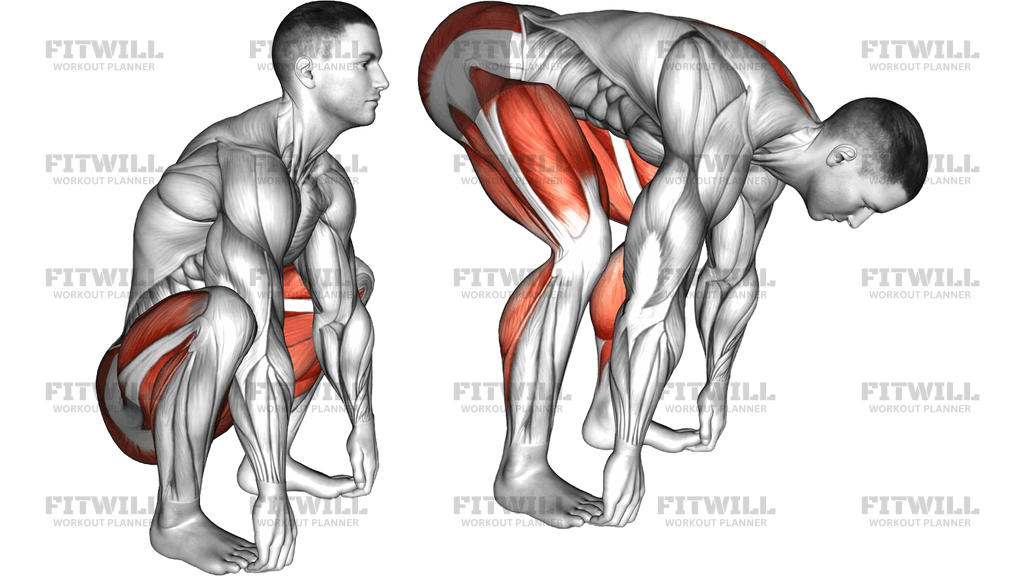
The Tuck To Hamstring Stretch is a flowing bodyweight movement that moves you from a compact tuck squat into a standing forward fold with straight legs. The transition is the point: closing into the tuck rounds your entire spine and gives your lower back a brief release, then driving the hips back and straightening the knees lengthens the hamstrings under load of your own torso weight. Because you repeat the cycle, the muscles warm and lengthen gradually rather than being forced into one static position.
This sequence is especially useful before lower body training, running, or any activity that demands hip hinge mechanics, since tight hamstrings are one of the most common limits on a clean hinge pattern. It also suits people who sit for long hours, as the tuck phase mobilizes the spine and hips that stiffen in a chair, while the fold phase targets the back-of-thigh tension that shortens with prolonged sitting.
The primary work happens in the hamstrings along the back of the thigh, with the glutes and calves assisting as the hips travel back and the knees extend. The lower back rounds and extends through each repetition, so the spinal erectors get gentle movement as well. No equipment is required beyond a few feet of floor space, and the hands can hover near the floor or rest lightly on the shins for support.
Setup matters more than depth. Your feet should stay roughly hip-width apart and planted, because wobbling feet force your calves and ankles to compensate and steal the stretch from the hamstrings. In the tuck, let the hips sink fully and the arms reach forward for balance. On the way up, lead with the hips rather than lifting the chest first, so the fold lengthens the back of the legs instead of straining the lower back.
A good repetition feels like a rolling wave: sink, round, lift the hips, flatten the legs, then soften back down. Move slowly enough that you can feel exactly where your range ends each time. The stretch should be a firm pull along the back of the thighs, never a sharp or nerve-like sensation.
Common use cases include dynamic warm-ups, cooldowns, morning mobility routines, and breaks from desk work. If you cannot straighten the knees fully in the fold, that is normal at first. Bend them slightly and let the range improve over weeks of practice rather than forcing the legs flat on day one.
Fitwill
Log Workouts, Track Progress & Build Strength.
Achieve more with Fitwill: explore over 9600 exercises with images and videos, access built-in and custom workouts, perfect for both gym and home sessions, and see real results.
Start your journey. Download today!




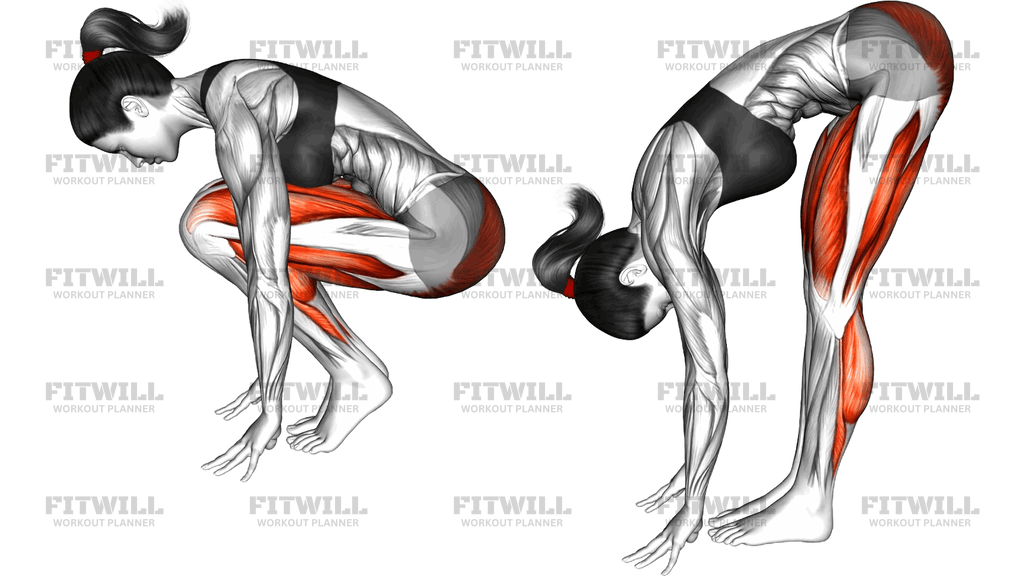
Instructions
- Stand with your feet about hip-width apart, toes pointing forward, and soften your knees slightly.
- Hinge at the hips and squat down into a deep tuck, bringing your chest toward your thighs and reaching your arms forward or down toward the floor for balance.
- Pause in the tuck for one breath, letting your lower back round and your hips settle close to your heels.
- Begin the transition by driving your hips up and back, keeping your hands low and near your feet.
- Straighten your knees gradually until you feel a firm stretch along the back of both thighs, letting your head and arms hang heavy toward the floor.
- Hold the folded position for two to three relaxed breaths, keeping your weight centered over the middle of your feet.
- Release the stretch by bending your knees first, then lower your hips back down into the tuck to complete one repetition.
- Exhale as you rise into the fold and inhale as you sink back into the tuck, matching breath to movement.
- Reset your foot position if it shifted, then repeat for 6 to 10 controlled repetitions, easing slightly deeper into the fold as the hamstrings loosen.
Tips & Tricks
- If your heels lift in the tuck, widen your stance slightly or allow the knees to press further apart instead of forcing a flat-footed deep squat.
- A common mistake is locking the knees with a jerk at the top of the fold; extend them slowly so the hamstrings lengthen progressively.
- Keep the stretch sensation in the back of the thighs. If you feel pinching at the front of the hips, you are pushing the fold too aggressively for your current range.
- Let the head hang in the fold rather than lifting it to look forward, which reduces strain through the neck and upper back.
- Do not chase fingertip-to-floor contact. The floor is a reference point, not a requirement, and hovering hands still give the hamstrings full work.
- If your lower back takes over and the fold feels concentrated there, bend the knees a touch more so the hips can travel further back.
- Warm the tissue first with a few gentle bodyweight squats if you are doing this cold, especially first thing in the morning.
- Keep your weight balanced over the whole foot in the fold; shifting onto the heels often means the hamstrings are too tight for the current depth.
- Move with breath rather than counting speed. One slow, full cycle beats five rushed ones.
Frequently Asked Questions
Which muscles does the Tuck To Hamstring Stretch target?
The hamstrings along the back of the thighs are the primary target, with the glutes and calves working during the transition. The lower back also moves through flexion and extension in each cycle.
Is the Tuck To Hamstring Stretch suitable for beginners?
Yes, because the range is self-adjusting. Beginners can keep the knees bent in the fold phase and only straighten them partway, then progress as flexibility improves.
Should I touch the floor with my hands in the fold position?
No, floor contact is optional. Resting the fingertips lightly on the floor or a low surface can add stability, but reaching forcefully for the floor tends to round the lower back excessively and reduce the hamstring stretch.
Why does the exercise start in a tuck instead of going straight into a forward fold?
The tuck rounds the spine and hips first, which acts as a gentle reset between stretches and lets the hamstrings lengthen gradually. Moving from compression to length also makes the fold feel smoother and less abrupt.
Should my knees be straight or bent during the hamstring stretch phase?
Start with slightly bent knees and straighten them only until you feel a firm but comfortable pull behind the thighs. Fully locked knees are not necessary and often push tension into the joint rather than the muscle.
How long should I hold the folded position each repetition?
Two to three relaxed breaths work well for most people. Since this is a flowing stretch, the repeated cycles accumulate the effect rather than one long static hold.
What should I do if I feel the stretch behind my knee instead of the thigh?
Bend the knees a few degrees and focus on pushing the hips further back. Sensation directly behind the knee often means the calves or the tendons around the joint are taking the load.
Can I use the Tuck To Hamstring Stretch before heavy lower body training?
Yes, its flowing nature makes it a good dynamic warm-up. Keep the holds short and the range moderate before lifting, and save longer, deeper holds for after training.
Is it safe if I have lower back issues?
The repeated rounding of the spine may not suit everyone with a sensitive lower back. Keep the tuck shallow, avoid bouncing, and stop if symptoms radiate down the leg or worsen.
How many repetitions should I perform per session?
Six to ten controlled cycles is a practical starting point. As flexibility improves, you can add repetitions or hold the fold slightly longer rather than forcing extra depth.