Standing Biceps Curl Door Frame
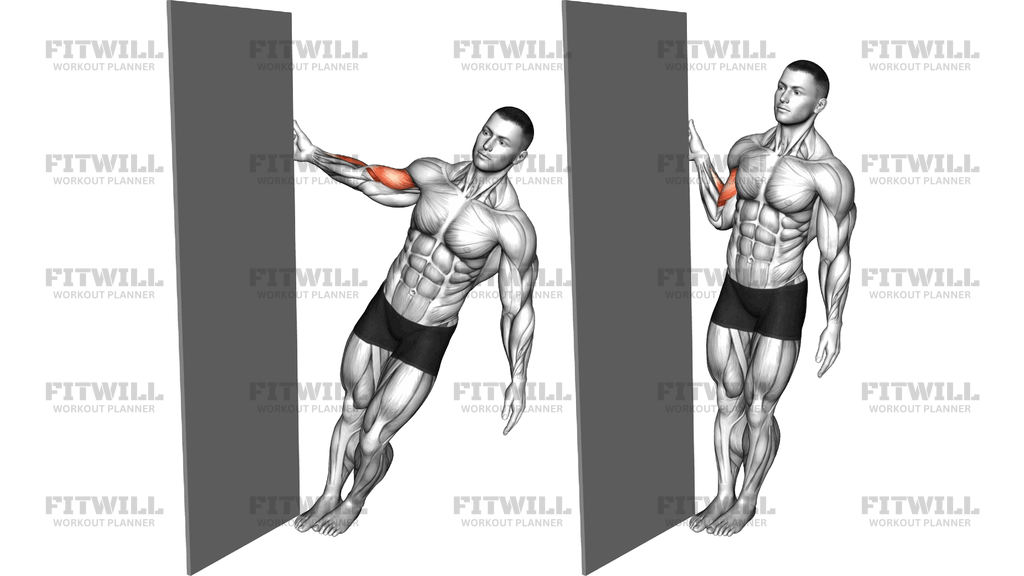
The Standing Biceps Curl Door Frame is a self-resisted body weight exercise that turns an ordinary door frame into a fixed point for loading the biceps. You place the palm of one hand flat against the side of the frame with the elbow bent to roughly 90 degrees, then lean your torso away from the frame. Your body weight tries to pull the arm straight, and your biceps fight to hold the bend, creating a hard isometric contraction without any dumbbells, bands, or cables.
This movement is genuinely useful for people who train at home, travel often, or simply want to add biceps work when no equipment is available. It also suits lifters who want a low-impact finisher after regular curls, and it can serve as a reintroduction to loading for the elbow flexors during return-to-training phases, since the intensity is entirely under your control through hand height and lean angle.
The main muscles worked are the biceps brachii on the front of the upper arm, with strong support from the brachialis underneath it and the brachioradialis and forearm flexors gripping through the hand. Because the hand stays fixed and the torso moves instead, the resistance comes from your own body weight, which means the setup height and lean angle determine how hard the biceps have to work.
Setup matters more here than in most biceps exercises. If the hand is placed too high or too low on the frame, the shoulder is forced into an awkward angle and the elbow flexors lose their line of pull. The forearm should stay roughly parallel to the floor, the palm flat against the frame, and the lean should come from the whole body shifting away as one piece rather than from a rounded or twisted torso.
To execute it well, press the palm firmly into the frame, keep the elbow pinned at your side at about 90 degrees, and gradually lean away until you feel the biceps working hard to hold the position. Breathe steadily through the hold, resist for five to fifteen seconds, then return upright under control before switching arms.
The most common use case is as a quick, no-equipment arm exercise, but it also works well as a finishing hold after sets of curls, or as a way to learn what a maximal biceps contraction actually feels like. Keep the effort at a level you can sustain with good posture, never slam into the frame, and stop if you feel any pinching in the shoulder or discomfort at the elbow.
[ Workout Log & Planner ]
Put your next workout in Fitwill
Keep your plan and training log ready when you are.


Instructions
- Stand in an open doorway facing sideways, so the door frame is beside your working arm.
- Bend the working elbow to about 90 degrees and press the full palm flat against the side of the frame, with the forearm roughly parallel to the floor and the elbow held close to your ribs.
- Stagger your feet slightly and brace your core so your body forms one straight line from head to heels.
- Take a breath, then begin leaning your whole torso away from the frame while keeping the hand glued in place and the elbow angle unchanged.
- Lean only until you feel a strong, steady contraction in the biceps and front of the upper arm; the harder you lean, the more the biceps must resist the arm straightening.
- Hold that position for five to fifteen seconds, keeping the shoulder relaxed and down rather than shrugging toward the ear.
- Breathe continuously during the hold, exhaling slowly instead of holding your breath and straining.
- After the hold, push gently off the frame and bring your torso back upright in a slow, controlled motion rather than snapping back.
- Release the hand, shake out the arm briefly, then repeat on the other side.
- Complete the desired number of holds per side, keeping the lean angle consistent from set to set.
Tips & Tricks
- The most common mistake is letting the elbow drift away from the body or flare forward as you lean, which turns the hold into a shoulder exercise; pin the elbow to your ribs for every rep.
- If you feel the work in the shoulder instead of the biceps, lower your hand a few inches on the frame so the forearm sits closer to waist height.
- Build intensity gradually by leaning a little farther over several sets rather than maxing out on the first hold, since the frame gives no feedback about overload.
- Keep the wrist straight and the palm fully flat; bending the hand back against the frame shifts stress to the wrist joint instead of the elbow flexors.
- Do not round your lower back or push the hips back as you lean away, as this bleeds tension out of the arm and into the spine; move as one rigid block.
- Because this is an isometric hold, tension fades at the top of the range, so vary the elbow angle across sets to hit the biceps at different lengths.
- Keep the neck neutral and avoid tilting the head toward or away from the working arm during the lean.
- If the frame edge digs into your palm, place a folded towel over it rather than shortening the hold.
- Exhale through the effort, since breath-holding combined with a hard isometric can spike blood pressure noticeably.
Frequently Asked Questions
What muscles does the Standing Biceps Curl Door Frame work?
The primary muscle is the biceps brachii, with the brachialis and brachioradialis assisting elbow flexion and the forearm flexors working to keep the palm pressed against the frame.
How does a curl work without any weight?
Your hand stays fixed against the frame while your torso leans away, so your body weight tries to straighten the arm and the biceps must contract isometrically to hold the elbow bent. The lean angle sets the resistance.
Is the Standing Biceps Curl Door Frame suitable for beginners?
Yes. A beginner can stand nearly upright for a light hold and gradually increase the lean as strength improves, which makes the progression very easy to manage.
How high should I place my hand on the door frame?
Place the palm so the forearm is roughly parallel to the floor with the elbow bent about 90 degrees, typically around waist to lower chest height, and adjust from there based on comfort.
Why do I feel this more in my shoulder than my biceps?
This usually means the elbow is drifting away from your ribs or the hand is set too high, both of which shift the load toward the shoulder. Reset with the elbow pinned at your side and the forearm level.
How long should I hold each rep?
Five to fifteen seconds per hold works well for most people, repeated for several sets per side, with longer holds used at lower lean angles.
Can I replace regular dumbbell curls with this exercise?
It can substitute temporarily when no equipment is available, but because it is isometric it trains only the elbow angle you hold, so it does not fully replace full-range curls over time.
Is it safe to press hard against a door frame?
Yes, as long as the frame is solid and the door is secured or removed. Build pressure gradually rather than throwing yourself into the lean, and stop if you feel pinching at the shoulder or pain at the elbow.
Should I breathe during the hold?
Yes, breathe steadily throughout. Holding your breath during a hard isometric contraction raises strain unnecessarily, so exhale slowly as you lean in.
How many sets should I do per side?
Two to four holds per arm is a reasonable starting point, resting briefly between sides and keeping the lean angle consistent across all sets.