Glute Bridge From Bench
The Glute Bridge From Bench is a bodyweight hip extension exercise where you position your upper back across a flat bench with your feet planted on the floor, lower your hips toward the ground, and then drive upward until your torso and thighs form a straight line. It follows the same hip-dominant pattern as a standard floor glute bridge, but the elevated shoulders give the hips a longer range of motion and place the glutes under tension through a greater portion of the movement.
This exercise suits a wide range of trainees. Beginners use it to learn what true hip extension feels like before progressing to hip thrusts with load, while more experienced lifters use it as a warm-up primer, a high-rep finisher, or a low-back-friendly way to train the backside when barbell hip thrusts or deadlifts are not available. Because the load is your bodyweight, it is easy to scale simply by adjusting tempo, pause time, or single-leg variations.
The primary muscles working are the glutes, with strong assistance from the hamstrings as they help extend the hip and stabilize the knee. The core works to keep the ribcage down and the pelvis level, and the lower back supports the spine position without actually producing the movement. The bench simply acts as a stable support surface for the upper back, so no grip or pulling strength is required.
Setup matters more than people expect. The bench edge should sit just below your shoulder blades, and your feet need to be far enough forward that at the top position your shins are roughly vertical. If your feet are too close, the knees travel forward and the quads take over; too far back, and the hamstrings do most of the work while the hips struggle to reach full extension.
To perform it well, lower the hips under control, let them drop slightly toward the floor to stretch the glutes, then drive through the heels and squeeze the glutes until your body forms a straight line from knees to shoulders. Avoid arching the lower back to gain extra height. Exhale on the way up, inhale as you lower, and keep the arms crossed over the chest or resting on the shoulders throughout.
Common use cases include home workouts where a bench is the only equipment, glute-focused warm-up circuits, and rehabilitation-style training where posterior chain activation is needed without spinal loading. The main safety points are keeping the bench stable, controlling the descent so the hips do not crash down, and stopping if you feel the work shifting into your lower back rather than your hips.
[ Workout Log & Planner ]
Put your next workout in Fitwill
Keep your plan and training log ready when you are.


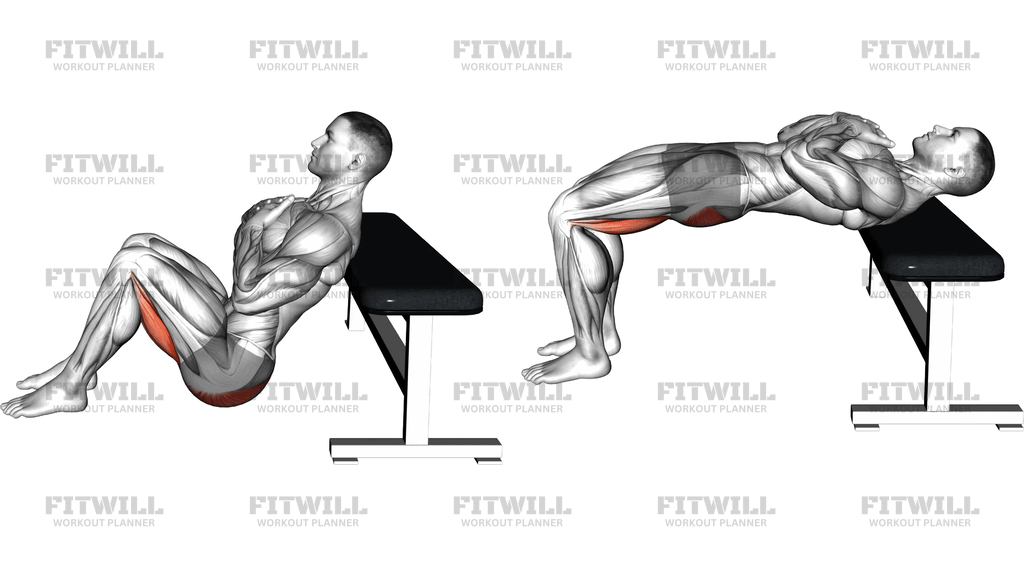
Instructions
- Sit on the floor with your upper back against the edge of a flat bench, and position the bench so the pad sits just below your shoulder blades.
- Bend your knees and plant your feet flat on the floor about hip-width apart, far enough forward that your shins will be close to vertical at the top.
- Cross your arms over your chest and brace your core as if preparing to take a light push to the stomach.
- Lower your hips toward the floor by bending the knees slightly and letting the pelvis drop, until you feel a stretch across the glutes.
- Exhale and drive through your heels and mid-foot, pushing the floor away to lift your hips upward.
- Continue raising until your shoulders, hips, and knees form a straight line, and squeeze the glutes hard at the top without arching your lower back.
- Hold the top position for a beat, keeping the ribs down and the pelvis tucked slightly under.
- Inhale and lower your hips back toward the floor under control, resisting the drop rather than free-falling.
- Reset your foot position and brace, then repeat for the desired number of repetitions.
- When finished, sit forward off the bench carefully rather than twisting out of the position.
Tips & Tricks
- If your hips stop short of full extension, your feet are probably too far back; walk them slightly forward so your shins are vertical at the top.
- Do not over-arch at the top to chase height — the movement ends when your body is level, and extra arch only loads the lower back.
- Push through the heels rather than the toes; lifting the heels usually means the feet are too close to the bench.
- Keep the arms crossed over the chest instead of bracing them on the bench, so the upper back stays pressed into the pad and does not slide.
- If the bench slides or tips during the set, wedge it against a wall or rack before continuing.
- Pause for two to three seconds at the top if you cannot feel the glutes working — this is more effective than adding extra reps.
- Let the hips drop below the level of the bench at the bottom; cutting the descent short removes the stretch that makes this variation better than a floor bridge.
- Keep the knees tracking over the toes; if they cave inward, consciously spread the floor with your feet as you drive up.
- Slow the lowering phase to two or three seconds to turn a light bodyweight movement into a genuine glute builder.
Frequently Asked Questions
What muscles does the Glute Bridge From Bench work?
The glutes are the primary movers, with the hamstrings assisting hip extension. The core and lower back stabilize the trunk, but they should not feel like the main working muscles.
Why put the upper back on a bench instead of doing a regular glute bridge on the floor?
Elevating the shoulders lets the hips drop lower and travel further, which increases the range of motion and the stretch on the glutes compared to bridging from the floor.
Is the Glute Bridge From Bench suitable for beginners?
Yes. It is a bodyweight movement with a short learning curve and is often used to teach hip extension before progressing to loaded hip thrusts or single-leg versions.
How far should my feet be from the bench?
Far enough that your shins are roughly vertical when your hips reach the top position. Feet too close push the knees forward and shift work to the quads; feet too far back shift it to the hamstrings.
Should I feel this in my lower back?
No. A sore lower back usually means you are arching to gain extra height at the top. Finish the rep when your torso and thighs are level and squeeze the glutes instead.
Can I add weight to the Glute Bridge From Bench?
Yes, a weight plate or dumbbell can be held across the hips with both hands once bodyweight reps feel easy. A barbell hip thrust from the same bench position is the natural next step.
What can I use if I don't have a bench?
A sturdy couch, stable box, or the edge of a bed can work, as long as the surface will not slide or tip and sits at roughly knee height or slightly lower.
How many reps and sets should I do?
For muscle and control, three to four sets of ten to fifteen reps with a pause at the top works well. For a warm-up, one or two lighter sets of eight to ten reps is enough.
Is it safe for my knees?
The knees only bend and extend under bodyweight in a controlled arc, which is generally well tolerated. Keep the knees tracking over the toes and stop if you feel pinching or pain rather than muscle effort.