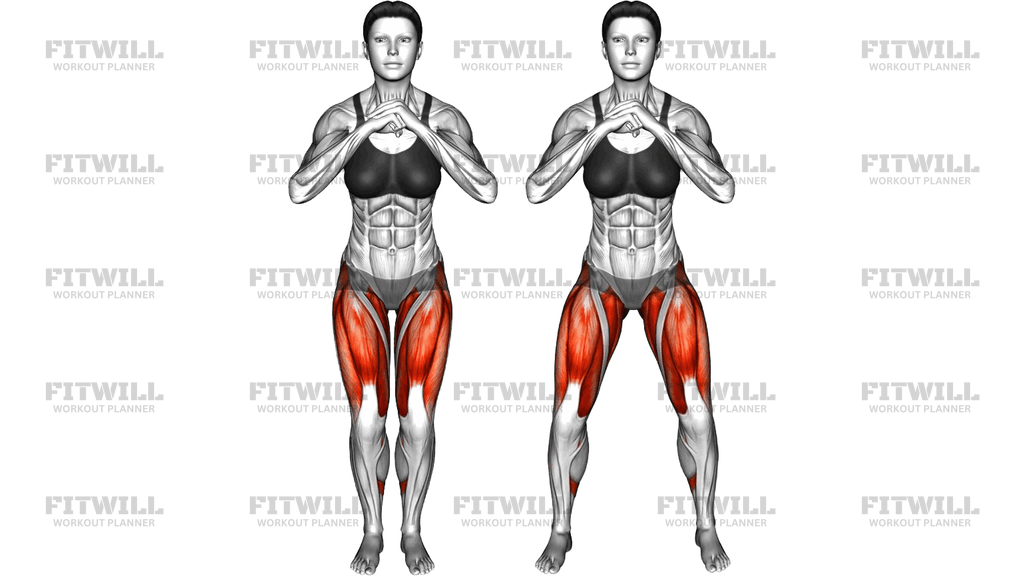
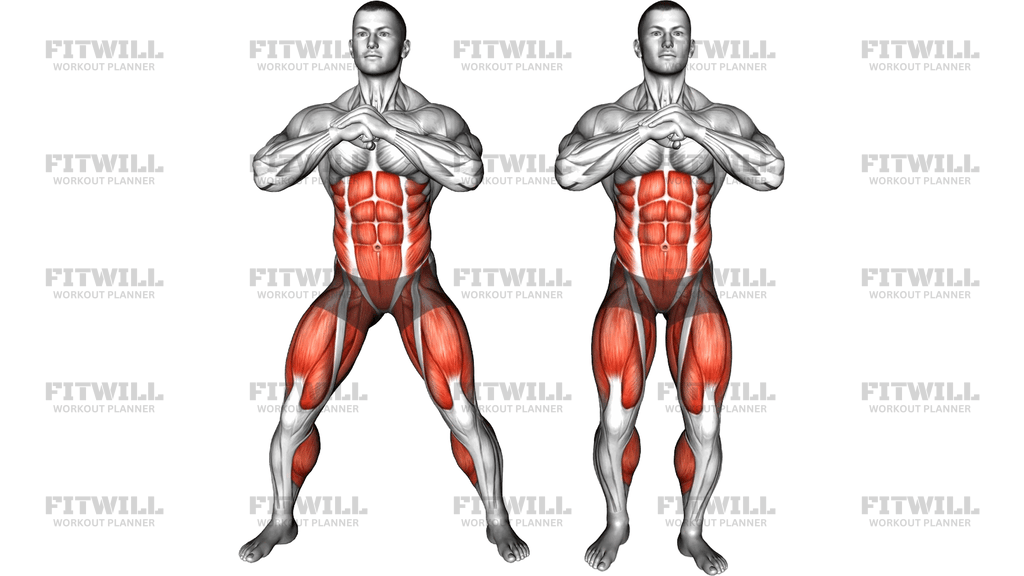
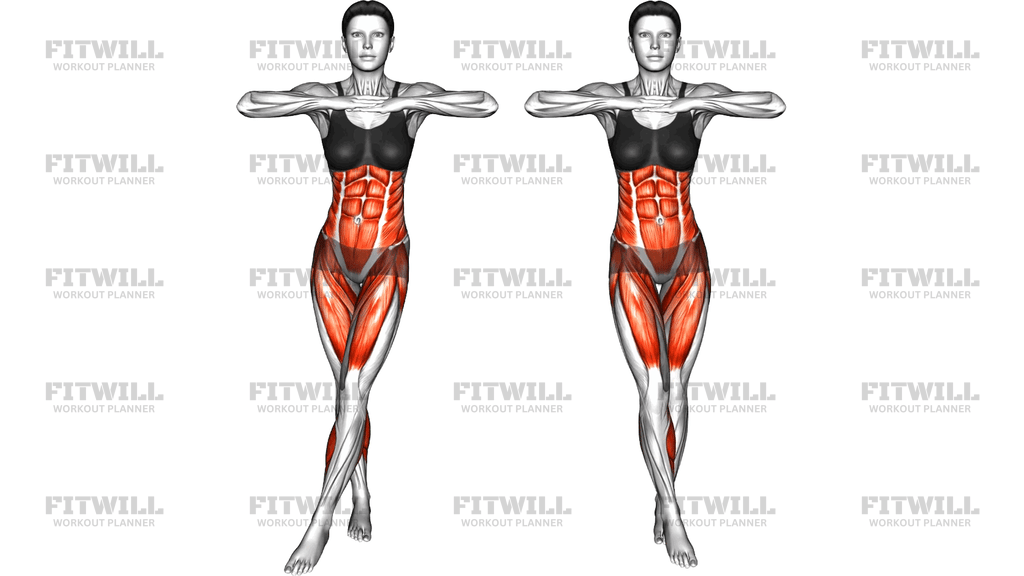
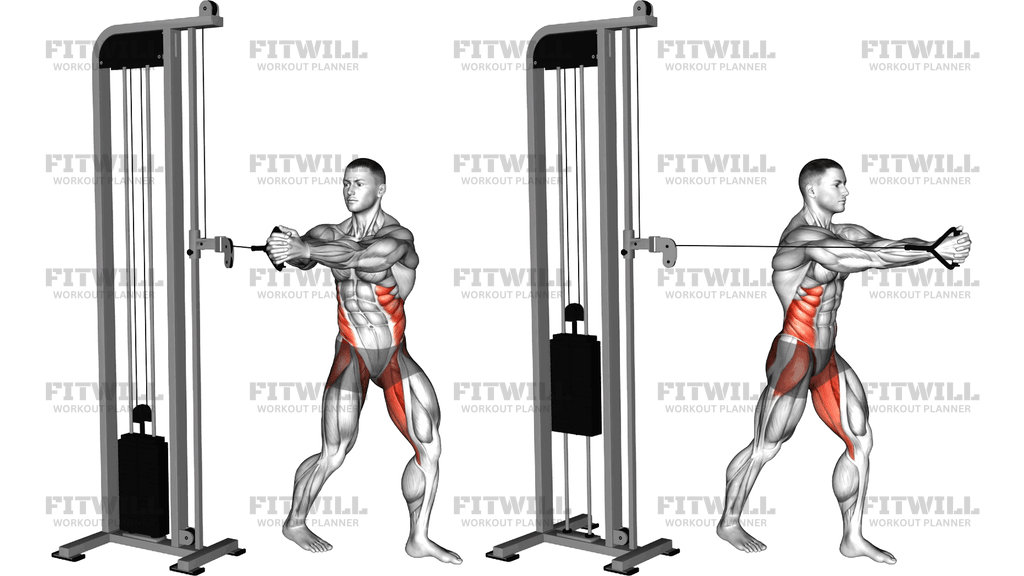
Inner Thigh Tap To Chest Open
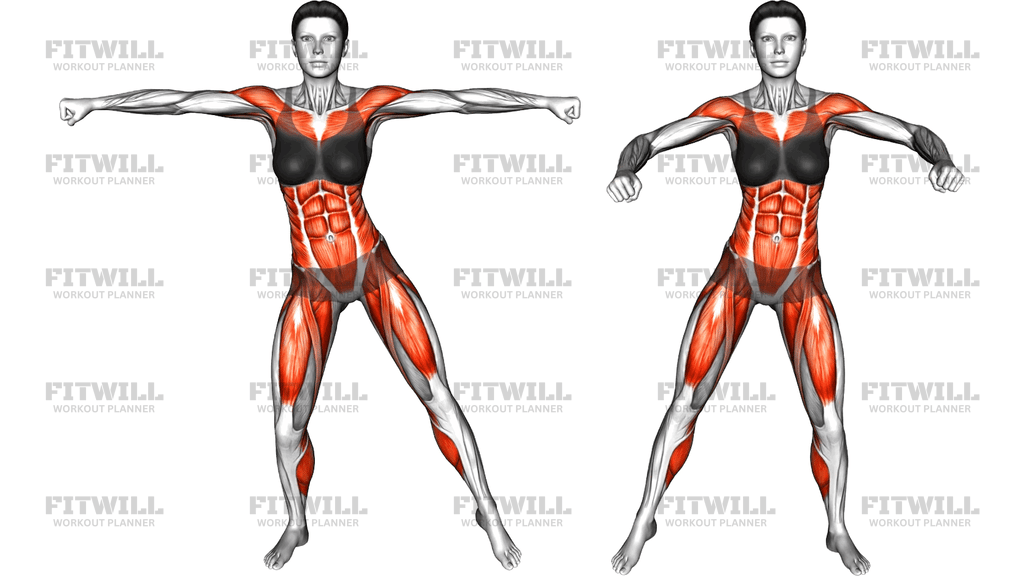
The Inner Thigh Tap To Chest Open is a bodyweight flow that links two opposite positions into one smooth sequence: a soft forward fold where the fingertips reach down to tap the inner thighs or shins, followed by a tall standing position with the arms swept wide and the chest lifted. It works as a dynamic stretch and movement primer, waking up the inner thighs and the back of the legs while reversing the rounded posture the fold creates. Because it needs no equipment and only a small amount of floor space, it fits naturally into warm-ups, desk-break routines, and cooldowns.
The movement primarily targets the adductors along the inner thigh and the hamstrings at the back of the legs, both of which lengthen as you hinge down toward the tap. The hinge itself also asks the lower back to round and lengthen under control, while the standing phase opens the chest and fronts of the shoulders in the opposite direction. That contrast is the whole point of the exercise: you are not just stretching one area, you are teaching the torso to move from a folded position to an open one without losing balance or rhythm.
Setup matters more than it might seem for such a simple drill. Stand with feet roughly hip-width to slightly wider, knees soft rather than locked, and weight spread evenly across the whole foot. If your stance is too narrow, the tap forces an awkward reach; if it is too wide, the fold shifts entirely into the hips and the inner thighs stop doing their share. Keeping a slight knee bend protects the hamstrings and lets you fold from the hips instead of just collapsing through the spine.
To perform it well, exhale as you hinge forward, letting the head and arms travel down together until the fingertips tap lightly against the inner thighs, knees, or shins. Do not yank yourself deeper; let each exhale buy you a small amount of extra range. On the way up, lead with the chest rather than the head, sweep the arms out to the sides, and finish standing tall with the collarbones wide and the gaze forward. The tap should be a gentle touch, never a bounce or a slam, and the return should feel like one continuous wave rather than two separate poses.
This drill is especially useful before lower-body training sessions that involve squats, lunges, or any wide-stance work, since it preps the adductors and hamstrings for loaded positions. It is equally valuable for people who spend long hours sitting, because the folded phase lengthens the exact tissues that shorten in a chair while the open phase reverses the slouched upper-back posture. Move at a pace you can breathe through, and treat the end range as a place to visit, not a place to force.
[ Workout Log & Planner ]
Put your next workout in Fitwill
Keep your plan and training log ready when you are.


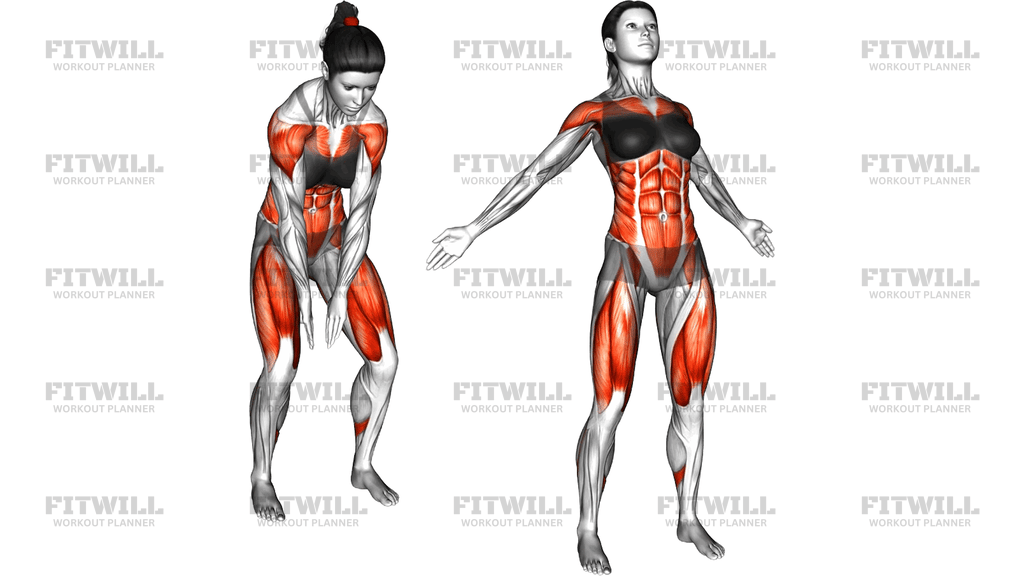
Instructions
- Stand with your feet about hip-width apart or slightly wider, weight spread evenly across both feet.
- Keep a soft bend in both knees and let your arms hang relaxed at your sides.
- Draw your belly button in slightly and lengthen the back of your neck so your head stays neutral before you fold.
- Exhale and hinge forward from the hips, letting your head and arms travel down together toward your legs.
- Tap your fingertips lightly against your inner thighs, knees, or shins at the bottom of the fold.
- Pause for one breath in the folded position, letting the inner thighs and hamstrings lengthen without bouncing.
- Inhale and roll back up by leading with the chest, sweeping your arms out wide to the sides as you rise.
- Finish standing tall with the chest lifted, shoulders back and down, and your gaze level ahead.
- Lower the arms back to your sides, reset your stance, and repeat for the desired number of repetitions.
- Breathe out on the way down and in on the way up, keeping each rep smooth and continuous.
Tips & Tricks
- If your fingertips cannot reach your inner thighs comfortably, tap the knees or shins instead — the height of the tap is not a score, the hinge quality is.
- The most common mistake is rounding from the neck first, which turns the fold into a head-dive; cue yourself to push the hips back and let the head be the last thing to travel down.
- Avoid locking the knees at the top; locked knees in the standing phase shift stress into the joint and reduce the chest-opening benefit.
- Keep the tap light and brief. Pressing hard into the leg or bouncing at the bottom turns a controlled stretch into a ballistic tug on the hamstrings.
- If you feel the fold only in your lower back, widen your stance slightly and sit the hips further back so the hips and inner thighs share the range.
- Move the arms deliberately during the chest-open phase; letting them flop up steals the shoulder opening that makes the top position worthwhile.
- People with tight hamstrings can bend the knees more deeply in the fold and straighten them slightly only as range improves over weeks.
- Match one full breath cycle to one full repetition rather than rushing the transitions — the controlled rise is where the posture reset happens.
- If balance feels shaky in the fold, place your feet a touch wider and keep both heels firmly planted to steady the base.
Frequently Asked Questions
What muscles does the Inner Thigh Tap To Chest Open work?
It primarily lengthens and activates the inner thighs (adductors) and hamstrings during the fold, while the standing phase opens the chest and fronts of the shoulders. The lower back works to control the rounding and returning of the spine.
Is the Inner Thigh Tap To Chest Open a stretch or a strength exercise?
It is best treated as a dynamic stretch and movement-prep drill. It builds control and mobility through the hinge and chest-open positions rather than loading the muscles heavily.
How deep should I fold during the tap portion?
Fold only until your fingertips can tap lightly against your inner thighs, knees, or shins with a mild stretch. Depth should come from the hips, not from forcing the spine to round further.
Can beginners do the Inner Thigh Tap To Chest Open?
Yes, it is very beginner-friendly since it uses body weight only and the range is self-selected. Beginners should bend the knees more and tap higher on the legs until flexibility improves.
Why do my hamstrings, not my inner thighs, feel the Inner Thigh Tap To Chest Open the most?
This usually means the knees are locked or the stance is too narrow. Soften the knees and widen the feet slightly so the adductors are asked to lengthen along with the hamstrings.
When should I use this exercise in a workout?
It fits well at the start of a lower-body session, especially before squats, lunges, or wide-stance work, and it also works as a midday posture reset for people who sit for long periods.
How many repetitions of the Inner Thigh Tap To Chest Open should I do?
Six to ten slow, breath-matched repetitions is a practical starting point. Focus on smooth transitions rather than piling up reps.
Is it safe to round the lower back in the folded position?
A gentle, controlled round is part of the movement, but it should never be forced or bounced. Keep the fold within a comfortable range and stop short of any pulling or pinching sensation.
What can I substitute if the tap position is uncomfortable?
A simple bodyweight hinge with hands reaching toward the knees, followed by a standing chest-opening arm sweep, covers the same two positions without requiring as much reach.
Should I hold the chest-open position at the top?
A brief one-to-two second hold with the arms wide and the chest lifted helps reinforce the open posture, but it does not need to be a long static hold in this flowing version.