Kneeling Thoracic Rotation
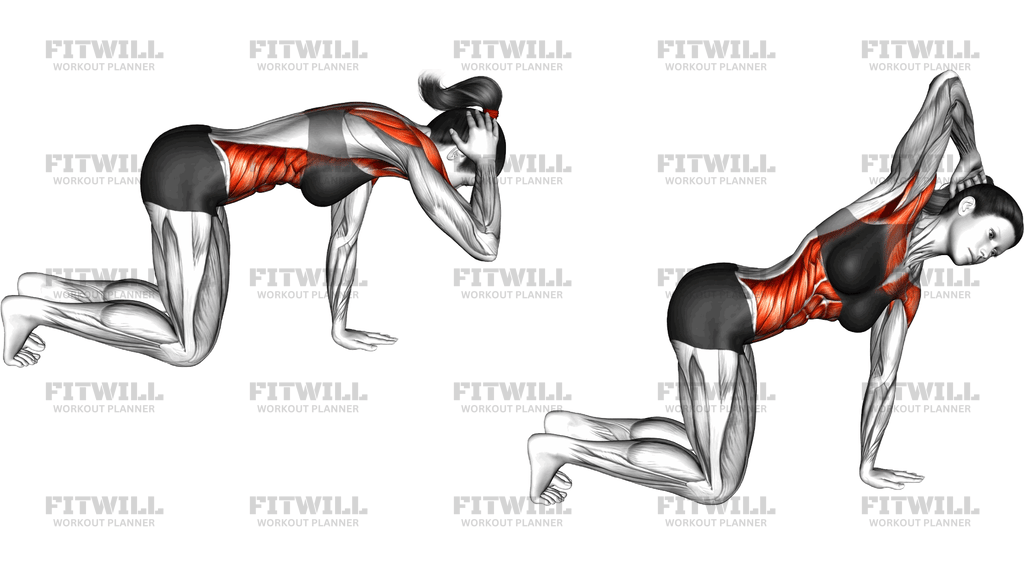
Kneeling Thoracic Rotation is a bodyweight mobility drill performed from an all-fours position, with one hand supporting you on the floor and the other placed behind your head. From there, you rotate your upper back toward the ceiling, letting your elbow and ribcage open up before returning under control. Because your knees and one hand anchor your lower body, the rotation is forced to come from the mid-back rather than the hips or lower spine, which is exactly what makes the drill effective.
The main target is thoracic rotation — the twisting range of your mid-back — along with the obliques that drive the turn and the muscles between the shoulder blades that control the end of the movement. Most adults lose rotational range through long hours of sitting, and that stiffness often shows up as compensation in the lower back or shoulders during lifting, throwing, or swinging sports. This exercise gives that rotation back in a low-load, easy-to-control position.
The quadruped setup matters more than it looks. Kneeling locks the pelvis roughly over the knees, so when you rotate, your lumbar spine has little choice but to stay quiet while the thoracic spine does the work. The hand behind the head acts as a pointer: wherever your elbow travels shows you exactly how much rotation you actually have, making it easy to compare sides and track progress over time.
To perform it well, think of lifting your elbow toward the ceiling and steering the movement with your ribs, not by cranking your neck or shrugging your shoulder. Exhale as you rotate, pause briefly at your end range, then reverse the same path back down. The rep should feel like a smooth arc, not a jerky twist.
It fits naturally into warm-ups before squats, deadlifts, presses, golf, tennis, or baseball, and it also works as a standalone desk-break reset. People with stiff mid-backs, one-sided rotation limits, or shoulder blade control issues tend to benefit the most. Move within a range that feels like a stretch and muscle working — never into sharp pain — and expect the tighter side to improve gradually with consistent reps rather than one aggressive session.
[ Workout Log & Planner ]
Put your next workout in Fitwill
Keep your plan and training log ready when you are.


Instructions
- Kneel on an exercise mat and set up on all fours with your hands directly under your shoulders and your knees directly under your hips.
- Place one hand gently behind your head with the elbow pointing out to the side, and keep the other hand flat on the floor for support.
- Settle your hips back slightly over your heels and brace your core lightly so your lower back stays neutral before you start turning.
- Keeping your hips level and square to the floor, rotate your upper back by lifting the bent elbow up and out toward the ceiling.
- Follow your elbow with your eyes and let your ribcage open, pausing for one to two seconds once you reach your comfortable end range.
- Reverse the arc slowly, lowering the elbow back down and rotating the torso so it returns toward the supporting arm.
- Breathe steadily throughout — exhale as you rotate open, inhale as you return — and avoid holding your breath at the top.
- Complete all reps on one side, then switch the supporting hand and repeat on the other side, matching the rep count.
- Reset your kneeling position between sets so your knees stay under your hips and your supporting wrist stays stacked under your shoulder.
Tips & Tricks
- If your hips swing with each rep, imagine a cup of water resting on your lower back — the torso rotates, but the pelvis stays level.
- Do not pull on your head with the bent hand; rest it there lightly, because pulling strains the neck and robs the mid-back of the work.
- A common error is collapsing into the supporting shoulder — press the floor away slightly so the shoulder stays stacked over the wrist.
- Rotate further by turning from the ribs, not by shrugging the elbow; a high shoulder with a closed ribcage is fake range.
- If your knees ache on a hard floor, fold the mat double under them or pad the shins — comfort in the kneel lets you focus on rotation.
- Compare sides and do an extra two or three reps on the stiffer side only if the movement quality stays identical.
- Pause at the top rather than bouncing; the end-range hold is where most of the usable range is gained.
- Keep the movement smooth and slightly slower than feels necessary — rushing turns it into a lumbar twist, which defeats the purpose.
- If your wrist complains about the supporting hand, make a fist and support on the knuckles or hold on to dumbbells placed on the floor.
Frequently Asked Questions
Which muscles does Kneeling Thoracic Rotation work?
It primarily trains the obliques as they rotate the ribcage, along with the mid-back muscles between the shoulder blades that control the turn. The supporting shoulder and arm work isometrically to stabilize you throughout.
Why is the rotation done from a kneeling quadruped position instead of standing?
Kneeling with one hand on the floor anchors the pelvis and limits how much the lower back can twist, pushing the rotation into the thoracic spine where it is wanted. Standing versions let the hips and lumbar spine cheat easily.
Is Kneeling Thoracic Rotation suitable for beginners?
Yes, it is one of the safest ways to train rotational mobility because the load is just your own bodyweight and the floor gives constant feedback. Beginners should simply work to a moderate range and prioritize keeping the hips still.
Should my hips move while I rotate?
They should stay level and square to the floor for the whole rep. If the pelvis rocks or swings, the rotation is leaking into the lower back, so reduce the range until you can turn without the hips following.
How many reps and sets should I do?
Five to eight slow, controlled rotations per side for one to three sets works well, either in a warm-up or as a standalone mobility block. Quality of the arc matters far more than the total number of reps.
One side rotates much less than the other — what should I do?
Side-to-side differences are common, especially in people who throw, swing, or sit rotated at a desk. Match your sets to the stiffer side's range, and consider adding a couple of extra reps on that side for a few weeks.
Can I do this exercise if I have lower back sensitivity?
The anchored kneeling setup is often tolerated well because it keeps the lumbar spine quiet, but you should stay well within a pain-free range and stop if symptoms appear. Check with a qualified professional for guidance specific to your situation.
What can I use instead if kneeling is uncomfortable?
A standing version with the feet hip-width apart and hands behind the head works, though you must consciously keep the hips facing forward. Seated rotations on a bench are another option that still limits pelvic movement.
Should Kneeling Thoracic Rotation be done before or after training?
It works best before training as part of your warm-up, particularly before squats, deadlifts, presses, or rotational sports. It can also be used after training or during the day as a gentle mobility reset.
Why do I feel the exercise in my supporting shoulder?
The stabilizing arm holds you up the entire set, so some shoulder and triceps engagement is normal. If it becomes the dominant sensation, press less hard into the floor, check that the wrist stays under the shoulder, and take a short rest between sides.