Band Single Arm Shoulder Press
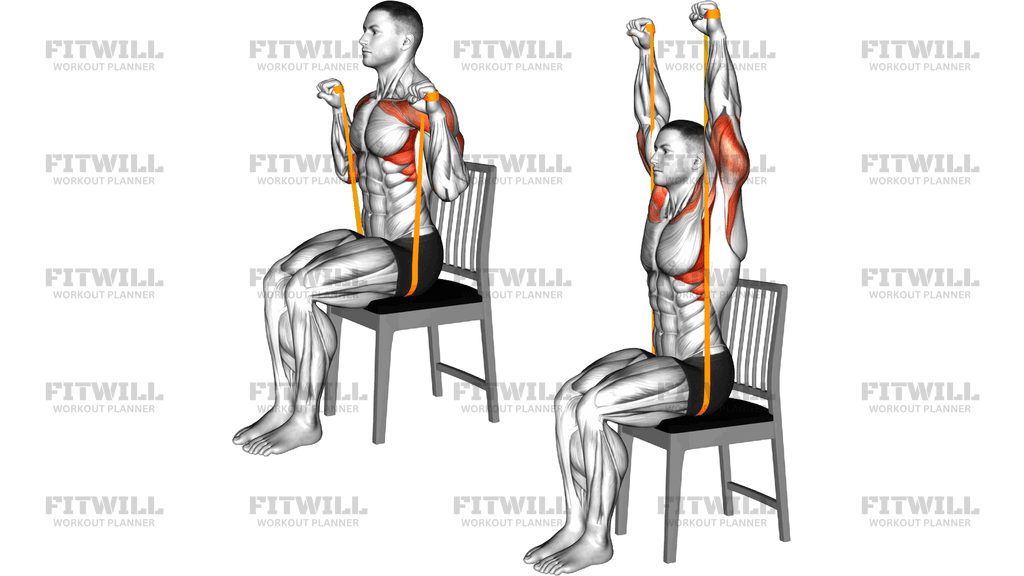
The Band Single Arm Shoulder Press is a standing overhead press performed one side at a time with a resistance band anchored under your foot. You hold the handle at shoulder height with your working hand while your free hand manages the slack of the band near your hip, then press straight overhead until the arm is fully extended before lowering under control. Because the band runs from the floor to your hand, the resistance stays on the shoulder through the entire range of motion, and it actually gets harder as you approach lockout rather than easier like some pressing angles do.
This setup trains the front and side of the shoulder as the primary movers, with the triceps finishing the lockout and the upper traps assisting near the top. Working one arm at a time also places a real demand on your core: the obliques and deep trunk muscles have to keep your ribcage from tilting sideways as the load travels up on just one side of your body. That anti-lean work is one of the biggest reasons to choose the single-arm version over a two-handed press.
The setup matters more with bands than with dumbbells. Where you anchor the band under your foot determines how much tension you start with, and a slack starting position means your first few inches of pressing are doing almost nothing. Stand so the band is already snug when your hand is at shoulder height, and keep the band traveling along the outside of your arm, not across your body, so the resistance vector stays in line with the press.
To execute well, plant both feet about hip-width apart, brace your midsection as if bracing for a light nudge, and press the handle up and slightly back so the band tracks past the side of your head rather than forward. Fully extend the elbow at the top with the handle roughly above your ear or shoulder line, then lower until the elbow sits just below shoulder height before starting the next rep. Keep your wrist stacked over your elbow throughout instead of letting the handle pull your hand backward.
This movement suits people training at home, travelers, or anyone who wants overhead pressing without a rack or heavy weights. It is also a useful tool for correcting left-right differences, since the weaker or stiffer side has to do its own work. The band's ascending resistance is generally friendly to the shoulder joint at lighter loads, making it a reasonable choice for those easing back into pressing, though anyone with an active shoulder issue should keep the range pain-free and consult a professional if unsure.
Practically speaking, progress this exercise by moving the band under your foot for more tension, shortening your grip on the band to pre-tension it further, or stepping to a thicker band. Control the lowering phase just as much as the press, since the band will actively pull your arm down and the temptation to let it snap back is the most common fault seen in band pressing.
[ Workout Log & Planner ]
Put your next workout in Fitwill
Keep your plan and training log ready when you are.


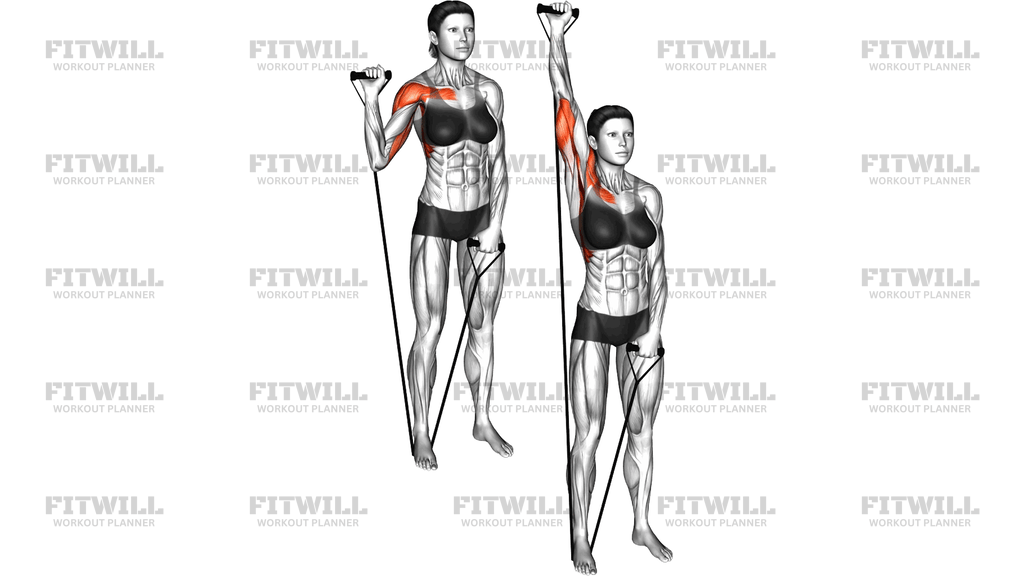
Instructions
- Anchor one end of the resistance band securely under one foot and stand tall with feet hip-width apart, gripping the handle in one hand with that band side running along the outside of your working arm.
- Pull the handle up so your elbow is bent at roughly 90 degrees, level with or slightly below your shoulder, and take up the slack with your free hand holding the band near your opposite hip.
- Set your stance firmly, soften the knees slightly, and brace your abdominal muscles so your ribcage and hips stay square to the front.
- Press the handle straight up and slightly back so the band tracks past the outside of your arm and head, not across your body.
- Extend your arm fully at the top with the handle above your shoulder, wrist stacked over the elbow, and pause briefly.
- Lower the handle under slow control until the elbow returns to just below shoulder height, resisting the band's pull on the way down.
- Exhale as you press up and inhale as you lower the handle.
- Complete all reps on one side, then reset the band under your other foot and press with the opposite arm for the same number of reps.
- Between sets, release tension gently by lowering the handle toward the anchored foot rather than letting the band snap your arm down.
Tips & Tricks
- The most common fault is leaning your torso sideways as you press. Keep both shoulders level and think of pressing your free hip slightly down into the floor to stay tall.
- If your first few inches feel too easy, the band is slack at the start. Shorten your grip on the band or anchor it more firmly under your foot so tension is present at shoulder height.
- Do not let the band pull your wrist backward at the top. Keep your knuckles stacked over your wrist and forearm so the handle sits in line with the band.
- Avoid flaring the elbow straight out to the side at a 90-degree angle from the start. A slightly forward, roughly 30-to-45-degree elbow position is usually more comfortable for the shoulder.
- Watch for the handle drifting forward past your face. The press path should stay close to the side of your head, finishing above the shoulder, not out in front of you.
- If your lower back arches hard at the top, squeeze your glutes and brace harder before pressing rather than shrinking the range, which shortchanges the lockout work.
- Match the working side by tension and reps, not by feel. Anchor the band identically on both feet so the weaker side gets an honest comparison.
- Keep the band away from your neck and face on the way up. If it rides close, adjust your grip angle on the handle so the band exits over the outer shoulder.
- Slow the lowering phase to two or three seconds. The band actively pulls your arm down, and bouncing out of the bottom is where form breaks down fastest in this movement.
Frequently Asked Questions
Which muscles does the Band Single Arm Shoulder Press work?
The front and side of the shoulder do most of the pressing, with the triceps extending the elbow to lockout. The upper traps assist near the top, and the obliques and core work to keep your torso from leaning as you press one arm at a time.
Is the Band Single Arm Shoulder Press good for beginners?
Yes, as long as you start with a light band and focus on keeping your torso upright and your wrist stacked. The band's smooth, ascending resistance is easier to manage for many beginners than a heavy dumbbell overhead.
How do I make the Band Single Arm Shoulder Press harder?
Anchor the band more firmly under your foot, choke up on the band to create more starting tension, or switch to a thicker band. Increasing tension at the bottom matters more than at the top, since band resistance is already hardest at lockout.
Why does my torso lean away from the pressing arm?
The single-arm setup loads one side of your body, so your obliques and trunk stabilizers are fighting that pull. Brace your midsection before each rep, keep both shoulders level, and reduce the band tension if the lean persists.
Should the band be under the same foot as the working arm or the opposite foot?
Anchoring it under the same-side foot keeps the resistance vector aligned with the press along the outside of your arm. The opposite-foot setup changes the pull angle and is a different variation, so pick one and keep it consistent.
Can I do the Band Single Arm Shoulder Press seated?
Yes, sitting on a bench or chair with the band anchored under your foot works, and it reduces the balance and core demand. Standing is the version shown and trains trunk stability more, so choose based on your goal.
What can I substitute if I do not have a band with handles?
A single dumbbell or kettlebell single-arm overhead press is the closest substitute. The main difference is that a weight is hardest at the bottom, while the band is hardest at the top, so the two complement each other nicely.
How high should my elbow start on each rep?
Start with the elbow around shoulder height or just slightly below, bent about 90 degrees. Dropping much lower than that shifts the work away from the press and lets the band drag the arm down out of position.
Is it safe to press overhead with a shoulder problem?
Band pressing at light tension is often well tolerated, but you should stay within a pain-free range and stop if you feel pinching. Check with a qualified professional before loading an irritated or injured shoulder.