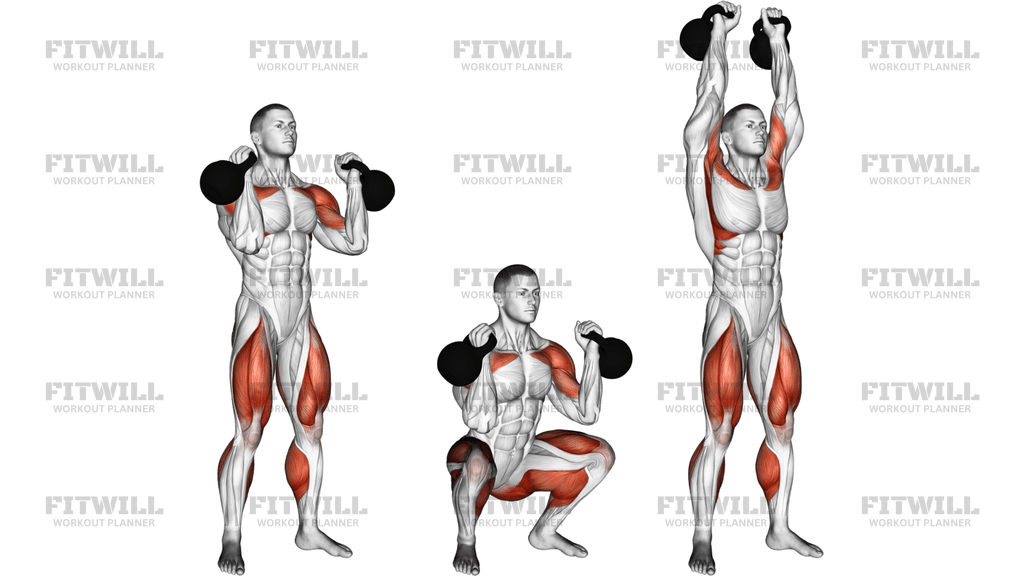
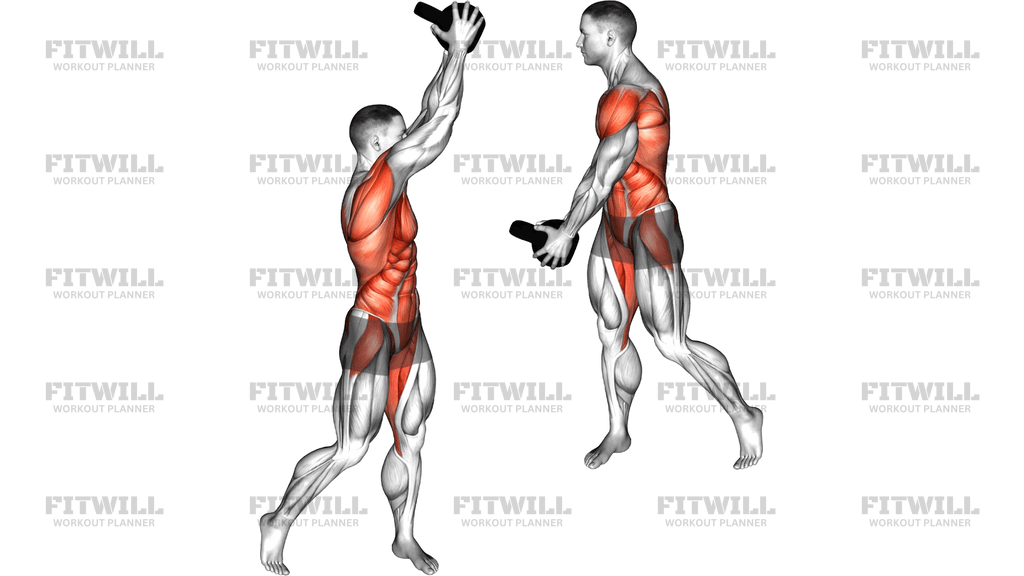
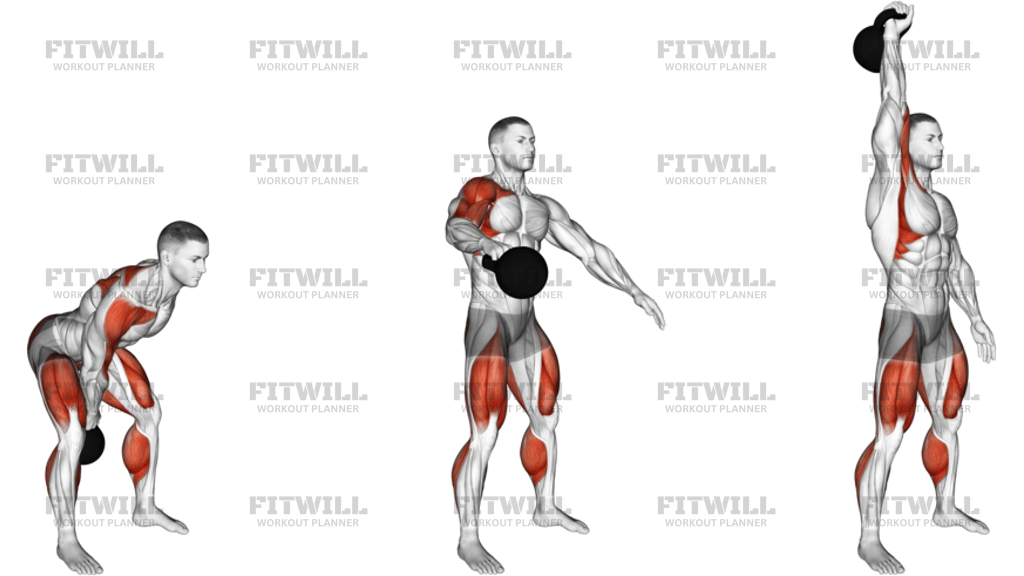
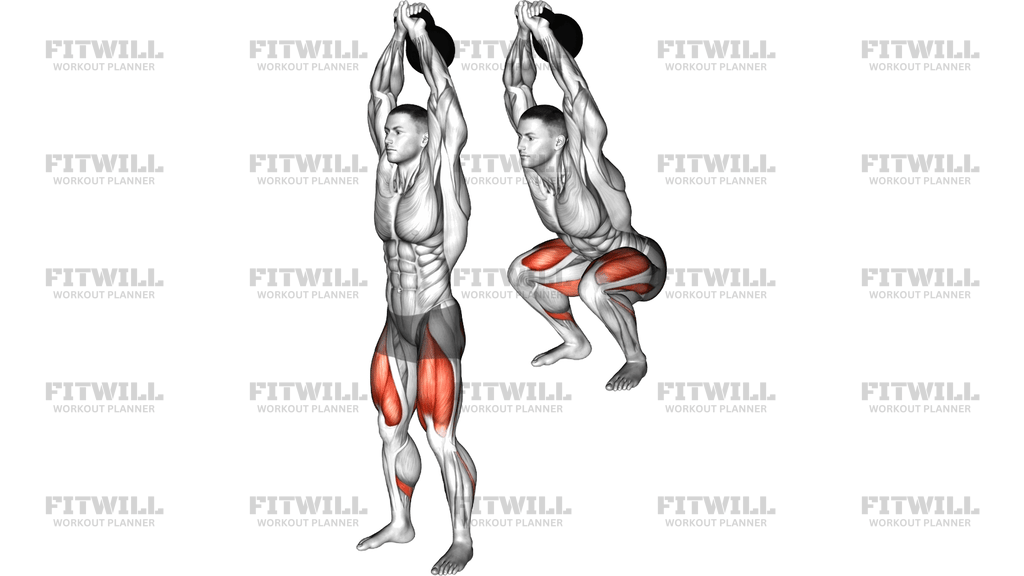
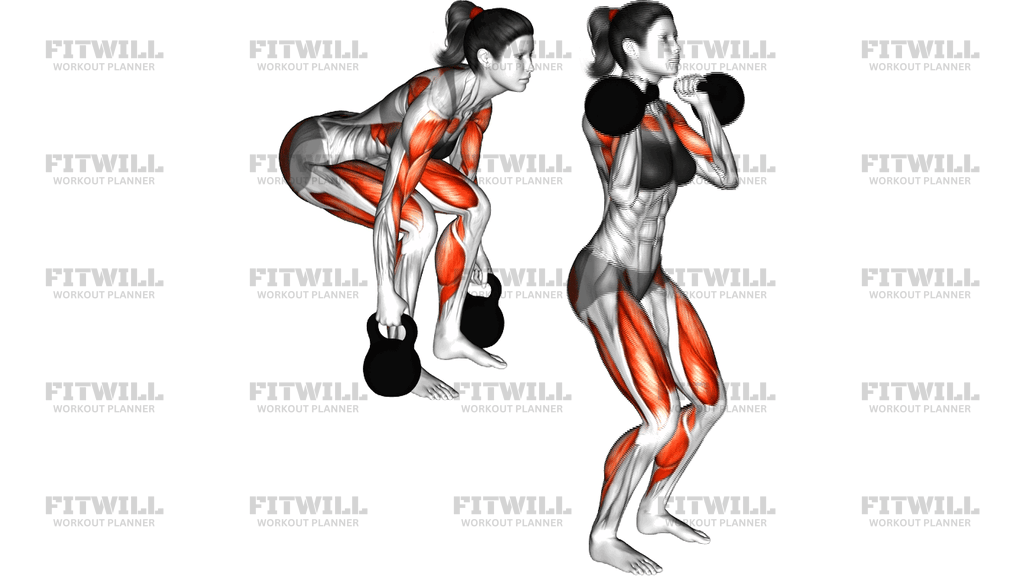
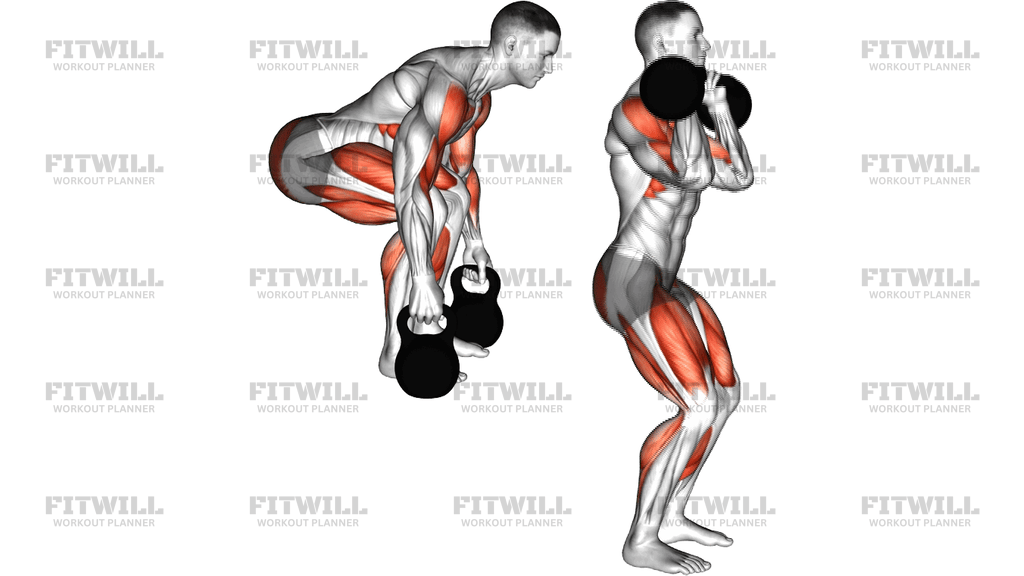
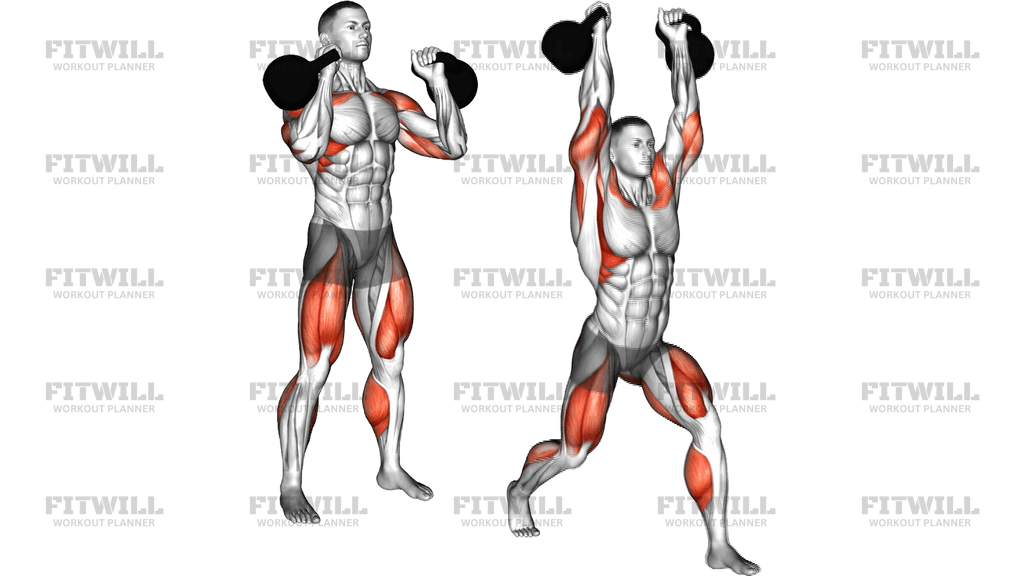
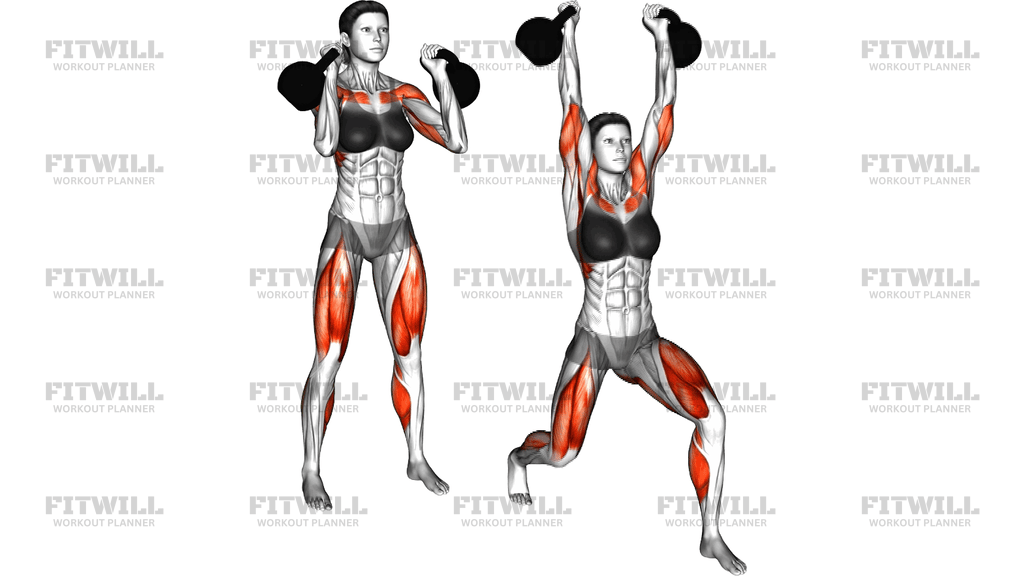
Kettlebell One Arm Clean And Jerk
The Kettlebell One Arm Clean And Jerk is a two-phase compound lift that takes a single kettlebell from a hang position between your legs, up to your shoulder in one powerful pull, then drives it overhead with a jerk. Unlike pressing the bell up with arm strength alone, the jerk uses a short, sharp dip and drive from the legs to launch the kettlebell, so your whole body contributes to every rep. It is essentially a full-body expression of power packed into one kettlebell movement.
This lift rewards coordination as much as strength. The clean phase is driven by a hip hinge — the same hip snap you use in a swing — while the jerk depends on a quick knee dip, an aggressive leg extension, and a smooth punch of the arm to catch the bell overhead. Because everything happens on one side at a time, your trunk has to resist rotation and side-bending throughout, which makes the obliques and deep core work far harder than the weight would suggest.
Athletes use this movement to build explosive hip power, overhead strength, and conditioning all at once. It appears frequently in kettlebell sport training, general strength programs, and metabolic circuits, because moderate loads can be cycled for sustained sets that spike the heart rate quickly. For lifters who only have one kettlebell at home, it replaces several barbell or dumbbell exercises without needing a rack or bench.
Setup matters more than most people expect. The one-arm grip changes the loading pattern, so your stance, the path of the bell between your legs, and the position of the free arm all influence whether the kettlebell arrives at your shoulder cleanly or crashes down on your forearm. Keep the bell close to the body on both the clean and the press, and let the handle rotate in your grip as the bell settles into the rack rather than fighting it.
Execution should feel like one continuous wave: hinge and hike the bell back, snap the hips to float it up to the rack, pause long enough to own the position, then dip and drive to punch the bell overhead. Common faults include muscling the clean with the arm, letting the kettlebell flop onto the forearm, and pressing without using the legs. Start with a weight you could swing confidently for ten reps, and treat the timing as the skill before adding load.
[ Workout Log & Planner ]
Put your next workout in Fitwill
Keep your plan and training log ready when you are.


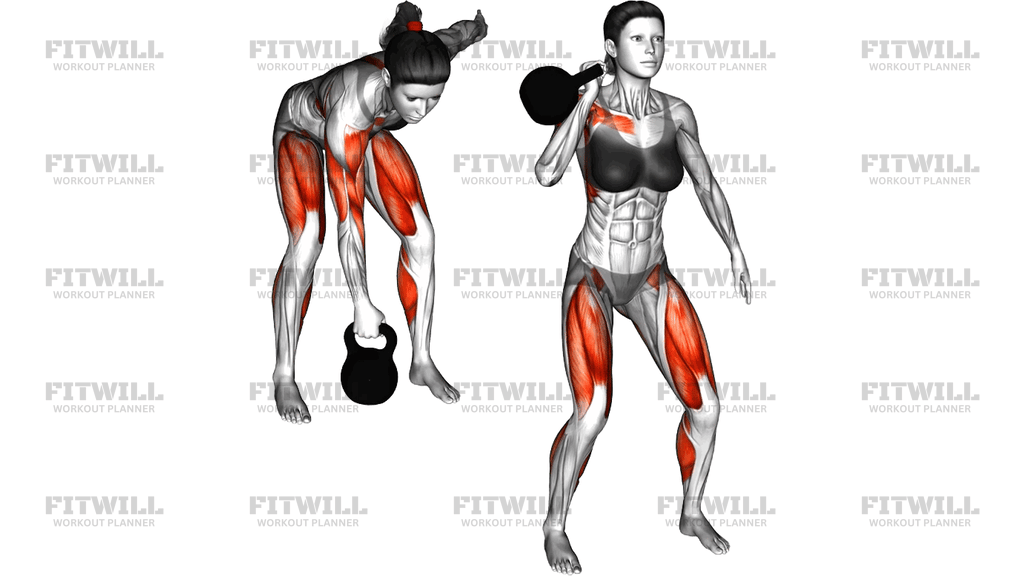
Instructions
- Place one kettlebell on the floor about a foot in front of you and stand over it with feet roughly hip-width apart, toes turned slightly out.
- Hinge at the hips, bend the knees, and grip the handle with one hand, thumb pointing back toward you; keep your back flat and shoulders slightly higher than your hips.
- Hike the kettlebell back between your legs like a football snap, letting it swing behind you with your arm relaxed and your weight on the heels.
- Snap your hips forward sharply to stand tall; guide the bell up the front of your body and let the handle rotate in your hand as the bell lands softly on the back of your forearm in the rack position.
- Settle into the rack with the elbow tucked against your ribs, wrist straight, and the bell resting on your forearm and shoulder; take a brief breath here before the jerk.
- Dip your knees a few inches while keeping the torso upright, then drive forcefully through the floor to extend the legs and punch the kettlebell straight up overhead.
- Lock out with the arm beside your ear, bicep near the head, shoulder packed, and legs standing tall; hold briefly to stabilize the bell.
- Lower the kettlebell back to the rack by bending the elbow and absorbing the drop with a small knee dip, then perform another rep or lower the bell to the hang.
- Exhale on the hip snap during the clean and again on the overhead drive; inhale in the rack between reps.
- When finished, swing the kettlebell back between your legs and set it down on the floor in front of you, then switch arms and repeat on the other side.
Tips & Tricks
- If the kettlebell smacks your forearm on the clean, you are lifting with the arm; the bell should float from hip drive, with your hand merely steering it around to the rack.
- Keep the free arm active and slightly out to the side for balance — letting it dangle dead encourages torso rotation as the bell travels up.
- In the rack, do not let the elbow flare out wide; a tucked elbow lets the bell rest on the forearm so your skeleton, not your biceps, carries the load.
- The dip before the jerk should be quick and shallow — about a quarter of a squat. A slow, deep dip turns the jerk into a grind and kills the leg drive.
- Punch your hand up and slightly toward your ear on the jerk so the bell stacks over your shoulder, hip, and mid-foot instead of drifting in front of your face.
- Keep your heels planted during both the clean and the dip; rising onto the toes early is a sign the weight is too heavy or the timing is off.
- If your lower back rounds when the bell swings behind you, shorten the hike — the bell only needs to pass behind the knees, not reach the floor.
- Switch arms between sets rather than mid-set when you are learning, so fatigue does not compromise your hinge pattern on the weaker side.
- Chalk or a dry towel on your hand helps; a sweaty grip forces you to squeeze harder and fatigues the forearms long before the legs and shoulders.
Frequently Asked Questions
Which muscles does the Kettlebell One Arm Clean And Jerk work?
It targets the shoulders and triceps for the overhead lockout, with heavy contributions from the glutes, hamstrings, and quads during the hip snap and jerk drive. The traps, forearms, and obliques also work hard to control the bell and resist rotation.
Is the Kettlebell One Arm Clean And Jerk suitable for beginners?
Yes, but only after the hip hinge and a basic one-arm clean feel comfortable. Beginners should learn the clean and the jerk as separate drills before combining them, and start with a light bell to practice the timing.
How is the jerk different from just pressing the kettlebell overhead?
In a press, the arm does all the work from a static rack. In the jerk, a quick knee dip and leg drive launch the bell, so you catch it at or near full extension with far less arm strain — this is what lets you use heavier loads and longer sets.
Why does the kettlebell keep banging on my forearm during the clean?
That usually means the bell is being muscled up with the arm instead of floated by the hips, or the hand is gripping too tightly to let the handle rotate. Relax the grip as the bell rises and aim for it to land on the forearm rather than swing onto it.
How heavy should the kettlebell be for this exercise?
Choose a weight you can swing cleanly for about ten reps with one hand. Because the jerk amplifies your leg power, most people can jerk more than they can press, but the clean and rack positions will usually limit the load first.
How many reps should I do per set of the Kettlebell One Arm Clean And Jerk?
For strength, work in sets of 3-5 reps per arm with a moderate-to-heavy bell; for conditioning, use a lighter bell for timed sets of 30-60 seconds per side. Always match the work on both arms.
What can I substitute if I do not have a kettlebell?
A single dumbbell can mimic the clean and press, though the offset handle makes the rack position less comfortable. A barbell clean and jerk trains the same pattern but removes the single-arm core challenge.
Should my feet stay in the same position during the whole movement?
Yes, keep the same hip-width stance for the clean, the rack, and the jerk. Shifting or scissoring the feet during the dip suggests the leg drive is not being directed vertically.
Is it safe for my lower back?
When performed with a braced, neutral spine and a proper hinge, the movement loads the hips and legs more than the back. Problems usually come from rounding during the hike, twisting to chase the bell, or using a weight that yanks you forward.
How do I lower the kettlebell safely after the last rep?
Return the bell to the rack first, then swing it back between your legs and set it down in front of you with a flat back, or drop it from the hang onto a suitable surface if you are training on rubber flooring. Never lower it straight from overhead with a tired arm.