Plank Pike Slide With Towel
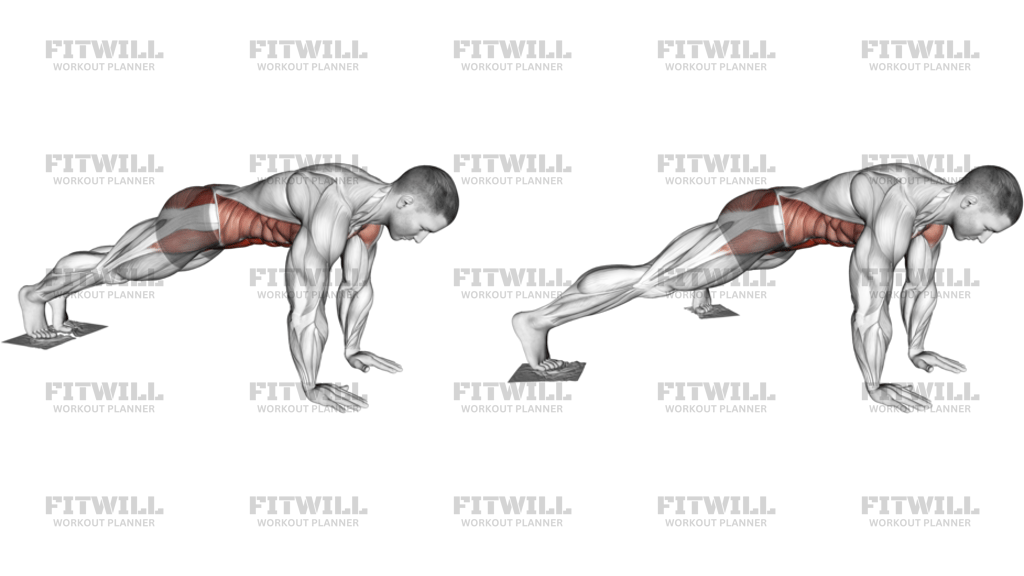
The Plank Pike Slide With Towel is a sliding bodyweight movement that takes you from a high plank into an inverted pike position by drawing your feet toward your hands on a smooth floor. A small towel placed under your toes acts as the slider, so as your hips lift, your feet glide in along the floor instead of staying fixed in place. The result is a hybrid of a plank, a jackknife, and a pike-up that demands far more trunk control than any of those done on their own.
This movement is a strong choice for anyone who has already built a basic plank tolerance and wants to load the abs in a dynamic way without equipment beyond a towel and open floor. It is popular in home training because the towel works on hardwood, tile, or laminate just as well as a dedicated slider disc would. Gymnasts, calisthenics practitioners, and general lifters all use sliding pike variations to build the compression and overhead-reaching strength that carries into handstand work, V-ups, and strict toes-to-bar.
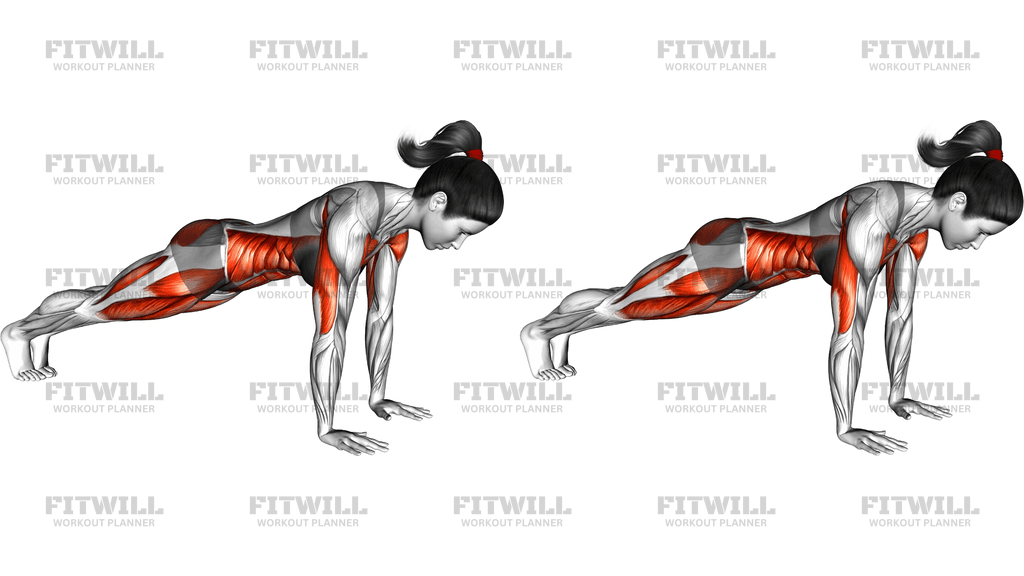
The primary work comes from the abdominal wall, especially the lower portion of the rectus abdominis and the deep corset muscles that keep your spine from sagging as your center of mass travels. Your shoulders work hard in a flexed, overhead-reaching position, and your hip flexors and hamstrings share the load as your hips hinge upward. Because the towel removes friction, your feet can drift sideways or your hips can rotate without you noticing, which means the anti-rotation demand on the obliques is real and worth respecting.
Setup matters more than speed here. The towel needs to sit only under the toes and balls of the feet, your hands should be stacked directly under your shoulders, and the floor must be smooth enough for the towel to slide freely. On carpet or a grippy surface the towel will catch, and you will end up dragging your knees or collapsing through the shoulders to finish the rep.
To execute it well, think of the pike as a single hinge happening at the hips while the arms stay long and steady. The hips rise toward the ceiling as the feet slide forward and inward, and the head drops between the arms so the spine forms one clean inverted V. The most common fault is turning it into a knee tuck or a worm-like roll through the shoulders, both of which unload the abs. If your lower back feels strained at the bottom of the slide, start with a shorter range and only slide as far as you can keep your ribs down and your pelvis neutral.
Progress by slowing the descent back to the plank, adding a pause at the top of the pike, or increasing reps. Because the shoulders carry bodyweight in a flexed position for the whole set, people with cranky shoulders should warm them up thoroughly or choose a lower-load core drill instead.
[ Workout Log & Planner ]
Put your next workout in Fitwill
Keep your plan and training log ready when you are.


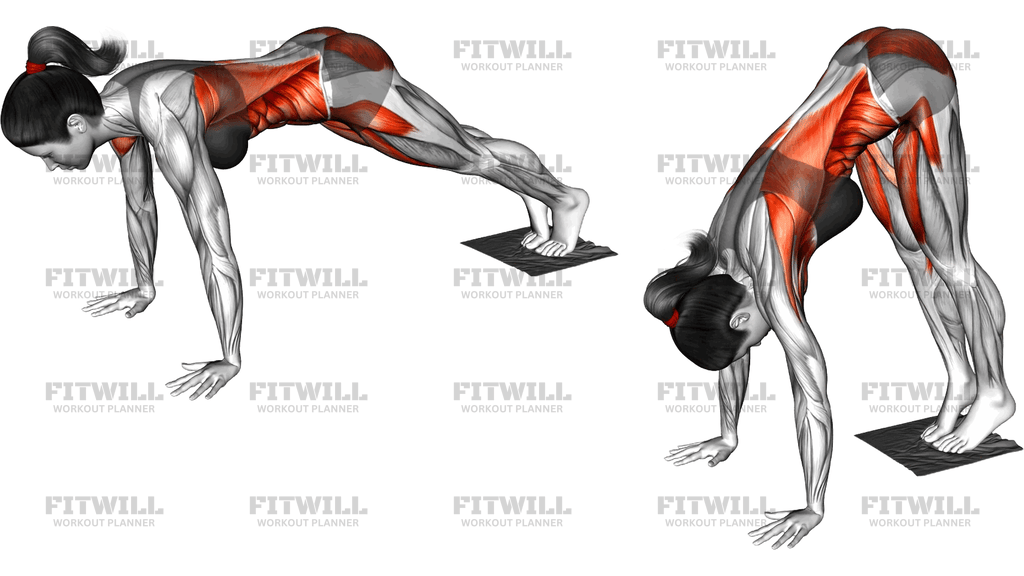
Instructions
- Place a small towel on a smooth hard floor and stand with your feet about hip-width apart.
- Fold down, place both palms flat on the floor under your shoulders, then step one foot at a time back onto the towel so only your toes and forefoot rest on it.
- Set up in a high plank with your arms straight, wrists stacked under shoulders, legs extended, and your body forming one straight line from head to heels.
- Brace your abs as if bracing for a nudge, squeeze your glutes slightly, and press the floor away so your upper back does not sink between your shoulder blades.
- Slide both feet forward along the floor while lifting your hips straight up toward the ceiling, keeping your knees locked long and your arms vertical.
- Continue until your hips are at their highest point, your head hangs between your arms, and your body forms an inverted V with the towel under your toes near your hands.
- Pause for a beat at the top, then slowly slide your feet back out along the same path until you return to a full plank without letting your hips sag.
- Exhale as you slide into the pike and inhale as you lower back to the plank.
- Finish the rep by re-bracing and checking that your hips and shoulders are level before starting the next one.
- Reset the towel under your toes if it has wandered, and step off rather than collapsing to the floor between sets.
Tips & Tricks
- If your feet shoot inward unevenly, the towel is probably sliding on one foot more than the other; check that both forefeet sit on the fabric before every rep.
- Do not let your chest drift forward over your hands as you pike. Your arms should stay stacked under your shoulders so the work stays in your abs and shoulders instead of loading the wrists.
- A bent-knee finish means the hips are not hinging enough. Push your heels and hips back less and think of folding at the hip crease rather than pulling your knees in.
- If the towel grips the floor mid-rep, you may be on a textured or semi-carpeted surface; a plastic bag or dedicated slider glides better than cotton on those floors.
- Keep a slight inward turn on the toes so the towel does not spin sideways as your hips rise and rotate your pelvis.
- Avoid letting your head crane up to watch your feet. Look back toward your ankles at the top so your neck stays neutral in line with your spine.
- If your hips sag when you slide back out to the plank, shorten the range. A smaller pike performed with a rigid trunk beats a big pike with a broken one.
- Warm up your wrists and shoulders first; you are holding a flexed-arm support position for the entire set, and cold shoulders tend to shrug up by the ears under fatigue.
Frequently Asked Questions
What muscles does the Plank Pike Slide With Towel work?
The abdominals, especially the lower abs, do most of the work to curl the hips upward, while the shoulders, hip flexors, glutes, and hamstrings assist through the pike. The obliques also work to keep your hips from rotating as the feet slide.
Can beginners do the Plank Pike Slide With Towel?
Yes, but it helps to first hold a solid 30-second high plank. Beginners can slide only partway into the pike, or start with both feet on a single larger towel for stability, and progress to full range over time.
Why does the exercise use a towel instead of no equipment?
The towel lets your feet glide across a smooth floor, so your feet travel toward your hands as your hips lift. Without it, your feet stay anchored and the movement becomes a static pike-up rather than a slide.
What surfaces work best for the Plank Pike Slide With Towel?
Hardwood, tile, laminate, and other smooth floors let a cotton towel slide freely. On carpet the towel catches, so a plastic slider disc is a better substitute there.
Why do my hips twist or my feet drift sideways during the slide?
That usually means one foot is carrying more of the slide, or the towel has rotated. Center the towel under both forefeet, point your toes slightly inward, and move both feet together at the same speed.
How is the Plank Pike Slide With Towel different from a slider knee tuck?
In a knee tuck the knees bend and come toward the chest, while in the pike slide the legs stay long and the hips hinge upward, forming an inverted V. The pike version demands more hamstring flexibility and more straight-leg core control.
My lower back aches after doing the Plank Pike Slide With Towel. What should I change?
Your hips are likely sagging during the return slide, which arches the lower back under load. Reduce your range, re-brace your abs before each rep, and move your feet back out more slowly with your glutes engaged.
What can I use if I do not have a towel?
Furniture sliders, paper plates on carpet, or a folded plastic bag on hard flooring all work the same way. The key is a low-friction surface under the forefeet that still lets you press down for control.
How many reps of the Plank Pike Slide With Towel should I do?
Start with 2 to 3 sets of 6 to 10 controlled reps, treating the slow return slide as the main strength stimulus. Add reps or a pause at the top of the pike before adding speed.
Is it safe to do this movement with wrist or shoulder discomfort?
If your wrists or shoulders hurt during a high plank, this exercise will likely aggravate them because your full bodyweight rests on straight arms throughout. Warm up thoroughly, keep your upper back actively pressed away, or choose a core drill that does not load the shoulders overhead.