Sitting Prayer Chest Squeeze On A Chair
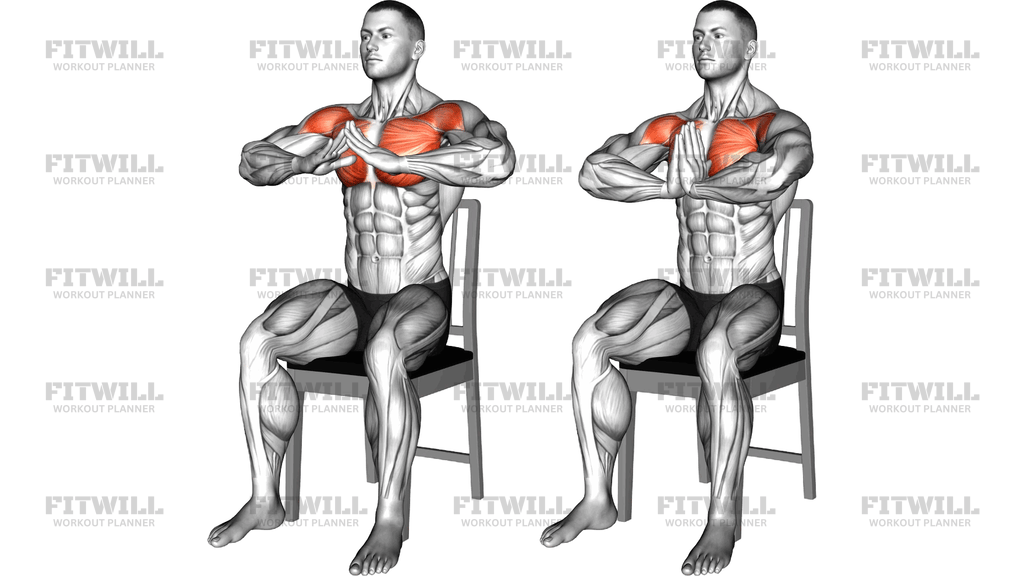
The Sitting Prayer Chest Squeeze On A Chair is an isometric chest exercise performed entirely with your own hands providing the resistance. You sit upright on a sturdy chair, bring your palms together in front of your chest in a prayer position, and press them firmly against each other while keeping your elbows lifted out to the sides. Because the hands push against each other rather than against an external load, the tension on the chest is self-regulated: you decide how hard to squeeze, and you can adjust it instantly at any point in the hold.
This makes the movement especially useful for people who train at home, in an office, or anywhere without equipment, as well as for beginners learning what a chest contraction actually feels like. It is also a practical option during recovery from layoff periods or for older adults who want to keep the pressing muscles active without handling weights. Because you are seated with your back supported by your own posture rather than a bench, it doubles as a light postural drill for the upper back and shoulders.
The primary muscles worked are the pectorals, with strong emphasis on the upper chest because the hands sit at mid-chest height and the elbows stay high. The front shoulders assist the press, and the triceps and forearms work isometrically to hold the arm and hand position. Your core also stays quietly engaged to keep your torso from swaying as you squeeze.
Setup matters more than it looks. Sitting tall with feet flat on the floor gives you a stable base, and keeping the elbows at or slightly below shoulder height ensures the squeeze comes from the chest instead of turning into a shoulder shrug. If your hands drift toward your face or your shoulders ride up toward your ears, the emphasis shifts away from the pecs and neck tension creeps in.
To execute it well, place your palms flat against each other with fingers pointing up, take a breath in, and then press your hands together as hard as you comfortably can while exhaling slowly. Hold the squeeze for five to fifteen seconds, feeling the chest muscles contract across the front of your ribcage, then ease off deliberately rather than letting your hands spring apart. Repeat for several holds, keeping the pressure consistent within each set.
A few practical points will keep this safe and effective: keep the press centered in front of your sternum rather than off to one side, avoid holding your breath during the hold, and stop if you feel any sharp discomfort in the shoulders or wrists. Because the effort is entirely self-generated, the value of the exercise depends on how honestly you squeeze, so treat each hold as a deliberate maximal-effort contraction rather than a light hand clasp.
[ Workout Log & Planner ]
Put your next workout in Fitwill
Keep your plan and training log ready when you are.


Instructions
- Sit on a sturdy chair with your feet flat on the floor about hip-width apart and your sitting bones planted evenly on the seat.
- Sit up tall, lengthen the back of your neck, and let your shoulders drop away from your ears before you start.
- Bring your palms together in front of your chest in a prayer position, fingers pointing upward, with your elbows lifted out to the sides at roughly chest height.
- Brace your core lightly and keep your ribcage stacked over your hips so your torso stays upright throughout the hold.
- Inhale, then press your palms firmly into each other while exhaling slowly, squeezing your chest as if trying to crush something between your upper arms and pecs.
- Hold the maximum comfortable pressure for five to fifteen seconds, keeping the hands centered over your sternum and the elbows high.
- Release the squeeze gradually over two to three seconds instead of letting your hands snap apart, keeping light contact between the palms.
- Breathe steadily between reps, taking a full breath in before starting the next press.
- Reset your posture between reps if you feel your shoulders creeping up or your lower back rounding.
- Complete your planned number of holds, then gently shake out the arms and roll the shoulders to finish.
Tips & Tricks
- Press through the heels of the palms, not just the fingertips, so the contraction pulls across the whole chest instead of only loading the wrists.
- If your shoulders shrug during the squeeze, deliberately lower your elbows half an inch and imagine tucking your shoulder blades into your back pockets.
- A common mistake is pressing with straight arms close to the torso; keep the elbows wide and bent so the pectorals, not the triceps, do the work.
- Keep the hands vertically aligned in front of the sternum. If one hand pushes higher than the other, the tension becomes uneven across the two sides of the chest.
- Think of squeezing inward and slightly upward with the upper arms to bias the upper chest fibers more strongly.
- Vary the hold length rather than the hand position: longer ten to fifteen second holds build endurance, while shorter five second maximum squeezes emphasize peak tension.
- If your wrists ache, interlace less surface area by pressing palm-to-palm with fingers relaxed rather than rigid, or back off to about eighty percent effort.
- Do not lean your head forward to meet your hands; the hands come to the chest, not the chin to the hands.
- Because the resistance is self-generated, the temptation is to coast. Commit to a genuinely hard press on every hold or the set will feel easy while training nothing.
Frequently Asked Questions
What muscles does the Sitting Prayer Chest Squeeze On A Chair work?
The chest, especially the upper chest, is the primary muscle working during the press. The front shoulders assist, while the triceps and forearms hold the arm and hand position isometrically.
Is the Sitting Prayer Chest Squeeze On A Chair good for beginners?
Yes, it is one of the safest ways to learn chest activation because there is no external weight and you control the intensity completely. Beginners can start with lighter presses and shorter holds before building up.
Why should my elbows stay out to the sides during the prayer press?
High, wide elbows keep the upper arm aligned with the chest fibers so the pectorals produce the squeeze. If the elbows drop toward your ribs, the triceps and shoulders take over and the chest works far less.
How hard should I press my palms together?
Press as hard as you can while staying relaxed in the neck, jaw, and shoulders, and while breathing normally. A genuinely firm squeeze is what makes the exercise productive, since there is no added weight.
Can I do the Sitting Prayer Chest Squeeze On A Chair every day?
Because it is a low-load isometric hold with no eccentric stress, most people can perform it frequently. If your chest or shoulders feel persistently sore, take a rest day as you would with any strength work.
What is the most common mistake with this exercise?
Shrugging the shoulders toward the ears and pressing the hands near the face. Both shift tension to the neck and front shoulders, so keep the hands at sternum height and the shoulders pulled down.
What can I use instead of a chair?
Any firm, stable seat works, such as a bench, stool, or the edge of a sturdy bed. You can also perform the same prayer press standing, but sitting removes momentum and makes it easier to keep the torso still.
Can this exercise replace bench presses or push-ups?
It trains chest contraction but provides no external load or lengthening phase, so it does not fully replace pressing exercises for building maximal strength. It works well as a warm-up, a travel option, or a supplement when equipment is unavailable.
Is it safe if I have shoulder or wrist discomfort?
If you feel sharp pain rather than muscular effort, ease off the pressure or stop. Pressing palm-to-palm with the fingers relaxed usually reduces wrist strain, and reducing the squeeze intensity limits stress on the shoulder joint.
How long should each squeeze last?
Five to fifteen seconds per hold works well, with a slow release between reps. Longer holds with moderate pressure suit endurance and rehab-style work, while shorter maximal squeezes suit strength-focused sessions.