Resistance Band Renegade Row
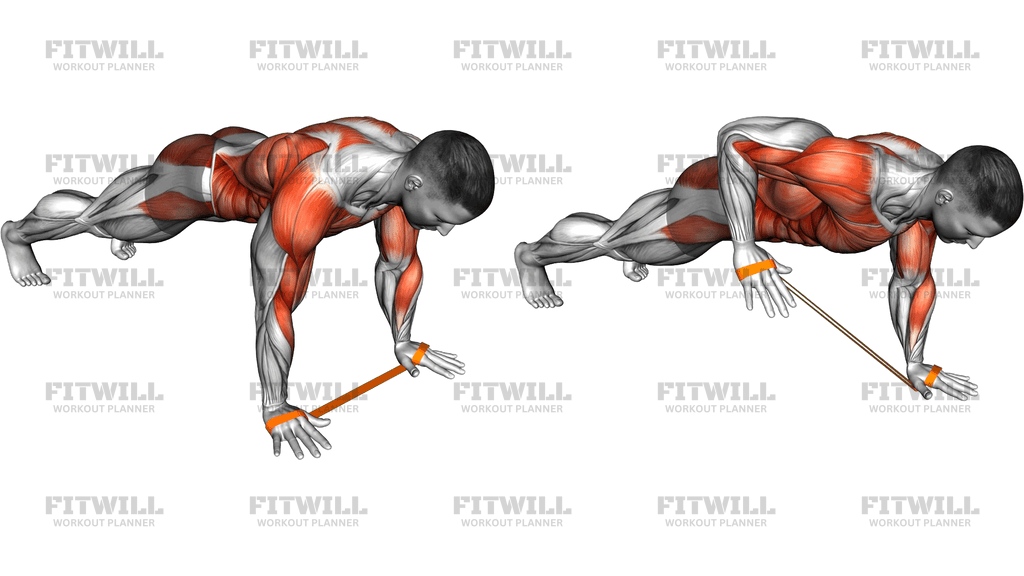
The Resistance Band Renegade Row is a rowing movement performed from a high plank position, with a resistance band looped around both wrists so your grounded hand anchors the band while the opposite hand pulls against the tension. Instead of relying on a dumbbell resting on the floor, the band supplies the resistance, which changes the feel of the exercise: the load builds as you pull, and your stabilizing side has to stay glued to the floor the whole time. It is essentially a plank and a row happening at once, and that combination is what makes it demanding despite using nothing more than a light loop band.
This movement is a strong choice for lifters who train at home or travel, since it delivers a genuine upper-back and lat stimulus with minimal equipment. It is also useful as a core-focused accessory for people who already row with barbells or dumbbells, because the plank position exposes exactly how well you can hold a rigid torso while one arm works. Athletes in combat sports, climbing, and overhead sports often use it to build the anti-rotation control that transfers to swinging, pulling, and pressing under instability.
The primary work comes from the lats and the muscles of the upper back, including the rhomboids and mid-traps, which draw the shoulder blade back as your hand pulls toward your ribs. The biceps assist the bend of the elbow, the rear shoulders help guide the elbow path, and the forearms work hard just to keep tension on the band. Meanwhile your entire trunk, especially the obliques and deep core, fights the rotational pull of the band so your hips stay level and square to the floor.
Setup matters more here than in most band exercises. The band should be looped securely around both wrists with the working side pulling against the anchored hand, and your hands should sit slightly wider than shoulder-width directly under your shoulders. A wider-than-normal foot stance, as shown, gives you a more stable base and makes it easier to keep your hips from swinging. If your hands creep too far forward or your feet are too narrow, the plank becomes a fight for balance and the row quality drops immediately.
To execute it well, think of pulling your hand back toward your lower ribs with your elbow close to your body, driving the movement from the shoulder blade rather than just bending the elbow. Exhale as you pull, pause briefly with the hand at the ribs, then lower with control so the band tension never jerks your shoulder forward. Keep your neck long and your gaze a few inches ahead of your hands rather than dropping your head.
Because the resistance is light and the stability demand is high, treat this as a control exercise: moderate reps, deliberate tempo, and a level pelvis beat heavy tension and sloppy hips every time. If your trunk starts rotating or your lower back sags, reduce the band tension or step your feet wider before adding anything harder.
[ Workout Log & Planner ]
Put your next workout in Fitwill
Keep your plan and training log ready when you are.


Instructions
- Loop a resistance band around both wrists so it sits snugly across the back of each hand, with enough slack between your hands to set up in a plank without pre-tension.
- Place your hands on the floor slightly wider than shoulder-width, fingers spread, and step your feet out to a stance wider than hip-width so your base is stable.
- Settle into a high plank with your shoulders stacked directly over your wrists and your body forming one straight line from heels to head.
- Brace your core and squeeze your glutes, then shift a small amount of weight into the hand that will anchor the band so it pulls taut as the working arm lifts.
- Pull the working hand back toward your lower ribs, keeping the elbow close to your body and letting the shoulder blade glide back as the band stretches.
- At the top, your hand should be at or near your ribs with the elbow pointing back, not flared out to the side, while your hips stay level and square to the floor.
- Lower the hand back to the floor under control, resisting the band's pull rather than letting it snap your arm down.
- Exhale as you pull the band toward your ribs and inhale as you return your hand to the plank position.
- Complete all repetitions on one side, then switch the band setup and row with the opposite arm.
- Reset your plank line between sets: shoulders over wrists, hips level, feet planted wide, and the band seated securely on both wrists.
Tips & Tricks
- If your hips twist toward the pulling side, widen your feet first; a wider base is the fastest fix for rotation in this movement.
- The band wants to drag your hand forward on the way down—fight that by lowering over a two-count instead of letting the tension snap your arm back.
- Drive the pull from the shoulder blade, not just the elbow; if you only bend your arm, the lats and upper back stop doing the work.
- Keep the working elbow tracking close to your ribs. A flared elbow turns the row into a rear-delt swing and stresses the shoulder.
- Spread your fingers and press the floor away with the anchored hand—passive support there is the most common reason the plank line collapses.
- Choose a band you can pull for at least eight slow reps; going heavier usually costs you hip position before it costs you strength.
- Check the band placement on your wrists before every set; if it slides toward your palm mid-set, your grip is losing tension and the resistance changes.
- Avoid letting your head drop between your shoulders—keep your neck in line with your spine and look at a spot on the floor just ahead of your hands.
- If you cannot stop your lower back from sagging, shorten your sets rather than dropping to your knees mid-set; mixing plank heights mid-rep breaks your bracing pattern.
Frequently Asked Questions
Which muscles does the Resistance Band Renegade Row work?
The lats and upper back muscles, including the rhomboids and mid-traps, drive the row, while the biceps and rear shoulders assist. Your obliques, deep core, and lower back work continuously to keep your hips from rotating during the pull.
How is the Resistance Band Renegade Row different from a dumbbell renegade row?
With a band, the resistance comes from tension between your own hands, so the load increases as you pull and there is no weight resting on the floor. This places more demand on the anchoring arm and the core, while keeping the exercise joint-friendly and easy to scale by changing band thickness.
Is the Resistance Band Renegade Row suitable for beginners?
Yes, if you can already hold a solid high plank for 30 seconds. Beginners should use a light band, a wide foot stance, and short sets, focusing on keeping the hips perfectly level rather than pulling hard.
Why should my feet be wider than hip-width in this exercise?
A wider stance gives you a broader base of support, which makes it much easier to resist the rotational pull of the band. As your anti-rotation control improves, you can gradually bring your feet closer to increase the difficulty.
My hips rotate every time I pull—what should I fix?
Slow the tempo down, shift more of your weight into the anchored hand before starting the pull, and widen your feet. If rotation persists, the band is likely too heavy, so drop to a lighter loop until your trunk can hold position.
Should the elbow flare out or stay close to my body?
Keep the elbow close to your ribs, pointing back toward your hips. This keeps the lats and upper back in a strong pulling line; a flared elbow shifts stress to the shoulder joint and reduces rowing effectiveness.
What can I use if I don't have a resistance band?
A light dumbbell renegade row is the closest substitute, though the anchoring demand is different. Suspension trainer rows from a plank position also train a similar combination of pulling and anti-rotation core control.
How many reps and sets should I do?
Two to four sets of 8 to 12 controlled reps per side works well for most lifters. Because the stability demand is high, prioritize smooth tempo and level hips over chasing a higher number.
Can I do the Resistance Band Renegade Row if my wrists hurt in a plank?
Try placing your hands on a folded mat or using push-up handles to keep your wrists neutral. If discomfort continues, stop and choose a supported row variation instead, since a painful wrist will compromise both the plank and the pull.
Where exactly should the band sit on my hands?
Loop it around the wrist or across the back of the hand near the base of the fingers, snug enough that it cannot slide during the set. A loose band changes the resistance mid-rep and can slip off at the worst moment.