Seated Side Bend Shoulder Stretch
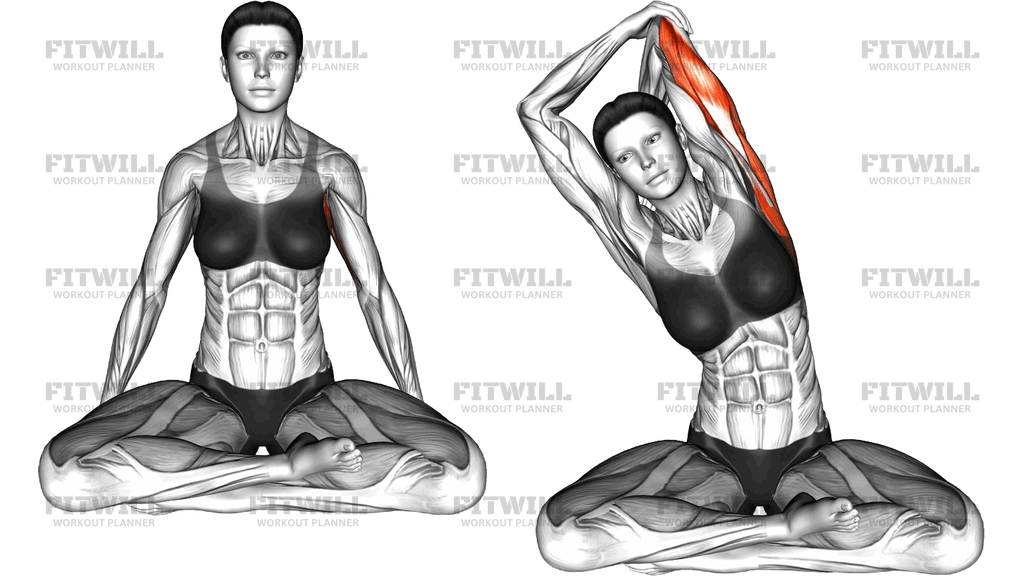
The Seated Side Bend Shoulder Stretch is a cross-legged, floor-based stretch that targets the entire side line of the upper body. You sit tall with the legs crossed, raise one arm overhead, bend the elbow so the hand rests behind your head, and then use the opposite hand to gently draw that elbow across as you lean into a side bend. The result is a long, satisfying pull that runs from the side of the neck, through the shoulder and triceps area, and down the lat and flank of the bending side.
Although the name puts the shoulder first, this is really a combined stretch for several linked structures. The overhead, bent-elbow arm position lengthens the lat and triceps on the lifted side, while the side bend adds length to the obliques and the tissues along the ribcage. Because the hips stay anchored in a cross-legged seat, the spine is the only mobile segment, which keeps the stretch focused where you want it instead of letting it leak into the hips or lower body.
This movement is especially useful for people who spend long hours sitting at a desk, since rounded shoulders and a compressed side body are common in that posture. It also suits lifters who press overhead, do pull-ups, or carry heavy loads, all of which can leave the lats and shoulders feeling tight. Yogis will recognize the shape as a cousin of seated side bend poses, and it works well as part of a cool-down or an evening mobility routine.
Setup matters more than most people expect. Sitting cross-legged on the floor gives you a stable, symmetrical base, but only if you keep both sit bones grounded and your chest facing forward. If your torso rotates as you lean, the stretch shifts away from the lats and shoulder and becomes a spinal twist instead. Keep the lean strictly sideways, as if your ribs were sliding along a wall beside you.
To execute it well, think of length before depth: grow tall through the spine first, then let the elbow pull create the curve. The stretch should feel like a gradual pulling sensation along the side of the torso and arm, never a sharp pinch in the neck or shoulder joint. Hold each side for a comfortable 20 to 40 seconds, breathe steadily, and repeat two to three times per side if you like.
A few practical points will keep this safe and effective. Never force the head or elbow past the point of a mild to moderate stretch, and avoid this position if you have an acute shoulder impingement or neck injury without professional guidance. If sitting on the floor is uncomfortable, the same stretch can be done in a sturdy chair or while kneeling, as long as the hips stay level and the side bend stays clean.
Fitwill
Log Workouts, Track Progress & Build Strength.
Achieve more with Fitwill: explore over 9600 exercises with images and videos, access built-in and custom workouts, perfect for both gym and home sessions, and see real results.
Start your journey. Download today!




Instructions
- Sit on the floor with your legs crossed in a comfortable position and both sit bones pressed evenly into the ground.
- Rest your hands on your knees or beside your hips, lengthen your spine, and check that your shoulders are stacked over your hips.
- Raise your right arm overhead, then bend the elbow so your right hand drops behind your head, pointing toward your upper back.
- Place your left hand on the right elbow, keeping the raised elbow close to the side of your head rather than flaring forward.
- Brace lightly through your trunk, then lean your torso directly to the left, letting your left hand guide the elbow so the stretch spreads along the right side of your ribs, shoulder, and arm.
- Hold the end position for 20 to 40 seconds, keeping both hips on the floor and your chest facing forward instead of twisting.
- Breathe slowly and evenly throughout the hold, using each exhale to soften a little deeper into the side bend.
- Release by using your torso to come back upright first, then let go of the elbow and lower the right arm.
- Switch sides, raising the left arm and bending to the right, and complete 2 to 3 holds per side.
Tips & Tricks
- If your cross-legged position tips your knees up and rolls your pelvis backward, sit on a folded blanket or cushion so your hips sit higher than your knees and your spine can stay tall.
- The most common mistake is turning this into a twist: if your chest rotates toward the floor, redirect the lean straight out to the side and recheck that both sit bones are still down.
- Pull the elbow gently across and slightly back of the midline of your head, not straight down; dragging it forward rotates the shoulder and can pinch the front of the joint.
- If you feel the stretch mostly in your neck instead of your side body, reduce the lean and focus on reaching the elbow up and away before bending.
- Keep the hand behind the head relaxed rather than pressing into your skull, so the triceps and lats do the lengthening instead of the neck working to hold the arm up.
- A tight lat usually announces itself as a pull near the armpit and outer ribs; if that area never engages, your elbow is probably drifting forward or your torso is twisting.
- Exhale as you settle into the bend and let the ribcage close slightly on the stretching side; holding your breath tends to lock up exactly the muscles you are trying to lengthen.
- Do not chase a big sideways arc. A modest lean with a genuine pull along the side beats a dramatic bend that comes from collapsing through the lower back.
- If one side is noticeably tighter, start with that side and give it an extra hold rather than forcing a deeper single stretch.
Frequently Asked Questions
Which muscles does the Seated Side Bend Shoulder Stretch target?
The main targets are the lats along the side of the back and the triceps of the raised arm, with the obliques and the tissues around the shoulder and upper traps assisting. The highlighted pull typically runs from the elbow down through the armpit and outer ribs.
Why do I need to sit cross-legged for this stretch instead of standing?
The cross-legged seat locks the hips in place so the side bend has to come from the spine and upper body. That isolates the lats, obliques, and shoulder-line tissues instead of letting the movement absorb into a hip shift.
Should the hand rest behind the head or stay straight overhead during the Seated Side Bend Shoulder Stretch?
Bending the elbow and resting the hand behind the head is the standard version, because it lengthens the triceps and lets the opposite hand guide the elbow. A straight-arm overhead version is possible but makes it harder to control the stretch.
I only feel it in my neck. What am I doing wrong?
You are likely pulling the elbow too hard or collapsing the head toward the arm. Ease off the elbow pressure, keep the elbow near the side of your head, and let the side bend itself create the stretch along the ribs and armpit.
How long should I hold each side?
Twenty to forty seconds per side works well for most people, repeated two to three times. If you are very tight, shorter holds of around 15 seconds with more repetitions feel more comfortable.
Can beginners do the Seated Side Bend Shoulder Stretch?
Yes, it is beginner friendly because it uses body weight only and the range is entirely self-controlled. Beginners should prioritize a tall spine and a small, clean side bend over depth.
What can I use if sitting on the floor is uncomfortable?
Sit on a firm cushion or folded blanket to raise your hips, or perform the same elbow-guided side bend on a sturdy chair with your feet flat. The key is a level pelvis, not the floor seat itself.
Is it normal for one side to feel much tighter than the other?
Yes, most people have a side difference, often from carrying habits or dominant-arm training. Stretch both sides equally, and simply give the tighter side an additional gentle hold rather than pushing harder.
When is the best time to use this stretch?
It works well after upper-body pulling or pressing sessions, at the end of a yoga or mobility routine, or as a break during a long workday when the shoulders and side body feel compressed.
Who should be cautious with the Seated Side Bend Shoulder Stretch?
Anyone with an acute shoulder impingement, recent shoulder or neck injury, or lower back irritation should keep the range very small or choose a supported version and consult a qualified professional first. A sharp or pinching sensation is a signal to stop, not to push through.