Resistance Band Lying Floor Chest Press
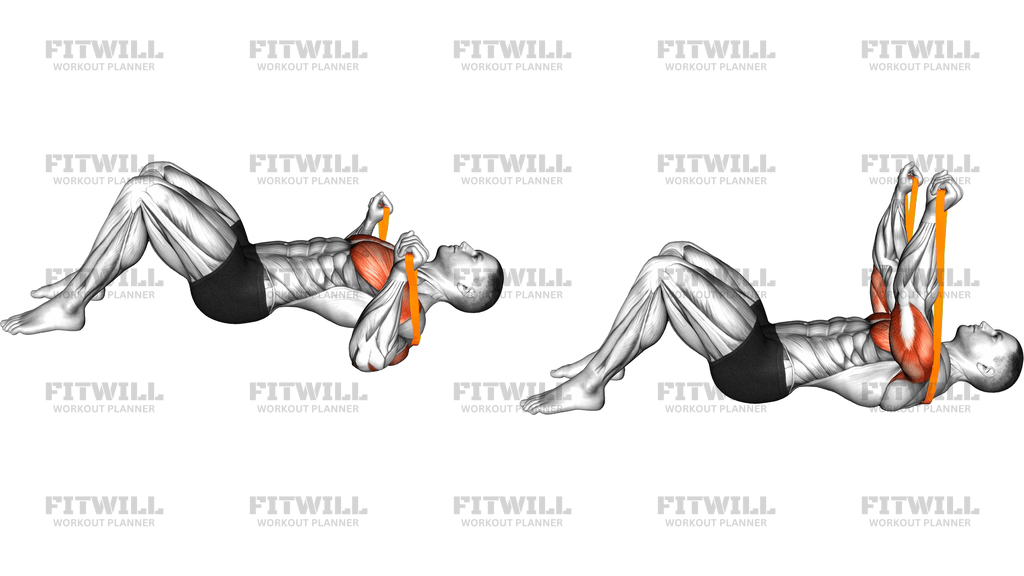
The Resistance Band Lying Floor Chest Press is a horizontal pressing exercise performed on the floor with a resistance band looped around your upper back and held in both hands. You lie on your back with knees bent, hands at chest level, and press the band straight up until your arms extend over your chest, then lower with control. Because the band anchors against your own back rather than a bench or machine, the setup travels with you and works in almost any space with enough room to lie down.
This movement suits home lifters, beginners learning the pressing pattern, and anyone who wants chest work without a bench or free weights. It is also a practical option for deload weeks, hotel workouts, and rehab-friendly training where a lighter, more accommodating load is useful. Unlike a barbell or dumbbell press, the band's tension rises as you press upward, so the hardest part of each rep is near lockout rather than at the bottom.
The primary muscles worked are the pectorals across the chest, with the triceps extending the elbows and the front shoulders assisting the press. Your shoulder blades stay pinned against the floor, which trains the ability to hold a stable scapular position while the arms move — the same skill that supports heavier bench pressing later. The floor also provides a natural safety stop: if the band slips or fatigue hits, your elbows simply rest on the ground.
Setup matters more than it looks. The band must sit across the top of your back and under both shoulder blades, with equal length on each side so both arms receive the same tension. Grip width should place your hands roughly above your elbows when your upper arms rest on the floor. If the band is too low on your back or the hands drift unevenly, one side will do more work and the pressing path will twist.
To execute it well, press the band toward the ceiling until the arms are extended over the mid-chest, keeping wrists straight and elbows tracking at roughly a 45-degree angle from your torso. Pause briefly at the top, then lower until your upper arms touch the floor without letting tension disappear completely. Breathing is straightforward: exhale as you press, inhale as you lower. If the band feels loose at the bottom, wrap it once more around your hands to shorten it and raise the starting tension.
The most common use cases are home chest training, warm-up activation before pressing, and high-rep finishers where the climbing band tension keeps the chest working through the whole range. Keep the lower back in contact with the floor rather than arching into a bridge, and choose a band resistance you can press for your target reps without the wrists collapsing backward.
[ Workout Log & Planner ]
Put your next workout in Fitwill
Keep your plan and training log ready when you are.


Instructions
- Lie on your back on the floor with your knees bent and feet flat, about hip-width apart.
- Loop the resistance band around your upper back so it sits under both shoulder blades, then pass each end through your hands and take a grip slightly wider than shoulder width.
- Bring your upper arms down to rest on the floor at roughly a 45-degree angle from your torso, elbows bent, hands positioned above your elbows at chest level.
- Check that the band tension is even on both sides and taut at the bottom position; adjust the wrap around your hands if it feels slack.
- Brace your core gently and keep your lower back in contact with the floor throughout the set.
- Press both hands straight up over your mid-chest until your arms are extended, pushing the band away from your body.
- Squeeze the chest briefly at the top without letting the band pull your shoulders off the floor.
- Lower with control until your upper arms touch the floor, keeping tension in the band rather than letting it go slack.
- Exhale as you press up and inhale as you lower down.
- Complete your reps, then release one hand at a time and carefully unwrap the band from your back.
Tips & Tricks
- If the band goes slack at the bottom of each rep, add a second wrap around your hands — a press that starts with no tension wastes the easiest portion of the range.
- Keep the band anchored under the shoulder blades, not the middle of the back; a low band position turns the movement into more of a shoulder exercise and reduces chest involvement.
- Watch for wrists bending backward at the top, which usually means the band resistance is too high; drop to a lighter band so the knuckles stay aligned over the forearms.
- Your elbows should end near the floor at the bottom but not slam into it — bouncing them off the ground removes control and jars the shoulder joints.
- If one arm drifts ahead of the other, slow the tempo and count a one-second pause at the top of every rep to force both sides to finish together.
- Keep the knees bent and feet flat instead of legs extended; this helps the lower back stay neutral and stops the hips from lifting as you press.
- Do not flare the elbows out to a full 90 degrees from the torso; the 45-degree position is friendlier to the shoulders and keeps the pressing path over the chest.
- For more resistance, widen your grip on the band or fold it to shorten its working length rather than jumping straight to a heavier band.
Frequently Asked Questions
Which muscles does the Resistance Band Lying Floor Chest Press work?
The chest is the primary muscle, with the triceps extending the elbows and the front shoulders assisting the press. The muscles that hold the shoulder blades stable also work isometrically throughout the set.
Is the Resistance Band Lying Floor Chest Press good for beginners?
Yes. The floor limits the range safely, the band load is easy to adjust, and the movement teaches the same pressing pattern and scapular stability needed for bench pressing later on.
Why does the Resistance Band Lying Floor Chest Press feel easier at the bottom than at the top?
A resistance band is slackest when your elbows are on the floor and stretches most as your arms extend, so tension peaks near lockout. Wrapping the band an extra time around your hands raises the starting tension if the bottom feels too easy.
Where exactly should the band sit during the Resistance Band Lying Floor Chest Press?
It should lie across your upper back under both shoulder blades, with equal length on each side. If it slides down toward the mid-back, one side will take over and the press will feel uneven.
Can I do the Resistance Band Lying Floor Chest Press instead of a bench press?
It is a useful substitute when no bench or weights are available, but the resistance profile is different since the band gets heavier toward lockout rather than staying constant. It works well as a stand-in or a supplement rather than an exact replacement.
How do I make the Resistance Band Lying Floor Chest Press harder without buying a new band?
Widen your grip slightly, wrap the band around your hands an extra time to shorten it, or slow the lowering phase to three or four seconds per rep. Any of these increases the demand with the same band.
Should my lower back stay flat on the floor during the Resistance Band Lying Floor Chest Press?
Keep a small natural arch with the lower back in contact with the floor and the core lightly braced. Driving the hips up into a bridge or arching hard turns it into a different movement and strains the lower back.
Is it safe if the band slips during the Resistance Band Lying Floor Chest Press?
The main risk is the band snapping back toward your face or shoulders, so keep constant tension and a secure grip on both ends. Release one hand at a time at the end of the set rather than letting go suddenly.
How many reps should I do of the Resistance Band Lying Floor Chest Press?
Bands suit moderate to higher rep ranges, so something like 10 to 20 controlled reps per set works well. If you cannot manage 10 clean reps, the band is too heavy for this position.