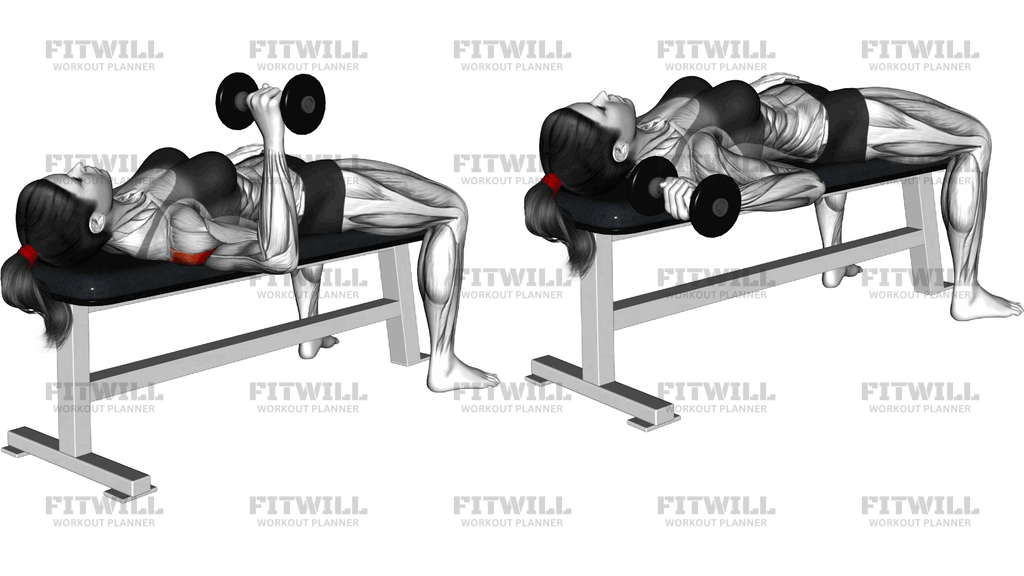
Dumbbell Lying External Shoulder Rotation
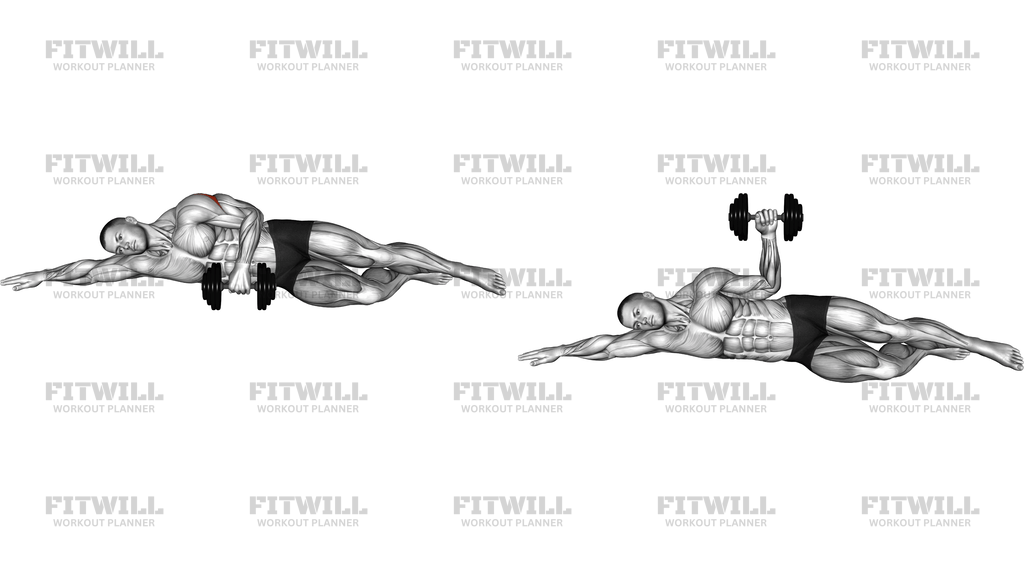
The Dumbbell Lying External Shoulder Rotation is a side-lying isolation exercise for the small muscles that rotate the upper arm outward, most notably the infraspinatus and teres minor of the rotator cuff. You lie on one side with your head supported by your bottom arm, hold a light dumbbell in the top hand, and rotate the forearm up and away from your torso while keeping the elbow pinned to your side.
This movement matters because the rotator cuff rarely gets direct work from pressing and pulling exercises, yet it is responsible for stabilizing the shoulder in nearly every upper-body lift. People rehabbing shoulder irritation, overhead athletes, and lifters who bench or press heavy all benefit from including controlled external rotation work. Because you are lying on your side, gravity pulls the dumbbell straight down, which makes the resistance rotate the arm inward, exactly the direction your cuff has to fight.
The setup is what makes or breaks this exercise. Lie on a bench or the floor on the side of the shoulder you are not training, rest your head on your extended lower arm or a small pad, and place a folded towel between your top arm and ribs. Your top elbow should be bent to roughly 90 degrees and stay pressed against the towel so the upper arm never drifts. Hold a light dumbbell with a neutral, comfortable grip, forearm angled down across your stomach at the start.
To perform the rep, exhale and rotate your forearm upward, pivoting only at the shoulder until your forearm points toward the ceiling or as far as your elbow allows without lifting off your side. Pause briefly at the top, then lower the dumbbell under control over two to three seconds back to the starting position across your waist. The lifting range on this exercise is short, often under 90 degrees, and that is completely normal.
Use very light weight. A pair of socks weighs more than the load most people need on this movement, and ego lifting here almost always turns the exercise into a sloppy side raise that trains the wrong muscles. Start with one to three pounds, or even just the smallest plate you own, and progress by adding reps before adding weight.
This is a low-fatigue, high-value accessory that fits well as a warm-up before pressing days or as a finisher after pulling work. Two to three sets of ten to fifteen slow reps per side is a sensible dose, and stopping a set when the rotation slows down matters more than hitting a rep target.
[ Workout Log & Planner ]
Put your next workout in Fitwill
Keep your plan and training log ready when you are.


Instructions
- Lie on your side on a bench or the floor with the shoulder you are not training underneath you, and extend your bottom arm along the floor so you can rest your head on it.
- Hold a light dumbbell in your top hand with a comfortable neutral grip, bend your top elbow to about 90 degrees, and rest your upper arm against your side with a folded towel tucked between arm and ribs.
- Start with your forearm angled down across your stomach so the dumbbell hangs near your waist.
- Brace your core lightly and keep your torso square so your shoulders stay stacked and your hips do not roll backward.
- Keeping your elbow glued to your side, rotate your forearm up and away from your body, pivoting only at the shoulder, until your forearm is vertical or you reach your comfortable end range.
- Hold the top position for a one-count and squeeze the back of your shoulder without shrugging.
- Lower the dumbbell slowly over two to three seconds until your forearm returns across your waist, resisting the weight the whole way down.
- Exhale as you rotate up and inhale as you lower the weight back to the start.
- Complete all reps on one side, then set the dumbbell down, switch sides, and repeat on the other arm.
Tips & Tricks
- If your elbow lifts off your ribs, the weight is too heavy or you are rushing; slide a folded towel between arm and torso as a physical reminder to keep contact.
- A rolling torso is the most common fault in this position. Press your bottom hip slightly forward and keep your shoulders stacked to stop the body from rotating instead of the arm.
- Do not let the wrist curl the dumbbell up. Keep your wrist straight and neutral so the rotation comes from the shoulder, not a flick of the forearm.
- Stop the range where your forearm reaches vertical. Forcing the forearm past that point while side-lying usually just rolls the shoulder blade backward and takes tension off the rotator cuff.
- If even a very light dumbbell feels too heavy, do the first sets with no weight at all and perfect the arc before adding load.
- Keep your neck relaxed on your bottom arm. Craning the head to watch the dumbbell strains the neck and pulls your torso out of position.
- Slow down the lowering phase rather than adding weight. The rotator cuff responds well to a deliberate two to three second return.
- Warm the shoulder up with a few bodyweight arm circles or band pull-aparts before your first set so the first rep is not done cold.
- Place the dumbbell down gently at the end of the set. Dropping it while you are side-lying can roll your wrist or shoulder into an awkward position.
Frequently Asked Questions
Which muscles does the Dumbbell Lying External Shoulder Rotation work?
It primarily targets the infraspinatus and teres minor, the external rotators of the rotator cuff, with support from the posterior deltoid and the muscles that steady the shoulder blade. The forearm and grip simply hold the dumbbell and do little of the work.
Why lie on my side instead of doing external rotation standing?
Side-lying puts the arm against gravity at the exact angle where external rotation is weakest, so the cuff gets direct resistance without momentum or compensation. Standing versions let the elbow drift and the torso rotate, which hides the work.
How heavy should the dumbbell be for the Dumbbell Lying External Shoulder Rotation?
Start with one to three pounds, or even no weight on your first sessions. If you cannot complete ten slow reps without your elbow leaving your side, the load is too heavy.
Should my elbow stay bent at 90 degrees the whole time?
Yes, the bend stays fixed and the movement happens purely at the shoulder. If your elbow angle changes, your forearm muscles are curling the weight instead of your rotator cuff rotating it.
How far should I rotate my forearm up?
Rotate until your forearm is roughly vertical or until your elbow starts to lift off your torso, whichever comes first. The range is short by design, and chasing extra rotation usually just rolls the shoulder blade.
Can beginners do the Dumbbell Lying External Shoulder Rotation?
Yes, and it is one of the safest places to start direct shoulder work because the body is fully supported and the load is tiny. Beginners should master the arc without weight for a week or two before picking up a dumbbell.
What can I use if I do not have a dumbbell?
A light resistance band anchored at waist height while lying on your side, or a small cable handle set low, replicates the same rotation path. A soup can or small water bottle works in a pinch for the same side-lying setup.
How many sets and reps should I do?
Two to three sets of ten to fifteen slow reps per side works well, either as a warm-up before pressing or as a finisher after pulling. Quality of the controlled return matters more than the rep count.
Is this exercise safe if my shoulder hurts during pressing?
External rotation work is commonly used to build tolerance in the shoulder, but pain during any movement is a signal to stop and get assessed by a qualified professional. Never push through sharp pain, and start with bodyweight-only reps to test tolerance.