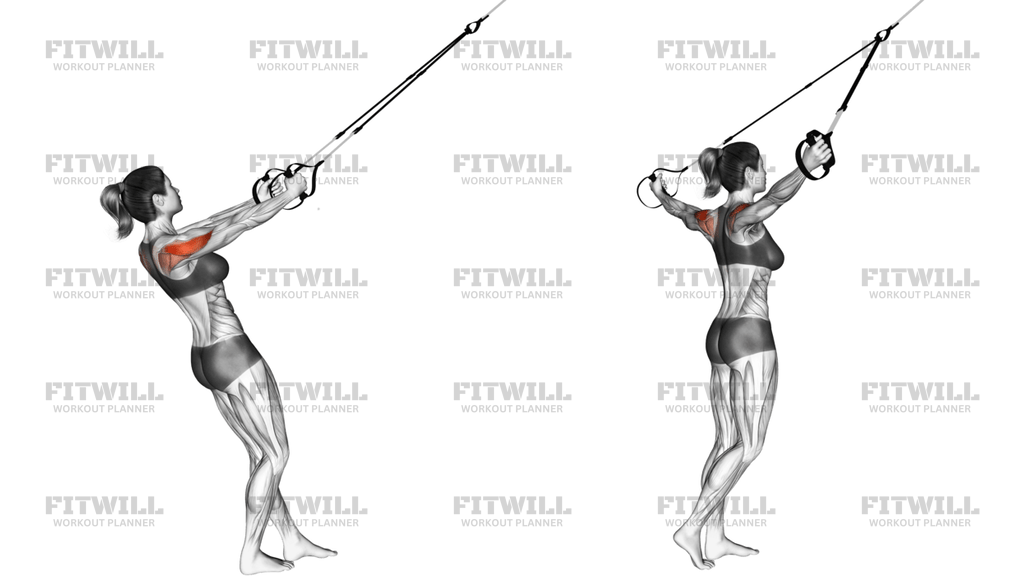
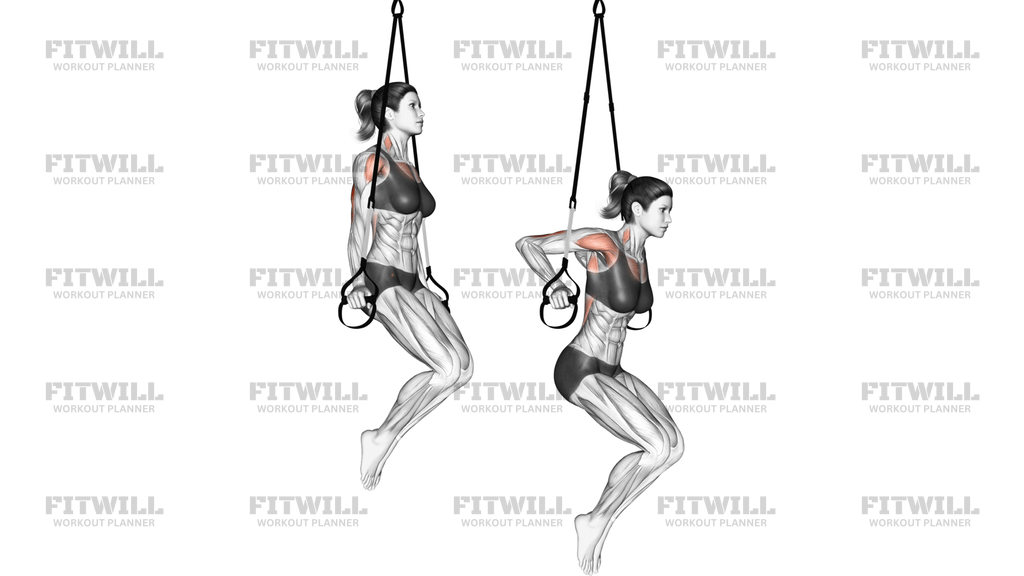
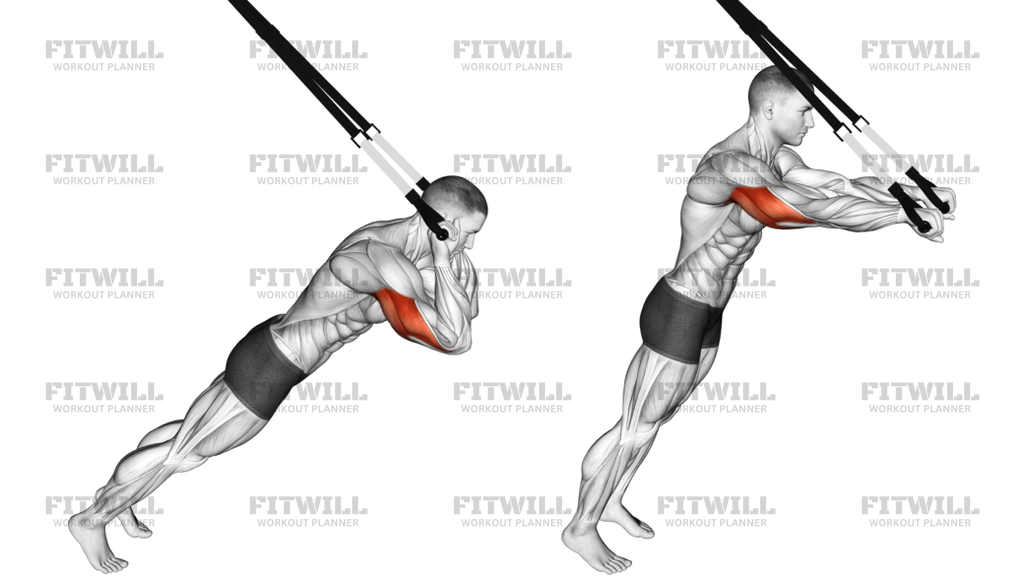
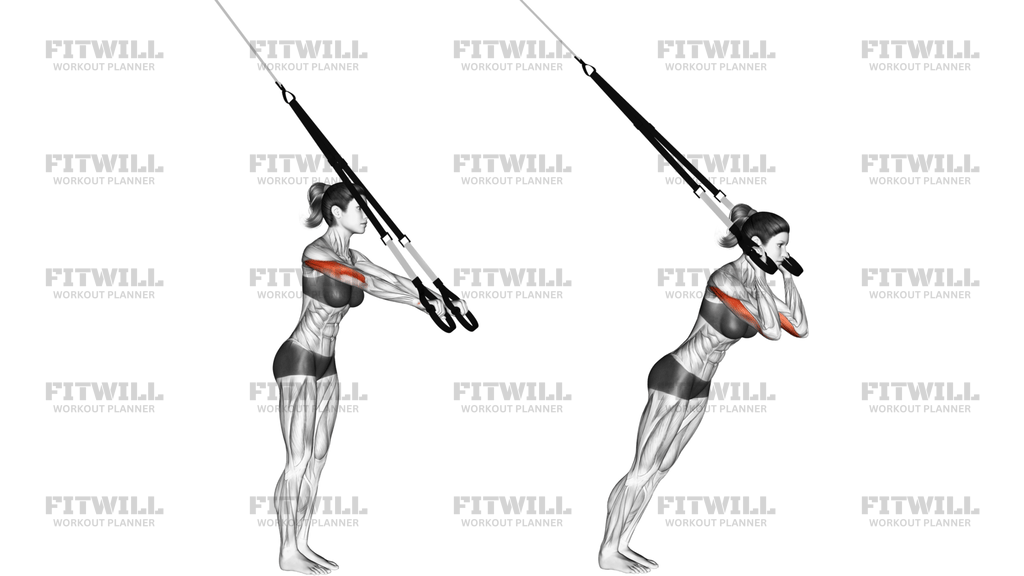
Suspender Triceps Press
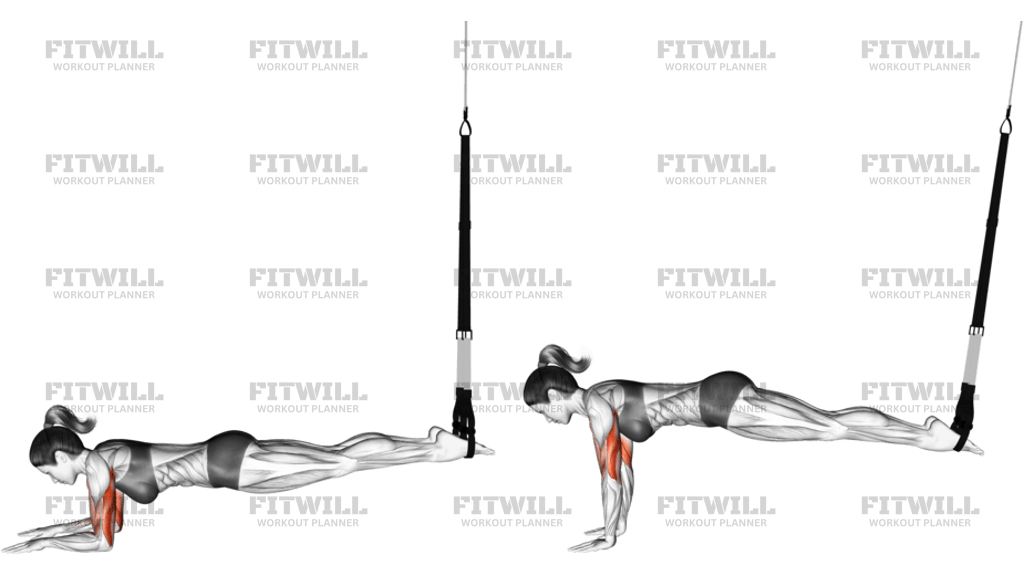
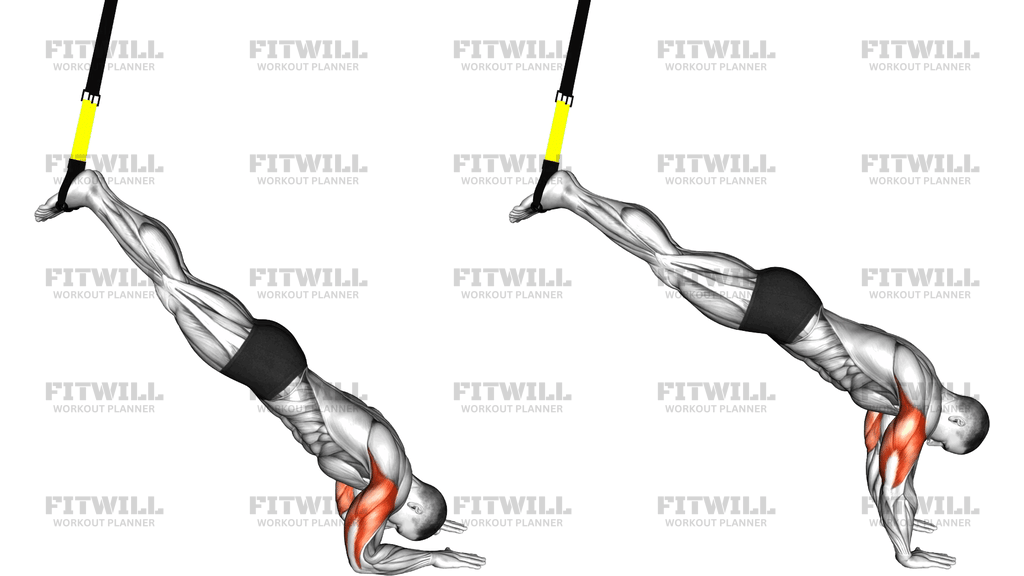
The Suspender Triceps Press is a bodyweight pressing exercise performed with your feet suspended in a stability trainer's straps while your hands stay planted on the floor. From this inverted plank position, you bend your elbows to lower your head and shoulders toward your hands, then press back up to straight arms. It works much like a skull crusher or close-grip push-up, but your own bodyweight provides the resistance and the hanging feet add an instability challenge that a bench version cannot replicate.
Because the straps support your feet rather than the floor, your core has to work overtime to keep your hips from sagging or piking. The triceps do the main work of extending the elbows, while the front shoulders and chest assist the press and the abs, obliques, and even the leg muscles stabilize the swinging, suspended lower body. This makes it a genuinely demanding compound movement despite requiring no external load.
This exercise suits intermediate to advanced trainees who already own solid plank and push-up strength. It is a popular choice in suspension training programs because it targets the often-neglected long head of the triceps through a long range of motion, and it scales easily: walking your feet back toward the anchor point reduces the load, while walking your hands further under your body increases it.
Setup details matter more here than in most triceps work. The strap height, your hand position, and the angle of your body all determine how much weight sits on your elbows and shoulders. Hands should be roughly shoulder-width or slightly narrower, directly under your shoulders at the start, with your body forming one long line from head to heels. If your hands drift forward or your hips drop, the movement shifts away from the triceps and stresses the lower back and shoulders instead.
Execution should be slow and controlled. Lower by bending the elbows and letting your head travel forward and down between or just past your hands, keeping them tight to your ribs rather than flaring wide. Press back up by driving the floor away until the arms are straight without locking them hard. Exhale on the press, inhale on the descent, and keep your neck neutral throughout.
The most common use cases are home and gym suspension circuits, triceps-focused finishers, and bodyweight upper body days when pressing strength is the goal. Check the straps and anchors before every set, keep the movement within a range your elbows tolerate comfortably, and stop the set the moment your hips begin to sag, since that is the clearest sign the core has given out before the triceps have.
[ Workout Log & Planner ]
Put your next workout in Fitwill
Keep your plan and training log ready when you are.


Instructions
- Anchor the suspension trainer to a secure overhead point and adjust the straps to roughly mid-calf or knee height.
- Kneel facing away from the anchor, place both feet into the straps so the cradles sit around your midfoot or ankles, then walk your hands out until your body forms a plank with hands under your shoulders.
- Set your hands about shoulder-width apart or slightly narrower, fingers spread, with your elbows pointing back toward your hips, not out to the sides.
- Brace your abs and squeeze your glutes so your body forms one straight line from head to heels; look down at the floor to keep your neck neutral.
- Inhale and bend your elbows, lowering your head and chest down between your hands while your elbows stay close to your ribs.
- Descend until your forearms are near parallel to the floor or your head is just above your hands, whichever your elbows and shoulders allow with control.
- Exhale and press the floor away, extending your elbows fully without snapping them into a hard lockout.
- Keep your hips level as you press; if they sag toward the floor or pike toward the ceiling, shorten the range or reduce the body angle.
- Complete the rep, pause briefly at the top to re-establish your plank line, then begin the next repetition.
- When finished, walk your hands back toward your feet, step out of the straps one foot at a time, and stand up carefully.
Tips & Tricks
- The most common mistake is flaring the elbows out wide, which turns the set into a shoulder-dominant pressing pattern; cue your elbows to trace back toward your hips so the triceps stay in the driver's seat.
- If your head crashes toward the floor and you lose tension at the bottom, you are descending too far for your current strength; stop a few inches higher and build the range gradually.
- Sagging hips usually appear on rep four or five, not rep one; end the set as soon as your lower back starts to arch instead of pushing through a broken position.
- Shorten the lever by walking your hands back closer to the anchor point if the full version is too heavy, or elevate your hands slightly on a low step to reduce the load.
- Press your fingertips into the floor and slightly grip it to protect your wrists, which take a lot of load in this extended plank position.
- The straps can swing side to side as you press; squeeze your legs together and brace your inner thighs to keep the cradles stable under your feet.
- Do not hold your breath at the bottom, which is where tension is highest; a sharp exhale on the way up helps you drive through the sticking point.
- Warm up your elbows and wrists with a few standard push-ups or plank holds first, since cold straight-arm pressing on the floor is hard on the joints.
- If the floor is abrasive on your palms, use thin gloves or a mat under your hands rather than shifting your weight to your wrists to avoid the discomfort.
Frequently Asked Questions
Which muscles does the Suspender Triceps Press work the hardest?
The triceps are the primary mover, especially the long head as the elbows extend under load. The abs, front shoulders, and chest work hard in a supporting role to stabilize the plank and assist the press.
Is the Suspender Triceps Press suitable for beginners?
It is quite demanding because your full bodyweight loads the arms while the core fights the unstable straps. Beginners should start with floor triceps push-ups or a steeper body angle, such as hands elevated on a bench, before progressing to the suspended version.
How high should I set the suspension straps for this exercise?
Roughly mid-calf to knee height works for most people. Lower straps create a longer, harder lever, so start higher and lower them only as your pressing strength and core control improve.
Why do my shoulders feel the Suspender Triceps Press more than my arms?
This usually means your elbows are flaring outward or your hands are set too wide, shifting the work to the front delts. Narrow your grip slightly and deliberately drive your elbows back toward your hips as you lower.
Can I replace skull crushers with the Suspender Triceps Press?
Yes, it trains a very similar elbow-extension pattern and hits the long head of the triceps well. The main difference is that the load comes from your bodyweight and the instability of the straps rather than a barbell or dumbbell.
How many reps should I aim for with the Suspender Triceps Press?
Because the resistance is fixed by your body angle, aim for sets of 6 to 12 quality reps and adjust the difficulty by moving your hands closer to or further from the anchor. Stop the set when your hips sag or your elbows flare, not just when the arms fatigue.
My lower back aches during this exercise. What should I change?
Back discomfort almost always signals a sagging pelvis, so re-brace your abs and squeeze your glutes before every rep. If it persists, reduce the range of motion or progress back to a less demanding angle until your core endurance catches up.
Is it safe to lock out my elbows at the top of the press?
Full extension is fine and actually completes the triceps contraction, but avoid snapping into a violent lockout, especially when tired. Extend with control and keep light tension in the arm at the top.
What can I use instead of a suspension trainer for this movement?
Close-grip push-ups, feet-elevated triceps push-ups, or a bar in a rack set up for bodyweight triceps extensions all train the same pattern. The suspended version is simply harder because the feet are unstable, so expect the other options to feel slightly easier at the same body angle.