Seated To Intense Plantar Flexion
Seated To Intense Plantar Flexion is a bodyweight stretch that starts from a tall kneeling position and finishes with you sitting back onto your heels while your toes stay tucked under. That tucked-foot position drives the ankles into deep plantar flexion and puts a strong, focused stretch across the tops of the feet, the front of the shins, and—because the knees fold completely closed—the quadriceps. It is one of the few simple ways to load the ankle into end-range plantar flexion without any equipment at all.
This stretch earns its place in a routine for anyone whose ankles and feet live in stiff, slightly dorsiflexed positions all day: runners who hammer the shins with thousands of toe-offs, lifters working toward a deep squat, martial artists and dancers who need mobile feet for kneeling and pointing positions, and anyone who gets tightness across the top of the foot or front of the shin after training. The full knee closure also gives the quads, especially rectus femoris, a long, steady stretch that is hard to isolate with standing variations.
Setup matters more here than in most stretches because a lot of your bodyweight ends up concentrated on a very small contact area—the pads of your toes and the balls of your feet. Kneel on a mat or other padded surface, tuck the toes fully under so the soles of the toes press into the floor, and place your hands on the floor just behind your hips. Those hands are your throttle: the more weight you allow to sink back through the arms, the gentler the stretch; the more you release the arms and sit tall, the more intense it becomes.
To execute it well, shift your hips back slowly and let them settle onto your heels rather than dropping down. Keep your torso upright to start, and only lean back onto your hands if you want to deepen the pressure through the feet. Breathe steadily and let the tissue ease open over 20 to 45 seconds instead of forcing the position. Toe cramping is common the first few sessions—ease your weight back onto your hands until it passes, then gradually transfer more load onto the feet over time.
A few practical safety points: keep the movement pain-free in the toes, ankles, and kneecaps; a strong stretch sensation is fine, sharp or pinching pain is not. If your quadriceps or kneecaps complain about the fully closed knee angle, sit slightly higher or place a rolled towel in the knee crease to open the angle a few degrees. Because the stretch is concentrated, one to three controlled holds per side—done here with both legs together—is usually plenty, either after training or as a standalone foot and ankle mobility session.
[ Workout Log & Planner ]
Put your next workout in Fitwill
Keep your plan and training log ready when you are.


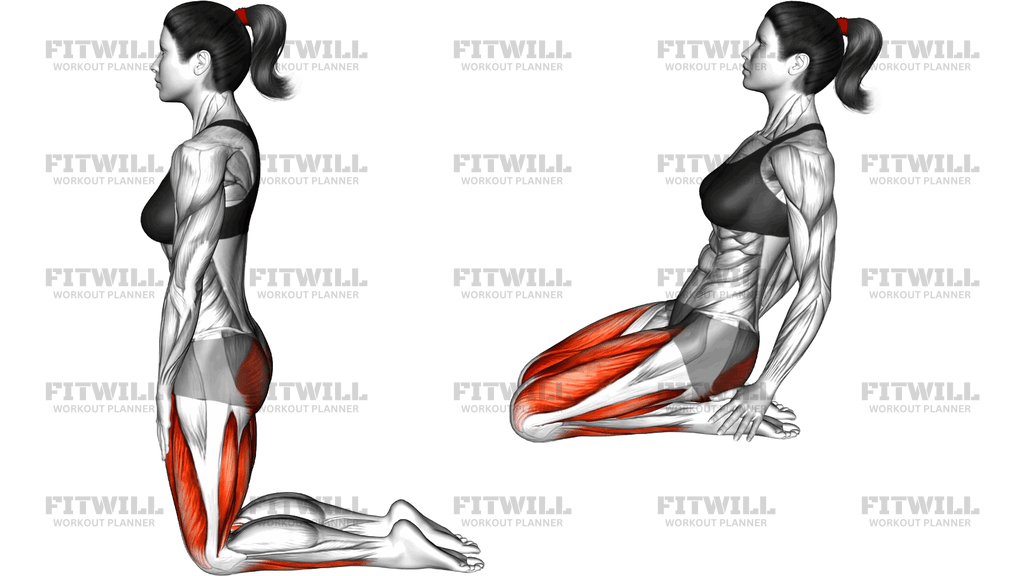
Instructions
- Kneel on an exercise mat with your knees about hip-width apart and your torso tall, shoulders relaxed over your hips.
- Tuck your toes under so the pads of your toes and the balls of your feet press flat into the floor and your heels point up behind you.
- Place your palms on the mat just behind your hips, fingers pointing backward, so you can support part of your bodyweight through your arms.
- Brace your trunk lightly and keep your neck long, looking straight ahead rather than down at your feet.
- Slowly shift your hips back toward your heels, letting the ankles fold into plantar flexion as the toes take more load.
- Continue lowering until your buttocks rest on your heels, using your hands to control how much weight sinks into the feet.
- At the end position, hold with steady breathing—inhale through the nose, exhale slowly, and let the tops of the feet and shins release a little more with each breath.
- To come out, push through your palms to lift some weight off the feet, lean your torso forward, and let your hips rise off the heels.
- Untuck the toes, shake out the feet briefly, and reset your kneeling position before repeating the hold.
Tips & Tricks
- Toe cramping is the most common problem in this stretch. It usually means too much weight is on the feet too soon—press into your hands to shift load off the toes, and only hand the weight back gradually as they adapt.
- If you feel a pinching sensation under the kneecap in the fully seated position, slide a rolled towel into the back of the knee crease or sit slightly higher so the knee angle opens a few degrees.
- Do not bounce at the bottom. Rocking up and down drives force through the toe joints in a way they do not tolerate well; hold still and let the tissue lengthen on its own.
- Keep your heels stacked directly under your sit bones. Allowing the heels to splay outward twists the knees and shifts the stretch away from the ankles.
- Your hands are the intensity dial: upright torso with light hand support is the beginner version, and leaning back so more bodyweight passes through the toes is the advanced version.
- If the tops of your feet are too sensitive to tolerate the tucked position even with hand support, start with one foot tucked and the other leg forward in a half-kneeling version, then progress to both.
- Breathe continuously through the hold. Holding your breath tightens the whole leg and shortens the stretch you are trying to create.
- Come out of the stretch under control rather than collapsing forward. Pushing through the hands protects the toes from a sudden release of load.
- Warm feet stretch better—do this after training or a short walk rather than first thing in the morning when the toe joints feel stiff and cranky.
Frequently Asked Questions
What does Seated To Intense Plantar Flexion stretch?
It primarily stretches the tops of the feet, the toe extensors, and the tibialis anterior along the front of the shin by pushing the ankles into deep plantar flexion, while the fully closed knee also lengthens the quadriceps.
Why are the toes tucked under instead of the tops of the feet flat on the floor?
Tucking the toes bends the toe joints backward as well as the ankle, which extends the stretch into the toe pads and arches. With the tops of the feet flat, the ankle gets some stretch but the toes get almost none.
Is Seated To Intense Plantar Flexion suitable for beginners?
Yes, as long as you keep your hands on the floor behind you and let them carry a good share of your weight. Beginners should start with shorter holds of 15 to 20 seconds and only gradually sit heavier onto the feet.
My toes cramp every time I sit back onto my heels—what should I change?
Cramping means the toe joints are taking more load than they are used to. Press into your hands to offload the feet, breathe through it, and return more weight to the toes only as the cramping fades over repeated sessions.
How long should I hold the Seated To Intense Plantar Flexion position?
Twenty to forty-five seconds per hold works well, repeated two to three times. Because the stretch is quite concentrated, longer is not automatically better—stop when the sensation stops easing.
Can this stretch help with squat depth?
It can contribute. Deep squats need comfortable plantar flexion at the ankle and toe end range so the heels and forefoot can stay loaded, and regularly working the feet into this tucked position improves that tolerance.
Is it normal to feel this in the quadriceps as well as the feet?
Yes. Sitting on the heels closes the knee completely, which puts the quads on a long stretch at the same time the ankles are in plantar flexion, so both areas commonly report the sensation.
What can I use instead if kneeling hurts my knees?
Place a folded mat or pad under the knees and a rolled towel in the knee crease to open the angle slightly. If kneeling is still uncomfortable, a standing version with one foot tucked and the toes pressed into the floor offers a similar ankle stretch with much less knee flexion.
When is the best time to do Seated To Intense Plantar Flexion?
It fits best after running, lifting, or a walk, when the feet and ankles are warm. Doing it cold, especially first thing in the morning, makes the toe joints more likely to complain.
Are there any warning signs I should stop for?
Stop or reduce the intensity if you feel sharp pain, pinching in the kneecap, or numbness and tingling in the toes. A deep stretch feeling is the goal; anything electric, stabbing, or rapidly worsening is not.