Burpee With Push Up (Version 2)
The Burpee With Push Up (Version 2) is a full-body movement that combines a squat, a hands-down transition to the floor, a full push up, and a return to standing. Unlike stripped-down burpees that skip the floor contact, this version forces you to press your chest through a complete push up every rep, which turns a conditioning drill into a genuine upper-body strength challenge as well. It requires no equipment beyond floor space, making it one of the most efficient body weight movements available when you want to raise your heart rate and load your pressing muscles at the same time.
The demand here is spread across the whole body. The push up portion works the chest, triceps, and shoulders, while the squat and jump phases drive the quads, glutes, hamstrings, and calves. Holding a rigid plank position as you kick out and back in keeps the core and hip flexors under continuous tension. Because each rep moves you from standing to the floor and back, your heart and lungs work hard throughout, which is why this exercise shows up so often in conditioning circuits, bootcamp classes, and military-style training.
The setup matters more than most people assume. Your hand placement on the floor determines whether the push up is clean or sloppy. Plant your hands roughly shoulder-width apart, directly under your shoulders, before you kick your feet back. If your hands land too far forward or too wide, the push up turns into a strained, partial press with your elbows flared and your lower back sagging. Taking a half-second to set your hands each rep is what separates a productive burpee from a rushed one.
Execution should be rhythmic but not frantic. Squat down, place your hands flat on the floor, kick your feet back into a straight plank, lower your chest to the floor in a controlled push up, press back up to the plank, jump your feet forward to a low squat, and stand or jump up to finish the rep. The most common breakdown point is the plank: letting the hips drop or the head poke forward as the feet kick back. Brace your abs as if bracing for a light punch and keep one straight line from shoulders to heels.
This movement suits intermediate trainees who already own a solid push up and a comfortable body weight squat. Beginners can still benefit by stepping the feet back and forward instead of jumping, or by performing the push up from the knees once in the plank position. Because the exercise cycles through so many positions, treat quality of reps as the priority over speed. Five crisp burpees with full push ups deliver more training value than ten sloppy ones, and they are far kinder to your wrists, shoulders, and lower back over the long run.
[ Workout Log & Planner ]
Put your next workout in Fitwill
Keep your plan and training log ready when you are.


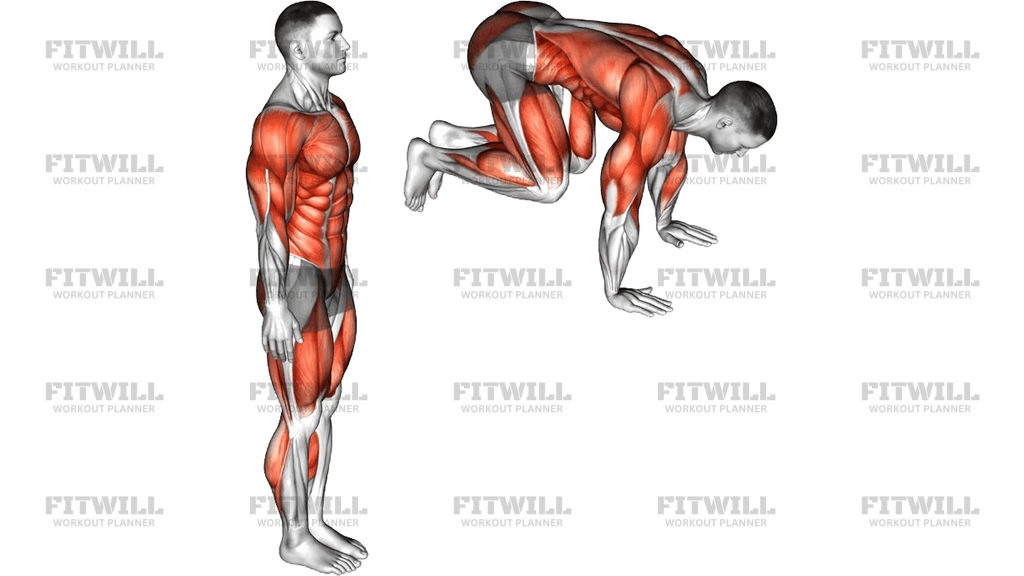
Instructions
- Stand tall with your feet about hip-width apart and your arms relaxed at your sides.
- Push your hips back and squat down until you can place both palms flat on the floor, hands about shoulder-width apart, directly below your shoulders.
- Shift your weight onto your hands and kick both feet straight back so you land in a high plank, forming one straight line from head to heels.
- Brace your abs and squeeze your glutes to lock the plank in place before you descend.
- Bend your elbows to lower your chest toward the floor, keeping your elbows at roughly a 45-degree angle to your torso, until your chest is just above or lightly touching the ground.
- Press firmly through your palms to straighten your arms and return to the plank position.
- Jump your feet forward so they land just outside or inside your hands, bringing you into a low squat with your chest up.
- Exhale as you press up from the push up and inhale as you lower; breathe steadily through the jump phases rather than holding your breath.
- Drive through your legs to stand fully upright, adding a small jump with arms overhead if you want a more intense finish to each rep.
- Reset your stance and brace briefly before starting the next rep instead of rolling straight into it.
Tips & Tricks
- If your hands slide forward when you squat down, mark a spot on the floor and aim to place your fingertips just in front of your toes so the hands end up under the shoulders.
- Sagging hips during the plank-to-push up phase are the most common fault; think about pulling your belly button up and tucking your ribs before you kick back.
- If your chest touches the floor and your hips bounce off the ground, slow the lowering phase of the push up rather than dropping the whole body at once.
- Land the foot jump softly, with bent knees, to protect your knees and ankles from the repeated impact of many reps.
- If your wrists ache, spread your fingers wide and grip the floor slightly, which reduces the extension angle at the wrist joint.
- Piking the hips up when jumping the feet back in usually means tight hamstrings or fatigue; step the feet in one at a time instead of forcing the jump.
- Scale the movement honestly: step-back burpees with knee push ups build the same pattern without the impact, and are the right choice if form breaks down after a few reps.
- On a hard floor, a thin exercise mat under the hands makes the push up position more comfortable without destabilizing the plank.
- Cap your set when the push up starts turning into a partial press; that's the signal the upper body is done for that set, even if your legs feel fresh.
Frequently Asked Questions
Which muscles does the Burpee With Push Up (Version 2) work the most?
The push up portion primarily loads the chest, triceps, and shoulders, while the squat, kick-back, and jump phases heavily involve the quads, glutes, hamstrings, and calves. The core works isometrically the entire time you hold the plank position.
How is Burpee With Push Up (Version 2) different from a basic burpee?
A basic burpee often skips the floor press, so the chest and arms only work to hold the plank. This version adds a full push up in every rep, which adds significant upper-body strength work to the conditioning demand.
Can beginners do the Burpee With Push Up (Version 2)?
Yes, with modifications. Step the feet back and forward instead of jumping, and perform the push up from the knees or elevate your hands on a low bench until a full-floor push up is comfortable.
Why do my hips sag when I kick back into the plank?
This usually happens when you rush the kick-back without bracing first. Squeeze your glutes and pull your abs in before your feet land, and check that your hands are under your shoulders rather than too far forward.
Should my chest actually touch the floor during the push up?
Lower until your chest is just above or lightly touching the floor, as long as you can keep your body in one straight line. If touching the floor makes your hips drop, shorten the range slightly and build up over time.
What can I use instead of the Burpee With Push Up (Version 2) if I need a lower-impact option?
A step-back burpee with a knee push up keeps the same movement pattern without jumping or full-floor pressing. A squat, walkout to plank, push up, and walk back to standing is a slower but joint-friendly substitute.
Is it safe to do high-rep sets of the Burpee With Push Up (Version 2)?
It is generally fine for healthy trainees, but form quality decides safety. Stop the set when the push up depth shortens or the plank position breaks down, since fatigued reps with sagging hips put unnecessary stress on the lower back and shoulders.
How many reps should I aim for?
Start with sets of 5 to 8 clean reps where every push up is full-depth and every plank is rigid. Add reps or sets gradually, or use time intervals such as 20 to 30 seconds of work once the movement feels automatic.
Why do my wrists hurt during this exercise?
Burpees place your wrists in extension under load twice per rep. Spread your fingers and press the base of the thumb into the floor to distribute the pressure, and consider a thin mat or push up handles if a hard surface makes it worse.