Frog Squat Into Forward Fold
Frog Squat Into Forward Fold is a bodyweight mobility flow that links two complementary positions: a deep squat with the elbows prying the knees outward, and a standing forward fold with the hands reaching to the floor. You move between them in one continuous rhythm, using the rise from the squat to pivot forward at the hips and the fold to reload into the next squat. The result is a single repetition that opens the hips, lengthens the hamstrings and lower back, and mobilizes the ankles all at once.
This movement is a favorite warm-up for leg days, deadlifts, squats, and any activity that demands deep hip flexion. It is equally useful as a standalone mobility drill for people who sit for long hours, since prolonged sitting tends to tighten the hip flexors, hamstrings, and lower back all in the same chain. Because no equipment is needed, it fits easily into home routines, gym warm-ups, and pre-run preparation.
The squat portion loads the deep hip and knee flexion positions, with the adductors, glutes, quads, and calves working to hold the bottom while the elbows gently press the knees out. The fold then reverses the demand, pulling a strong stretch through the hamstrings and along the spine as the torso hinges over straight legs. Alternating between the two positions teaches the hips to move through their full range under control rather than just holding one static stretch.
Setup matters more than speed here. Feet should be set slightly wider than shoulder width with the toes turned out a little, which gives the deep squat room and lets the elbows fit inside the knees. Moving too fast or bouncing between the two positions is the most common error; each transition should be slow enough that you can feel exactly where your range ends. If your heels lift in the squat or your hands cannot reach the floor in the fold, shorten the range slightly rather than forcing the position.
To execute it well, sink into a full squat, press the elbows against the inner knees to open the hips, then drive through the feet to stand while immediately hinging forward and sliding the hands down toward the floor. Let the head and neck relax in the fold, breathe steadily, and use the exhale to settle a little deeper. Reverse the path by planting the hands if needed, sinking the hips back and down into the squat, and repeat for a smooth set of eight to twelve repetitions. Keep the movement pain-free; a working stretch sensation is the goal, never pinching in the hips or strain in the lower back.
Fitwill
Log Workouts, Track Progress & Build Strength.
Achieve more with Fitwill: explore over 9600 exercises with images and videos, access built-in and custom workouts, perfect for both gym and home sessions, and see real results.
Start your journey. Download today!




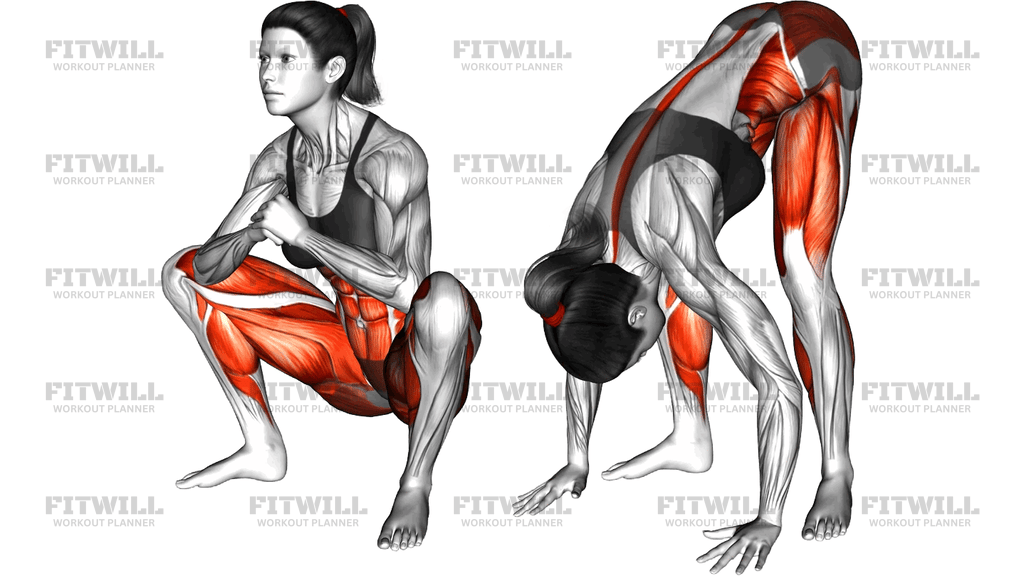
Instructions
- Stand with your feet slightly wider than shoulder width, toes turned out about 15 to 30 degrees, and no equipment required.
- Sit your hips straight down into a deep squat, keeping your chest up and your weight spread across the whole foot with heels down.
- Press your elbows against the inner sides of your knees and bring your palms together in front of your chest, gently pushing the knees outward to open the hips.
- Hold the bottom of the frog squat for a breath, feeling the adductors and glutes engage as the hips open.
- Drive through your feet to extend the legs, and as you rise, hinge forward at the hips instead of standing fully upright.
- Let your hands slide or reach down toward the floor, straightening the legs as much as your hamstrings allow, and relax your head and neck in the forward fold.
- Pause in the fold for a breath, exhaling to deepen the hamstring and lower back stretch without bouncing.
- Reverse the path by bending the knees and sinking the hips back and down, using your hands on the floor for support if needed, until you return to the deep frog squat.
- Breathe naturally throughout, inhaling on the descent into the squat and exhaling as you fold forward.
- Repeat for 8 to 12 smooth repetitions, moving slowly enough to control every transition.
Tips & Tricks
- If your heels lift off the floor in the squat, widen your stance slightly or turn your toes out more; forcing a narrow deep squat usually pushes people onto their toes.
- The most common mistake is rushing the transition and letting momentum swing you between positions; slow down until each rep takes at least four to five seconds.
- In the forward fold, hinge from the hips rather than rounding aggressively from the waist, so the stretch lands on the hamstrings instead of loading the lumbar spine.
- Do not bounce in the bottom of the fold to gain range; hold the end position and let each exhale settle you a little deeper.
- If your hands cannot reach the floor, bend your knees more during the fold rather than reaching with a rounded back; the range will improve with consistent practice.
- Use your elbows as active tools in the squat, pressing the knees out just enough to feel the inner thighs open, not shoving them into a painful stretch.
- Keep your gaze relaxed and downward in the fold; craning the neck up to look forward pulls tension into the upper back and interrupts the stretch.
- Place a mat or folded towel under your hands if you train on a hard surface, since the palms take some load in every transition.
- Stop if you feel pinching at the front of the hips in the squat or sharp pulling behind the knees in the fold; adjust the depth before continuing.
Frequently Asked Questions
What muscles does Frog Squat Into Forward Fold work?
It primarily stretches the hamstrings, inner thighs, glutes, and lower back while the deep squat position also mobilizes the hips, knees, and ankles. The quads and adductors work isometrically to hold the bottom of the squat.
Is Frog Squat Into Forward Fold a strength exercise or a stretch?
It is best treated as a mobility and stretching drill, though the deep squat portion does build isometric control in the legs. Most people use it as a dynamic warm-up rather than a strength builder.
Can beginners do Frog Squat Into Forward Fold?
Yes, as long as they reduce the range. Beginners can squat to a comfortable depth and let the hands stop at the shins or knees in the fold instead of the floor, progressing gradually as mobility improves.
Why do I have to press my elbows against my knees in the frog squat position?
Pressing the elbows inside the knees opens the hips and lengthens the inner thighs at the same time, which is what distinguishes the frog squat from a plain deep squat. It also helps keep the chest up and the spine long.
My heels lift every time I squat down. How do I fix that?
Widen your stance, turn your toes out slightly, and shift more weight toward the mid-foot. If your ankles are still tight, briefly placing a thin book or small wedge under the heels is acceptable while you work on ankle mobility.
How many repetitions of Frog Squat Into Forward Fold should I do?
Eight to twelve slow, controlled repetitions work well as a warm-up before squats, deadlifts, or running. For a dedicated mobility session, two to three sets with a brief pause in each position is a good target.
Can I substitute this movement if the deep squat is uncomfortable for my knees?
Yes. A standing good morning into a forward fold covers the hamstring and lower back portion, and a supported squat holding a doorframe or rack lets you limit the depth. Avoid pushing through knee pain in the bottom position.
Should my knees track over my toes in the frog squat?
With the toes turned out, the knees should travel roughly in line with the direction of the feet. Letting the knees collapse inward is the main fault to avoid, and the elbow press helps keep them tracking outward.
Is it safe to fold forward with straight legs?
For most people yes, provided the fold comes from the hips and stays free of pain. If you have a sensitive lower back, keep a soft bend in the knees and stop the fold at the point where the stretch feels productive rather than forced.