Seated Hamstring Side Stretch
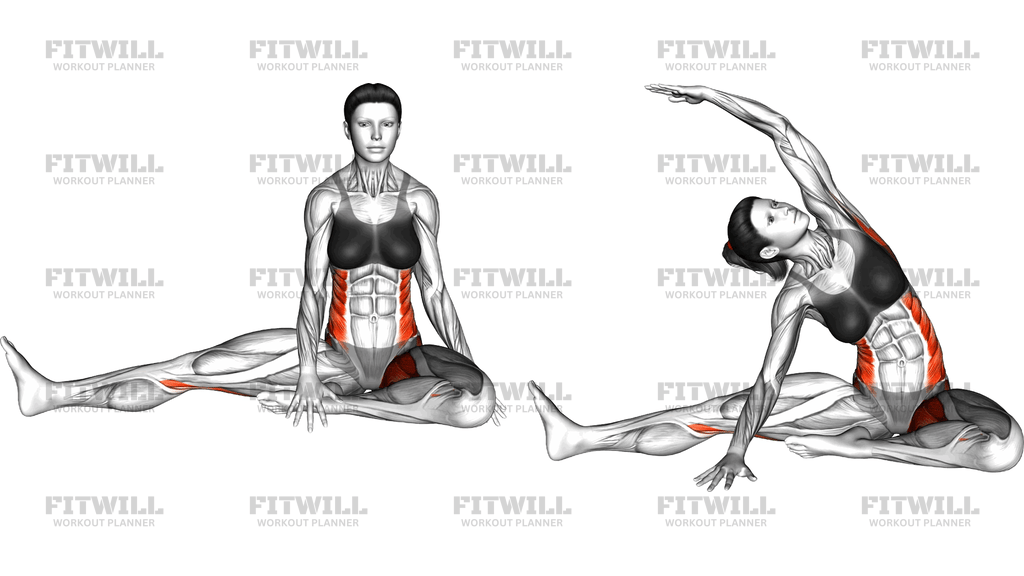
The Seated Hamstring Side Stretch is a floor-based flexibility drill that combines a wide-legged seated position with a lateral fold over one straight leg. One leg stays extended out to the side while the other knee bends, with the sole of that foot drawn in toward the inner thigh of the straight leg. From there you reach the opposite arm up and over, letting the torso tip sideways so the ribs travel toward the extended thigh.
Because the straight leg is angled out to the side rather than straight ahead, this stretch hits more than a classic seated forward fold. The hamstring of the extended leg works through a longer, rotated line, the inner thigh muscles of that same leg get pulled open, and the side waist on the top arm's side lengthens as you bend. It is a three-in-one stretch for the back of the leg, the groin, and the lateral trunk.
This movement suits anyone who sits for long hours, runners and lifters whose hamstrings and inner thighs feel chronically tight, and people building toward deeper straddle positions in yoga or mobility work. It is also a gentle way to open the side body after heavy squatting or deadlifting sessions, when the legs and trunk both feel compressed.
The setup matters more than most people expect. Sitting tall with both sit bones grounded and the extended leg truly straight sets the length of the hamstring before you ever lean. If you start slouched or with a bent knee, you stretch your lower back instead of the back of your thigh. The bent knee should rest toward the floor, and your hips should face the extended leg as squarely as your range allows.
Execution is slow and lateral. You reach the inside arm toward the extended foot, sweep the far arm overhead, and bend sideways from the ribs rather than crunching forward. The chest stays open toward the front so the stretch stays in the hamstring and side waist instead of collapsing into the spine. Hold the end position with steady breathing, then unwind slowly and switch sides.
Keep the effort at a mild to moderate pull, never sharp pain behind the knee or in the groin. Warm legs stretch better, so this fits well after training or at the end of a workout rather than as a cold first movement of the day.
Fitwill
Log Workouts, Track Progress & Build Strength.
Achieve more with Fitwill: explore over 9600 exercises with images and videos, access built-in and custom workouts, perfect for both gym and home sessions, and see real results.
Start your journey. Download today!




Instructions
- Sit on the floor with your legs in front of you, then open them and extend your left leg straight out to the left side, knee fully straight and toes pointing up.
- Bend your right knee and draw the right foot in so the sole rests against the inner left thigh, letting the right knee drop toward the floor.
- Place both hands on the floor beside your hips and sit tall, stacking your shoulders over your hips and grounding both sit bones evenly.
- Rotate your torso slightly so your chest faces the extended left leg, keeping the spine long rather than rounded.
- Inhale, slide your left hand toward your left foot, and sweep your right arm up and overhead close to your right ear.
- Exhale and bend sideways over the straight leg, reaching the right arm's fingertips toward the left toes while the left hand rests on the leg or foot where your range allows.
- Hold the end position for 20 to 40 seconds, breathing slowly and letting the stretch deepen slightly with each exhale.
- Keep both sit bones heavy on the floor throughout, and resist the urge to twist the chest down toward the floor.
- Exhale as you press through the left hand and slowly stack the torso back upright, lowering the right arm last.
- Straighten the right leg, reposition, and repeat the same sequence over the other side.
Tips & Tricks
- If your extended knee bends or the hip lifts off the floor as you fold, reduce the side bend depth; a straight knee with a smaller range beats a deep fold with a soft knee.
- Bend sideways from the ribs, not by rounding the lower back. If your chest starts facing the floor, you have drifted from a side stretch into a forward fold.
- Tight hips often make the bent knee float well above the floor. Supporting that knee on a folded towel or cushion keeps the pelvis level so the hamstring gets the stretch.
- Think of reaching long before you lean. Lengthening the top arm overhead first creates space in the side waist and makes the lateral fold smoother.
- Do not yank the extended foot toward you with the bottom hand. Let the hand rest wherever the leg naturally reaches and let time, not force, open the hamstring.
- Keep the toes of the straight leg pointing at the ceiling. If the leg rolls inward, the inner thigh takes over and the hamstring line shortens.
- If you feel a sharp pull behind the knee rather than along the back of the thigh, soften the knee a few degrees and slightly reduce the lean.
- Exhale as you fold and keep breathing in the hold. Holding your breath raises tension through the hips and trunk and fights the stretch.
- Do two to three rounds per side, with the second round typically reaching slightly deeper once the first has settled.
Frequently Asked Questions
Which muscles does the Seated Hamstring Side Stretch target?
The main target is the hamstring of the extended leg, with the inner thigh muscles of that leg and the obliques on the side you bend away from working as secondary areas. The glutes and lower back also receive a gentle lengthening.
Why does one leg stay bent with the foot against the inner thigh?
The bent-knee position tilts the pelvis slightly and rotates the torso, which lets you fold sideways over the straight leg rather than straight forward. This angle changes the stretch line through the hamstring and adds an inner thigh and side waist component a plain forward fold does not give you.
Is the Seated Hamstring Side Stretch good for beginners?
Yes, as long as you respect your current range. Beginners often cannot fold far sideways, and that is fine. Even a small lean with a tall spine and a straight knee delivers the stretch. Sitting on a folded towel to lift the hips makes the position more comfortable.
Why do I feel this more in my side waist than my hamstring?
That is common when the obliques are tight or when the chest twists toward the floor during the fold. Square your chest toward the extended leg, keep the fold purely lateral, and the emphasis should shift toward the back of the thigh.
How long should I hold the Seated Hamstring Side Stretch?
Hold 20 to 40 seconds per side for general flexibility work, or 60 to 90 seconds if you are using it as a dedicated cool-down for tight hamstrings. Two to three rounds per side works well.
What is the most common mistake in this stretch?
Collapsing forward into a rounded-spine fold instead of bending sideways. This hides the hamstring from the stretch and loads the lower back. Keep the chest open toward the extended leg and reach the top arm long overhead to stay on the lateral path.
Can I substitute this if I cannot sit on the floor comfortably?
Yes. A standing side bend over a straight leg propped on a low step or bench follows a similar stretch line, or you can do the same seated shape with your hips elevated on a cushion so the pelvis can tilt forward more easily.
Should I do the Seated Hamstring Side Stretch before or after training?
It works best after training or on its own, when the muscles are warm. Long static holds on cold hamstrings are less effective, so save it for a cool-down or an evening mobility session rather than a pre-workout warm-up.
Is it normal to feel the stretch behind the knee?
A mild pull near the knee is common because the hamstring tendons cross that joint, but sharp or pinching sensations there are a signal to back off. Soften the knee slightly and shorten the fold until the sensation moves up into the belly of the thigh.