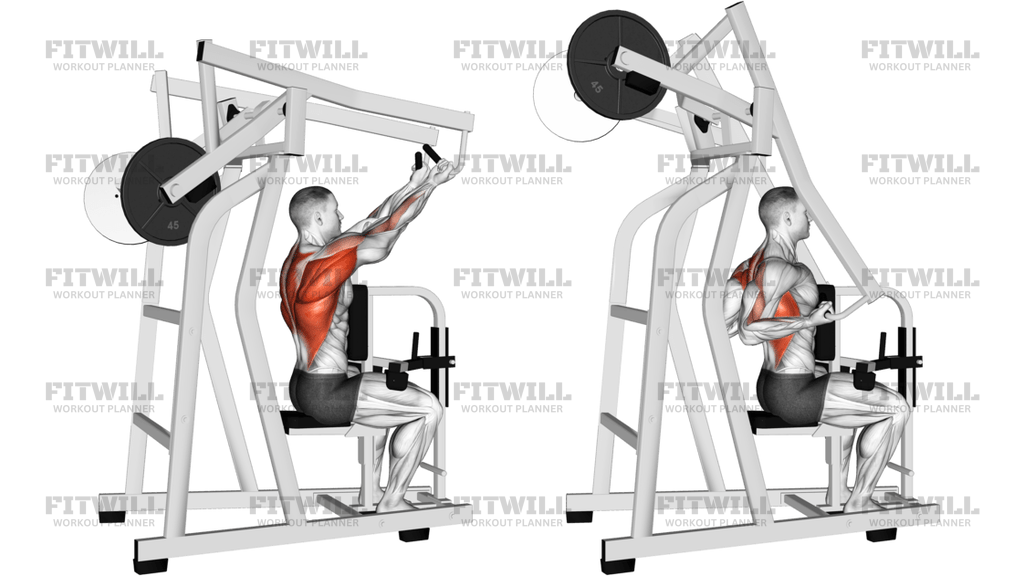
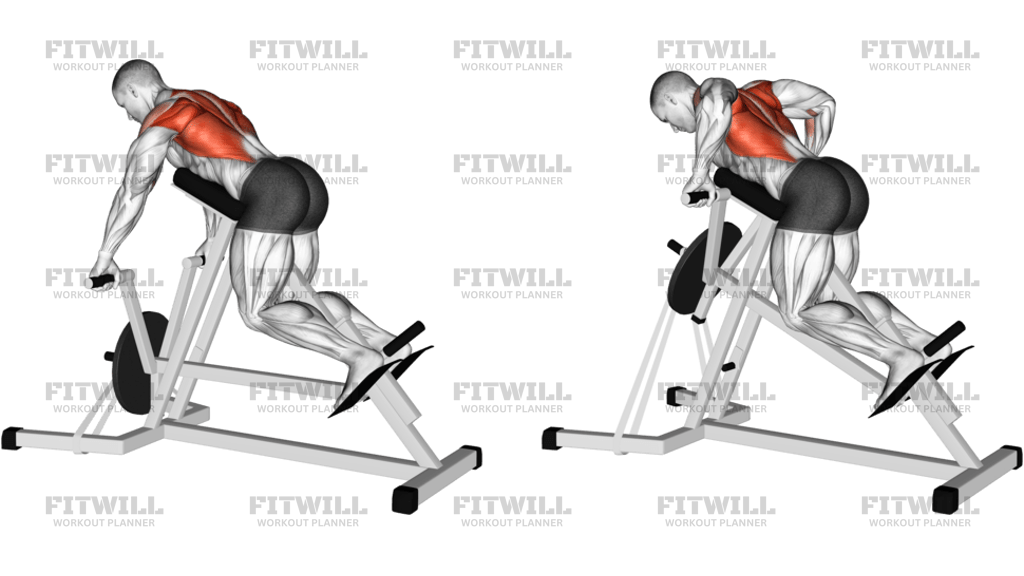
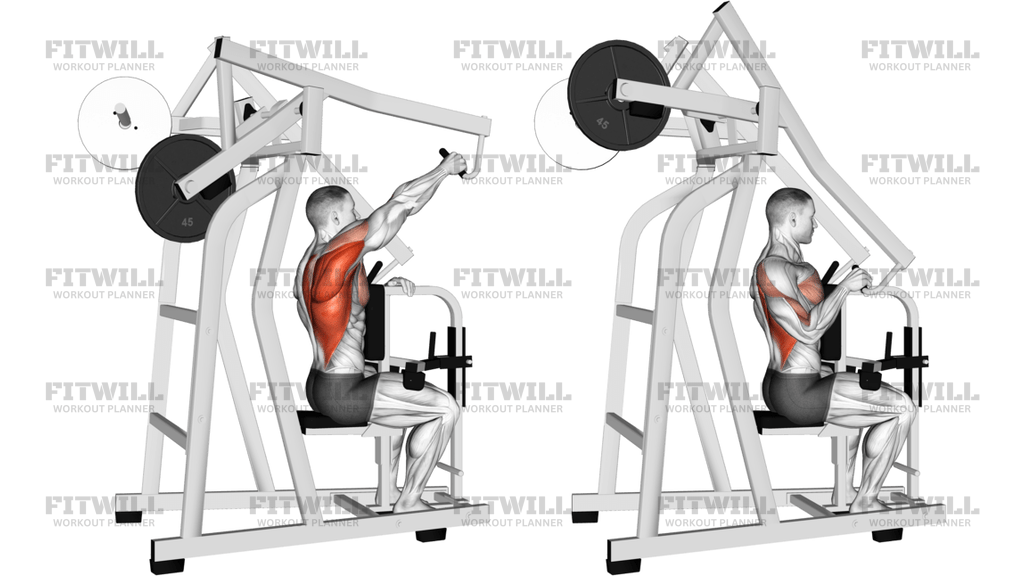
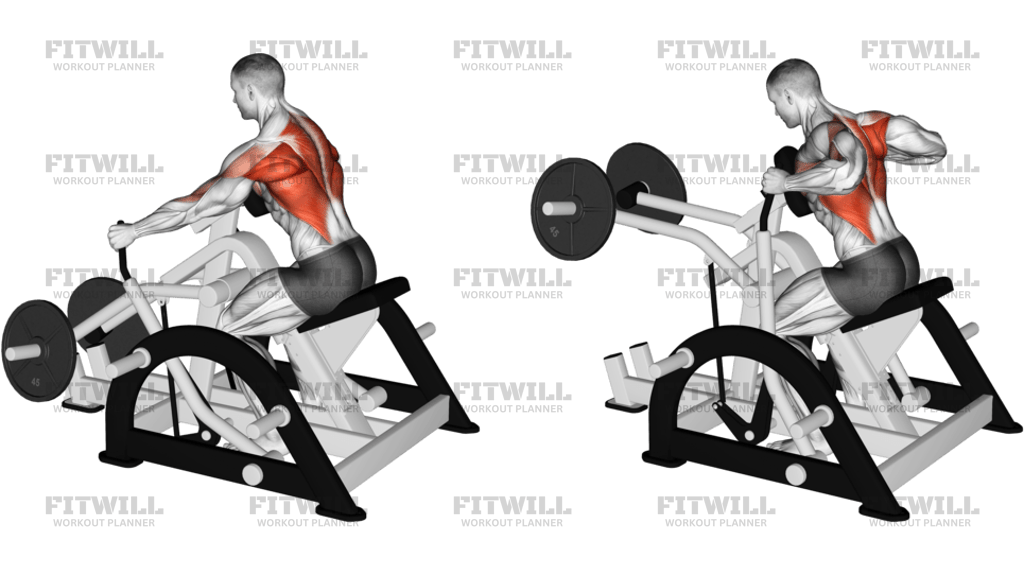
Lever Seated Single Arm Row
The Lever Seated Single Arm Row is a plate-loaded machine exercise performed one side at a time. You sit facing the machine's chest support, brace your torso against it, and pull a single handle from an extended arm position back toward your ribs. Because the resistance travels on a fixed lever path, you get the pulling benefit of a heavy row without needing to stabilize a barbell or dumbbell through the whole range.
This movement primarily targets the lats, with strong involvement from the rhomboids and mid traps as the shoulder blade retracts at the end of each pull. The biceps and rear shoulders assist, and the gripping hand and forearm work throughout. Training one arm at a time lets you focus on each side individually, which is useful for correcting side-to-side strength differences and for feeling the lat contract more clearly than you might with a two-handed row.
The setup matters more than most people think. Your chest should stay in contact with the pad, your feet planted firmly on the floor or foot pegs, and the handle height adjusted so your working arm starts roughly level with or slightly below your shoulder. If the seat is too high or the pad sits too far away, you end up leaning, shrugging, or twisting to reach the handle, and the pull loses its focus on the back.
To execute it well, think of driving your elbow back and down toward your hip rather than simply bending the arm. Pull until your hand is beside your torso, squeeze the shoulder blade back, then let the arm extend fully under control so the lat stretches at the start of each rep. The stretch at full extension and the squeeze at full contraction are where most of the value lives; rushing through either shortchanges the exercise.
It fits well as a main back builder in machine-focused programs, as a unilateral accessory after heavier barbell or dumbbell rows, or as a reintroduction to rowing for lifters coming back from time off who want a guided path and back support. Because the machine braces your torso, you can push the working muscles hard without your lower back becoming the limiting factor, which is a common complaint on bent-over rowing variations.
A few practical points: choose a weight you can pull without your shoulder hiking up toward your ear, keep your wrist neutral rather than bent back, and avoid rocking your torso off the pad to steal momentum. If you feel the work mostly in your biceps, drop the load, slow the tempo, and refocus on the elbow driving back instead of the hand pulling.
[ Workout Log & Planner ]
Put your next workout in Fitwill
Keep your plan and training log ready when you are.


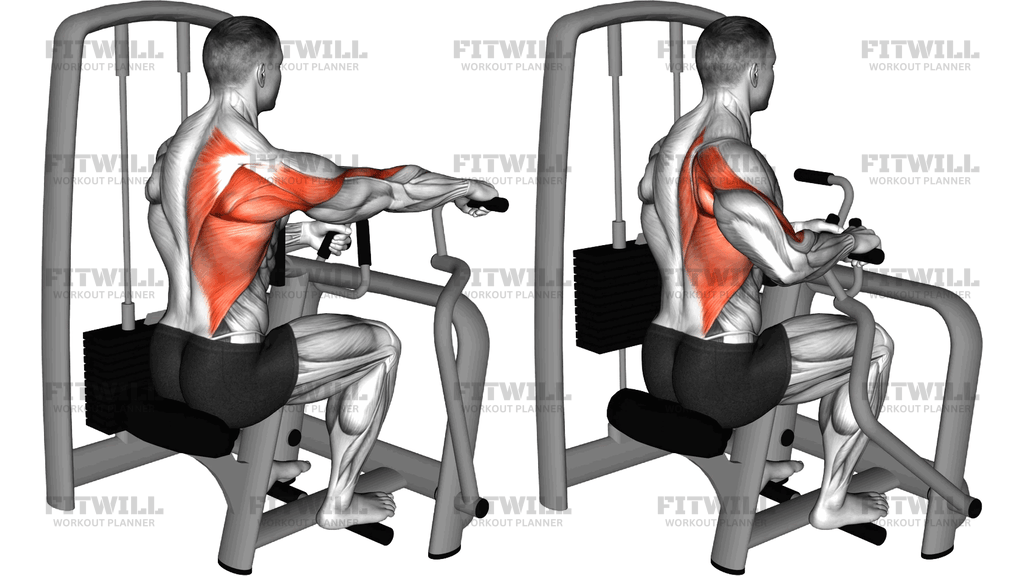
Instructions
- Sit on the machine facing the chest pad and plant both feet flat on the floor or foot pegs.
- Grip the single handle with one hand using a neutral or overhand grip, and adjust the seat so your arm starts extended with your shoulder roughly level with the handle.
- Press your chest firmly against the pad and keep your hips and both glutes in contact with the seat.
- Brace your core and set your shoulder blade down and back before initiating the pull.
- Pull the handle back toward your ribs by driving your elbow behind your torso, keeping it close to your body.
- At the end of the pull, squeeze your shoulder blade toward your spine and hold the contracted position for a brief moment.
- Slowly extend your arm forward, letting your shoulder blade reach fully forward so the lat stretches before the next rep.
- Exhale as you pull the handle back and inhale as you return it to the extended position.
- Complete all reps on one side, then reposition and perform the same number of reps with the other arm.
Tips & Tricks
- If your shoulder creeps up toward your ear during the pull, the weight is too heavy or you are leading with the trap; lighten the load and think about keeping the shoulder down.
- A common mistake on this machine is letting the chest peel off the pad as fatigue builds. If the pad loses contact, end the set rather than turning the row into a torso twist.
- Pull to your lower ribs or hip line rather than up toward your armpit to keep the emphasis on the lats instead of the upper traps.
- Stop the rep just short of a hard lockout at full extension if your shoulder feels pinched at the front; a long but comfortable stretch is enough.
- Keep your wrist straight in line with your forearm. Bending the wrist back under load shifts tension to the forearm and irritates the elbow over time.
- Do the weaker or less coordinated arm first and match its reps with the stronger side rather than working to the stronger arm's limit.
- Control the return for two to three seconds. On a lever machine the weight stack drops quickly, and letting it slam out of your hand robs you of the stretching half of the rep.
- If you feel this mostly in your biceps, slow down and start each pull from the shoulder blade instead of yanking with the arm.
Frequently Asked Questions
Which muscles does the Lever Seated Single Arm Row work?
The lats are the primary movers, supported by the rhomboids and mid traps as the shoulder blade retracts. The biceps, rear shoulders, and forearms assist throughout the pull.
Is the Lever Seated Single Arm Row good for beginners?
Yes. The fixed lever path and chest pad remove much of the balance and lower back demand of free-weight rows, so beginners can learn the rowing pattern with immediate feedback on torso position.
Why train one arm at a time instead of using both handles?
Unilateral reps expose and help correct side-to-side strength differences, and pulling with a single arm lets you concentrate on feeling the lat on that side. You can also use a slightly longer range since there is no opposite arm in the way.
Should my chest stay on the pad during the entire set?
Yes, that is the point of the setup. If your chest leaves the pad, momentum and torso rotation are taking work away from your back, so reduce the weight until you can stay planted.
Where should I pull the handle toward on my body?
Toward your lower ribs or hip to bias the lats. Pulling higher toward your chest shifts more work to the upper back and traps, which is fine if that is your goal, but be deliberate about the target.
How does this compare to a single-arm dumbbell row?
The dumbbell row requires you to support your torso and control the weight in all directions, while the machine fixes the path and braces your chest. Use the machine for focused back volume and the dumbbell row when you want more stabilization demand.
My biceps fatigue before my back feels anything. What should I change?
Lower the weight, slow the pulling phase, and focus on driving the elbow back rather than flexing the elbow. Starting each rep with a small shoulder blade movement before the arm bends also helps shift load to the back.
Can I use the Lever Seated Single Arm Row if my lower back gets sore from barbell rows?
Often yes, because the pad supports your torso and the seated position removes the bent-over hold. If discomfort persists in any position, stop and get it assessed before continuing to load the area.
How heavy should I go on this exercise?
Pick a load you can control through a full stretch and a full squeeze without shrugging or lifting off the pad. If you cannot pause briefly at the contracted position, the weight is ahead of your technique.