Cable Single Arm Low Fly
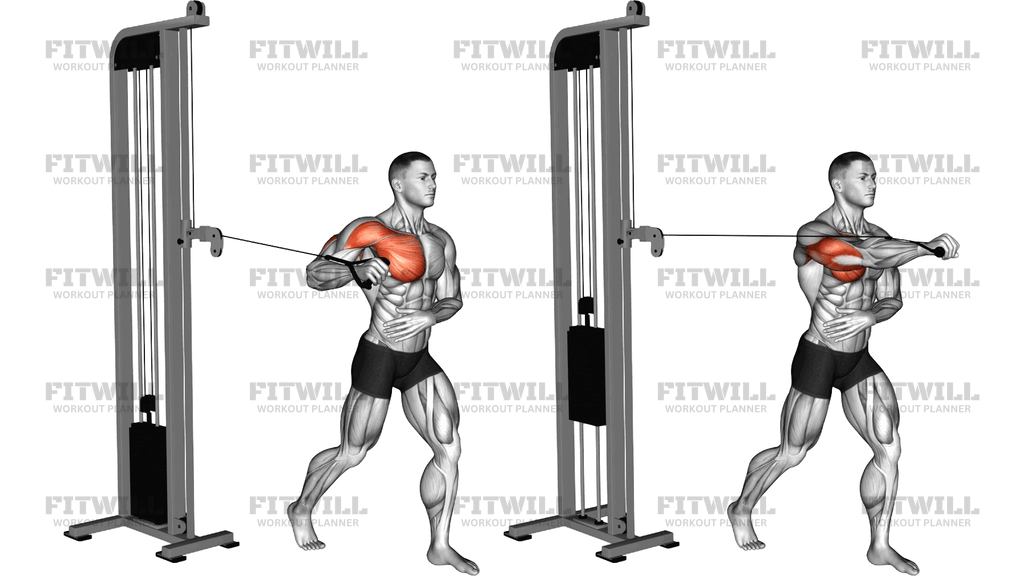
The Cable Single Arm Low Fly is a unilateral chest exercise performed from a low pulley, where you sweep the handle from a low position at your side up and across your body toward the opposite shoulder. Because the cable pulls from below, the resistance travels along an upward arc that emphasizes the upper portion of the chest while still loading the pectorals as a whole. The free hand rests against your abdomen or hip, which helps you notice and limit any torso rotation as the arm moves.
This movement is especially useful for lifters who want to bring up the upper chest, since the low-to-high path mimics an incline fly but with constant tension from the cable stack rather than gravity. It is also a smart pick for people with shoulder discomfort on pressing days, because the arm stays relatively free to follow its natural arc instead of being locked into a bar path. Training one side at a time exposes and helps correct left-to-right differences in strength and range of motion.
Setup matters more here than in most chest work. Stand far enough from the pulley that the cable is already under tension with your working arm at your side, and angle your body slightly so the cable can travel cleanly past your hip without rubbing your thigh. A staggered stance with a stable base keeps your torso from swaying as the cable pulls diagonally across your body.
Execution should feel like a sweeping hug. Keep a soft bend in the elbow, keep the wrist neutral, and lead with the elbow rather than the hand so the arm moves as one piece. Pull the handle up and across until it reaches roughly the height of your opposite shoulder or the far side of your chest, pause briefly to squeeze, then lower under control until you feel a comfortable stretch across the chest.
Because the cable pulls you backward and sideways at the same time, your core works to hold your ribcage and hips square throughout. This makes the exercise a quiet core challenge in addition to a chest builder. Keep the weight modest at first; the diagonal angle gives you less leverage than a standard chest fly, and form tends to break down quickly when the load climbs too high.
Common use cases include upper chest focused sessions, finishing work after presses, and rehabilitation-friendly chest training where a controlled, single-sided range of motion is preferred. Two to four sets of ten to fifteen reps per side usually works well, resting briefly between sides.
Safety-wise, the main points are simple: keep the movement in front of your body, never let the shoulder roll forward at the bottom, and control the return instead of letting the cable yank your arm back. Stop and reassess if you feel pinching at the front of the shoulder, and reduce the range before reducing the weight if that happens.
[ Workout Log & Planner ]
Put your next workout in Fitwill
Keep your plan and training log ready when you are.


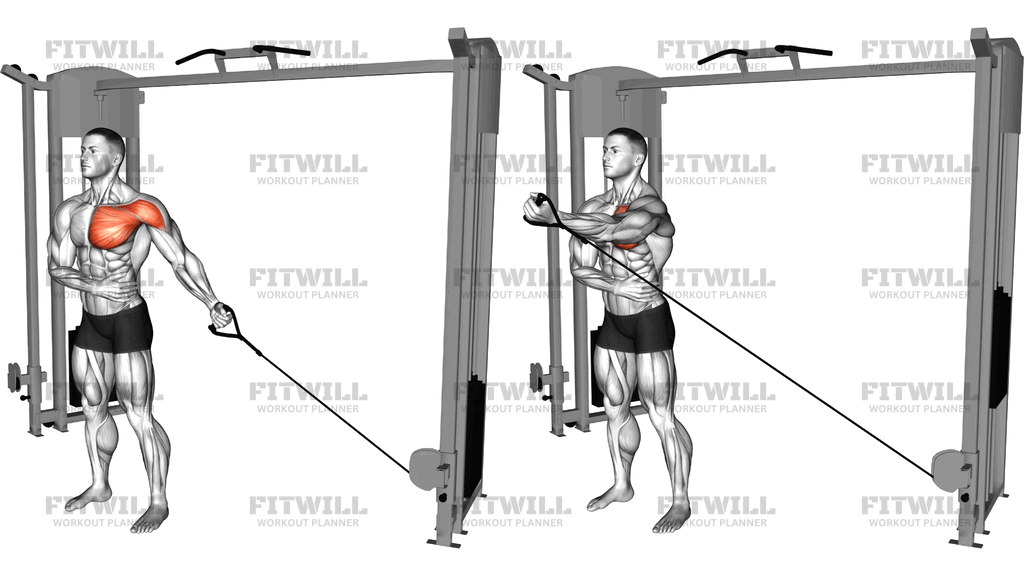
Instructions
- Attach a single handle to the low pulley of a cable machine and select a light to moderate weight.
- Stand facing slightly away from the pulley with your working arm closest to the machine, feet in a staggered stance about hip-width apart, far enough back that the cable is taut with your arm down at your side.
- Grip the handle with a neutral palm and place your free hand against your abdomen or the front of your hip to steady your torso.
- Brace your core, square your hips and shoulders toward the front, and allow the working arm to hang down and slightly behind your hip with a soft bend in the elbow.
- Sweep the handle up and across your body in a smooth arc, leading with the elbow, until your hand reaches about the height of your opposite shoulder or the far side of your chest.
- Pause for a moment at the top and squeeze the chest without shrugging the shoulder up toward your ear.
- Lower the handle slowly back down along the same diagonal path until you feel a stretch across the chest, keeping tension in the cable the whole time.
- Exhale as you sweep the handle up and across, inhale as you lower it back to the start.
- Complete all reps on one side, then switch stance and grip to work the other arm.
- Release the handle back onto the stack with your arm supported before adjusting the weight or walking away.
Tips & Tricks
- A frequent mistake is turning this into a front raise by pulling straight up in front of the body; make sure the handle finishes across the midline, near the opposite shoulder, or the chest stops doing the work.
- If your torso twists toward the working arm as you pull, lighten the load and press your free hand firmer into your abdomen to lock the ribcage down.
- Keep the elbow bend fixed throughout the set; straightening the arm at the top turns the movement into a cable raise and shifts tension to the shoulder.
- Watch the cable path near your hip and thigh. If the cable drags across your leg, adjust your stance angle so it clears cleanly.
- Do not let the shoulder blade tip forward at the bottom of the stretch; keep the chest lifted and the shoulder gently packed so the stretch stays in the pec.
- Wrist position matters: a bent-back wrist at the top usually means the weight is too heavy. Keep the knuckles aligned with the forearm.
- Because the low-to-high angle favors the upper chest, a slow two-second squeeze at the top pays off more here than adding extra reps.
- If you feel a pinch at the front of the shoulder, shorten the range at the bottom rather than dropping your elbow lower.
- Rest 15 to 30 seconds between sides on your first few sessions; the stabilizing demand is higher than it looks on the second set.
Frequently Asked Questions
Which muscles does the Cable Single Arm Low Fly work?
The chest is the primary mover, with extra emphasis on the upper chest because the cable travels from low to high. The front shoulders assist, and your core stabilizes the torso against the diagonal pull.
How is the Cable Single Arm Low Fly different from a standard cable fly?
A standard fly uses both arms and a mid or high pulley with a horizontal path, while this version uses one arm and a low pulley with an upward diagonal arc. The low-to-high path shifts more of the work to the upper chest fibers.
Is this exercise suitable for beginners?
Yes, as long as the weight stays light and the focus is on a smooth arc. The single-arm setup is actually helpful for beginners because it makes any torso twisting obvious and easy to correct.
Why does one hand rest on my stomach during the Cable Single Arm Low Fly?
The free hand gives you a reference point for torso position. If you feel your trunk rotating or leaning as you pull, that is your cue to brace harder or reduce the weight.
What is the most common mistake with this movement?
Pulling the handle straight up in front of the chest instead of across the body. That turns it into a shoulder raise. Finish with the hand near the opposite shoulder so the chest performs horizontal adduction.
How far should the handle travel at the top of the rep?
Bring it to roughly the height of your opposite shoulder or the far edge of your chest. Going much higher usually involves shrugging and loses chest tension.
What can I use if I do not have a cable machine?
A low-anchor resistance band with a single handle is the closest substitute, since it preserves the low-to-high diagonal resistance. Dumbbell incline flyes train a similar upper chest angle, though without constant tension.
How many sets and reps should I do?
Two to four sets of ten to fifteen reps per side is a solid range. Because the diagonal path offers less leverage, err on the lighter side and prioritize a controlled squeeze.
Is it safe for my shoulders?
For most people, yes. The arm follows a natural arc with no fixed bar path, and the load can be adjusted precisely. If you feel pinching at the front of the shoulder, reduce the range of motion at the bottom and keep the elbow slightly higher.
Should I train both arms in every session?
Yes, always match the reps on both sides, and consider starting with your weaker arm. Matching the weaker side's effort keeps left-right strength differences from growing.