Band Kneeling Single Arm Horizontal Row
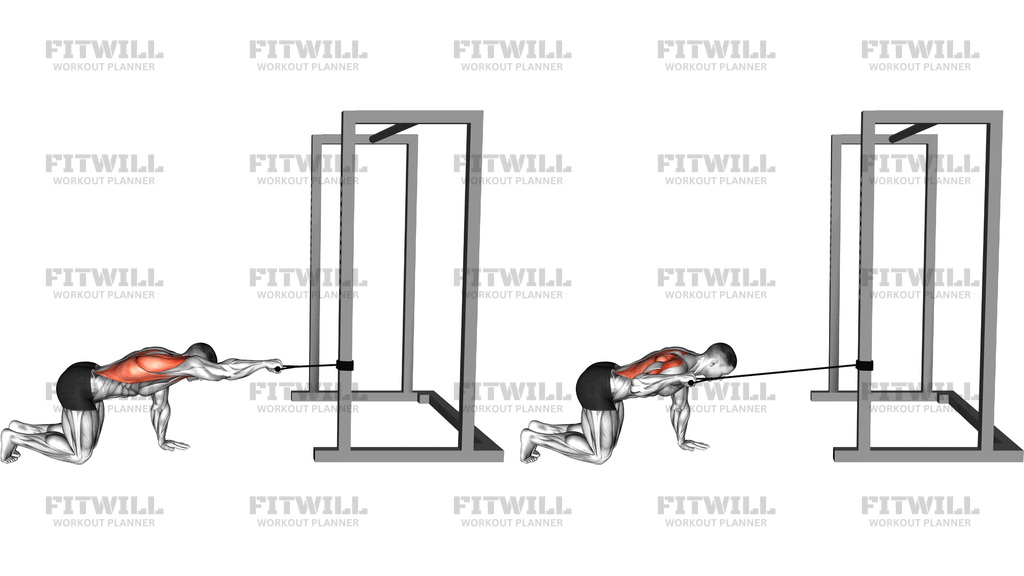
The Band Kneeling Single Arm Horizontal Row is a unilateral pulling exercise performed from a quadruped position, with a resistance band anchored to a rack or upright at roughly chest height. You support yourself on one hand and both knees while the working arm pulls the band handle horizontally back toward your lower chest. The highlighted area in the movement is the upper back, which does the bulk of the work as the shoulder blade retracts against the band's tension.
This setup is unusually honest about trunk control. Because you are kneeling on both knees with only one hand on the floor, there is nothing to brace against but your own midsection, so the anti-rotation demand on the core is real. If your torso starts twisting toward the band every time you pull, the exercise immediately tells you, which makes it a great diagnostic tool as well as a strength builder.
The single-arm format is worth choosing deliberately. Working one side at a time exposes left-right differences in back strength and shoulder blade control, and lets the working arm travel through a slightly longer range than a bar would allow. The horizontal pull path targets the rhomboids and mid-traps more directly than vertical pulls, making it a solid complement to pull-ups and pulldowns.
People who benefit most from this movement include lifters who sit a lot and need horizontal pulling volume, beginners learning how to move a shoulder blade before adding heavy load, and anyone rehabbing or prehabbing the upper back with low-compression, joint-friendly resistance. It also works well as a warm-up activation before heavy barbell rows or deadlifts.
Execution hinges on a few details. Set the band at chest height, keep the spine long and roughly parallel to the floor, and pull the handle to the side of your ribs rather than toward your face. Lead with the elbow, finish by squeezing the shoulder blade back, and let the band draw the arm forward under control so the stretch at the front is part of the repetition, not a race back to the start.
The main safety points are simple: never anchor the band to anything that could tip or fail, check it for wear before each session, and keep enough tension that the band never snaps slack mid-rep. If your lower back starts sagging or your hips shift, reduce the band tension or shorten the range before fatigue forces the position to break down.
[ Workout Log & Planner ]
Put your next workout in Fitwill
Keep your plan and training log ready when you are.


Instructions
- Anchor a resistance band to a secure rack upright at about chest height, and attach a single handle to the free end.
- Kneel on both knees facing the anchor point, roughly arm's length away so the band already has light tension, and place your non-working hand flat on the floor directly under your shoulder.
- Grip the handle with the working hand using a neutral grip, thumb up, and extend that arm forward so it lines up with the band.
- Set your hips directly over your knees, keep your neck in line with your spine, and brace your abdominals so your torso will not rotate toward the anchor.
- Pull the handle horizontally back toward your lower ribs, driving the elbow close to your body rather than flaring it wide.
- At the end of the pull, squeeze the shoulder blade back and down so your hand finishes beside your torso, roughly at the lower chest.
- Pause for a beat in the contracted position, feeling the upper back do the work rather than the biceps.
- Slowly extend the arm forward, resisting the band until the arm is straight and the shoulder blade has protracted fully at the front of the rep.
- Exhale as you pull in, inhale as the arm returns, and keep the breath steady instead of holding it.
- Complete all repetitions on one side, then switch hands so the other arm works against the same anchor point.
Tips & Tricks
- If your torso swings toward the band on each rep, you are pulling with momentum instead of muscle. Drop to a lighter band and own the position before adding tension.
- The most common mistake in this setup is letting the shoulder blade stay still while the arm does all the work. Think about drawing the elbow past your ribs, not just bending the arm.
- Keep the supporting hand stacked under the shoulder. Letting it drift forward turns the exercise into a side plank-ish struggle and robs the upper back of focus.
- Do not let the pulled shoulder shrug toward your ear at the finish. If it creeps up, you are using the upper traps to compensate for a weak mid-back squeeze.
- A band that goes slack at full extension makes each rep start with a jerk. Step back or pre-tension so there is some pull on the arm even at the stretched position.
- Check the band and anchor before every set. A band slipping off an upright under tension is the one genuine hazard in this otherwise low-risk movement.
- Keep your hips square to the floor throughout. If the same side hip lifts as you pull, your core is rotating and the row becomes a twisting drill.
- Slow down the return portion. The eccentric stretch of the lats and upper back under band tension is where a lot of the control benefit lives.
- If kneeling bothers your knees, fold a mat under them. The position should be comfortable enough that you never rush reps to escape discomfort.
Frequently Asked Questions
What muscles does the Band Kneeling Single Arm Horizontal Row work?
The primary movers are the rhomboids and mid-trapezius in the upper back, supported by the lats, rear shoulders, and biceps. The kneeling position also makes the core work to stop your torso from rotating toward the anchor.
Why is this row done kneeling instead of standing?
Kneeling removes leg drive and lowers the base of support, so you cannot lean back or hitch the weight with your body. It isolates the pull to the upper back and adds an anti-rotation challenge for the trunk.
How high should I anchor the band?
Set it at roughly chest height so the band's line of pull stays horizontal when your arm is extended. Too low turns it into a row with an upward angle, too high drags the shoulder down as you pull.
Is this a good exercise for beginners?
Yes. The band provides light, joint-friendly resistance and the floor gives immediate feedback on balance and control. Beginners should start with a thin band and focus on moving the shoulder blade, not just the hand.
My torso twists toward the band on every rep. How do I fix it?
Lighten the band tension and consciously brace your abdominals as if bracing for a light punch. You can also slow the pull down and think about keeping both hips pointed at the floor for the entire set.
What can I use instead if I have no band or rack?
A cable machine with a single handle set at chest height is the closest match, and a light dumbbell supported on a bench works in a pinch. The kneeling, one-hand-supported position is what makes this version distinct, so try to keep that element.
Should the elbow flare out or stay close to the body?
Keep it close. Tucking the elbow alongside your ribs keeps the emphasis on the lats and mid-back, while a wide flare shifts work toward the rear shoulder and reduces the row's effectiveness.
How many reps and sets should I do?
Two to four sets of 10 to 15 reps per side works well for most people, since band resistance is relatively light and the movement rewards control. Rest briefly between sides so the second arm gets the same quality of work.
Are there any safety concerns with band exercises like this?
The main risk is the band slipping off the anchor or snapping under tension, so use a dedicated band anchor or a solid upright, inspect the band for cracks or worn spots, and never anchor it to something that can tip. Keep your face out of the band's direct line as a habit.