Resistance Band Seated Eversion Foot
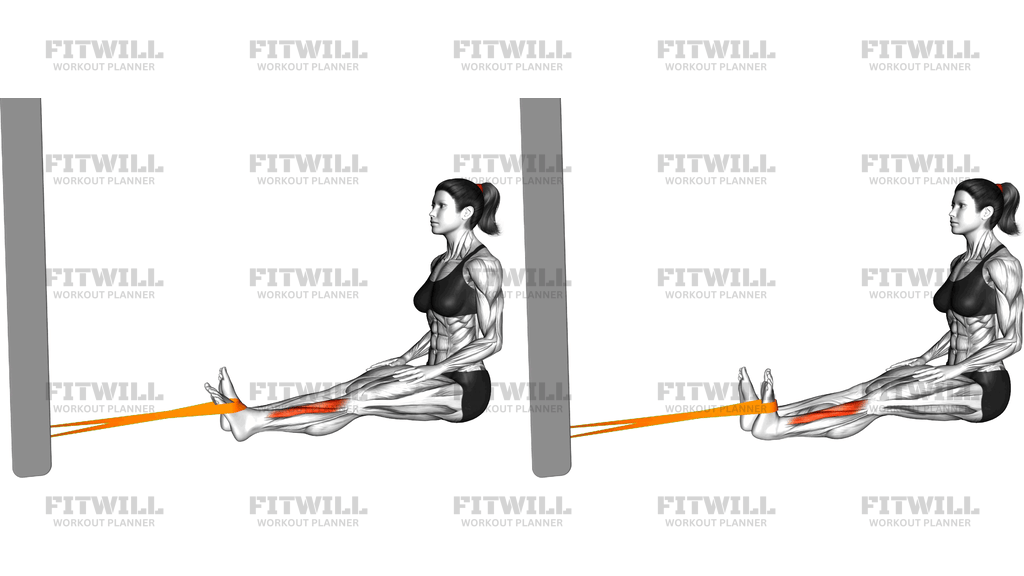
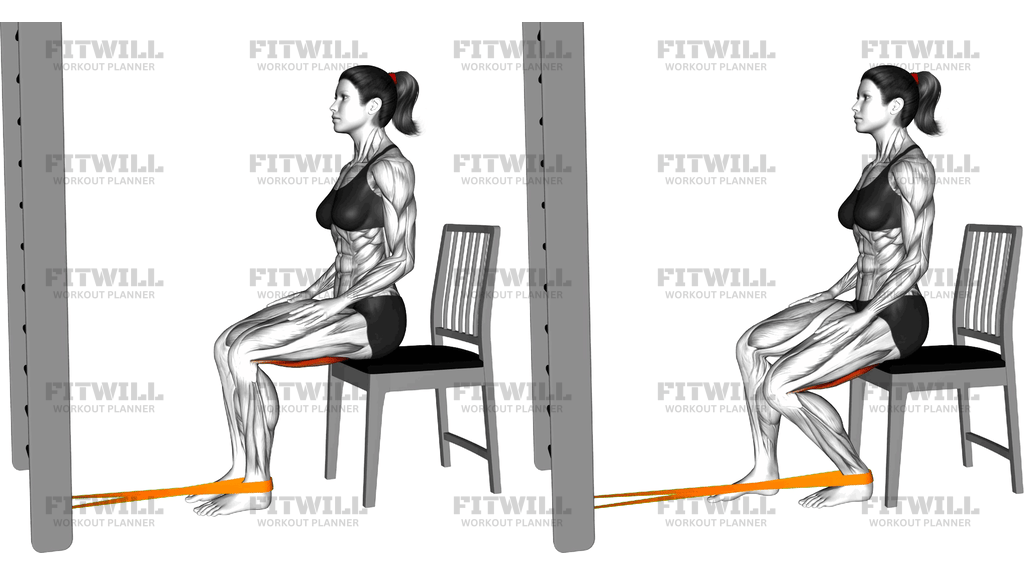
The Resistance Band Seated Eversion Foot is a small, targeted strength exercise for the muscles on the outside of the lower leg, mainly the peroneus longus and peroneus brevis. You sit upright on a chair or bench with a light band anchored to a rack upright or similar fixed point and looped around your forefoot. Because the band pulls your foot toward the inside while you turn it outward, your ankle works directly against the resistance through its natural eversion range.
This movement gets little attention in typical gym programs, yet the muscles it trains play a major role in everyday stability. The peroneal group helps control how your foot lands with every step, keeps the arch supported, and protects the lateral ankle during walking, running, and quick changes of direction. Weak everters are one reason people roll their ankles repeatedly, so this exercise is a common inclusion in ankle rehab and return-to-sport programming.
Setup quality matters here because the resistance must pull the foot inward for the outward turn to be the working motion. Anchor the band low, at or near floor level, and secure it around the inner edge of the forefoot. If the anchor sits too high or on the wrong side, the movement becomes an inversion or a plain pull rather than true eversion. Sit tall with your foot flat and relaxed so the ankle, not the hip or knee, does the work.
To execute well, keep the movement isolated to the ankle. Turn the sole of your foot outward and upward against the band, pause briefly at the outer edge of the range, then return with control instead of letting the band snap the foot back. The motion is small, so resist the urge to swing the whole leg or curl the toes aggressively to generate force.
Practically, this exercise suits people recovering from ankle sprains, runners and court-sport athletes who want sturdier lateral ankles, and anyone with flat-foot tendencies who has been told to strengthen the outside of the lower leg. Use a light band and higher repetitions, since these are small stabilizing muscles built for endurance rather than heavy loading.
[ Workout Log & Planner ]
Put your next workout in Fitwill
Keep your plan and training log ready when you are.


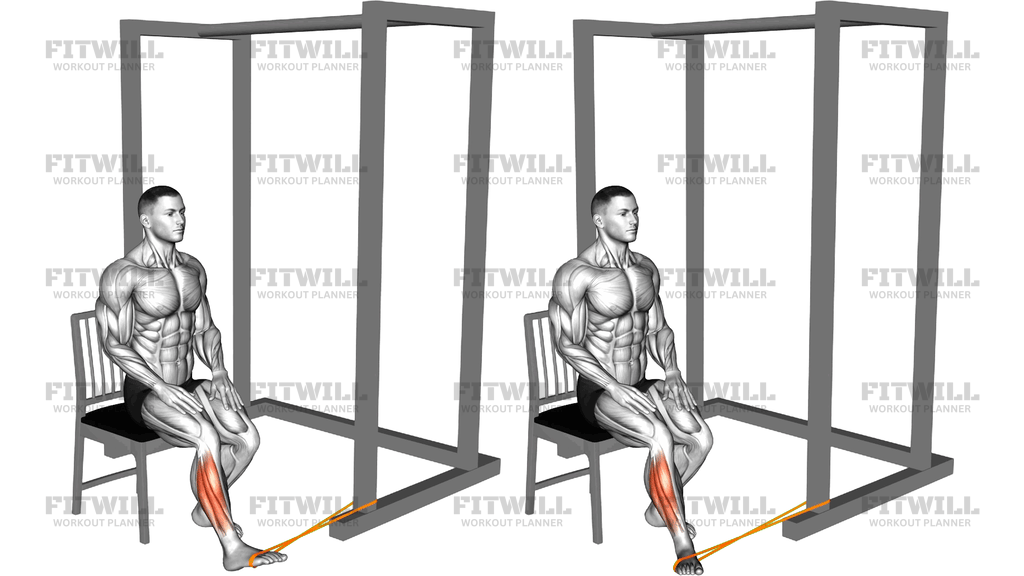
Instructions
- Sit upright on a chair or bench with your feet flat on the floor and your torso tall.
- Anchor a resistance band to a stable upright or heavy object at floor level, on the inner side of your working foot.
- Loop the free end of the band around the forefoot of the working foot so it pulls that foot inward and down toward the anchor.
- Rest your hands on your thighs, brace your trunk lightly, and keep your knee pointing straight ahead.
- Keeping your heel planted, turn the sole of your foot outward and upward against the band's pull.
- Pause for one second at the widest point of the outward turn, holding tension in the outer lower leg.
- Slowly let the foot return inward under control, stopping just before the band yanks the foot to the anchor.
- Exhale as you turn the foot out, and inhale as you let it come back.
- Complete all repetitions on one side, then re-anchor the band and work the other foot.
Tips & Tricks
- The range here is genuinely small; if your whole leg is swinging out, the hip is taking over and the ankle is barely working.
- Keep the heel in contact with the floor the entire time. Lifting the heel turns this into a calf press instead of an eversion drill.
- Curling your toes hard to grip the band is a common cheat. Lay the band flat across the forefoot and let the toes stay relaxed.
- Start with a very light band. These muscles are small, and a band that is too strong forces you to fire the calf and shin instead.
- If the band slides down toward the toes, reposition it over the widest part of the foot, just behind the little toe's base.
- Watch the kneecap tracking: it should stay forward and still. If the knee rotates outward as you pull, reduce the band tension.
- Pause deliberately at the end of the outward turn. That held moment at the outer edge is where the peroneals get most of their work.
- Slow the return phase down to two or three seconds; the lowering under band tension is as valuable as the pull itself.
Frequently Asked Questions
Which muscles does the Resistance Band Seated Eversion Foot work?
The primary movers are the peroneus longus and peroneus brevis on the outer lower leg, with supporting work from smaller muscles that stabilize the ankle and arch. The calves assist lightly but should not dominate the movement.
Why is the band anchored to the inner side of my foot?
Eversion means turning the sole of the foot outward, so the band must pull the opposite way, toward the inside. This lets your ankle work against resistance as it turns out, which is the whole point of the drill.
Can beginners do the Resistance Band Seated Eversion Foot?
Yes, and it is actually a very beginner-friendly exercise because you are seated and the load is light. Start with a thin band and ten to fifteen slow repetitions per foot, focusing on clean, isolated motion.
How is eversion different from inversion foot work with a band?
Inversion turns the sole of the foot inward and trains the tibialis posterior and tibialis anterior, while eversion turns the sole outward and trains the peroneals. The band anchor flips sides between the two, and both are worth training for balanced ankle stability.
I only feel my calf doing the work. What am I doing wrong?
The resistance is probably too heavy, or you are pressing the foot away instead of turning it out. Drop to a lighter band, keep the heel planted, and concentrate on rotating the sole upward and outward rather than extending the ankle.
Can I do this exercise without a rack to anchor the band?
You can loop the band around a heavy table leg, couch frame, or your own opposite foot to create the inward pull. Any low, immovable anchor on the inner side of the working foot will do the job.
How many sets and reps should I use for ankle stability?
Two to three sets of fifteen to twenty controlled repetitions per foot works well, since the peroneals are endurance-oriented stabilizers. Quality of the slow return matters more than adding resistance quickly.
Is the Resistance Band Seated Eversion Foot safe after an ankle sprain?
It is a standard early-stage strengthening drill for lateral ankle injuries, but timing and loading should be guided by a physical therapist or doctor. Stop if you feel sharp pain, swelling, or instability, and never stretch into a painful range against the band.
Should my knee move during the outward turn?
No. The knee should stay pointing straight ahead and completely still, with the heel planted. If the knee or hip rotates, reduce the band tension so the motion stays isolated at the ankle joint.