Seated Decline Chest Press On A Chair
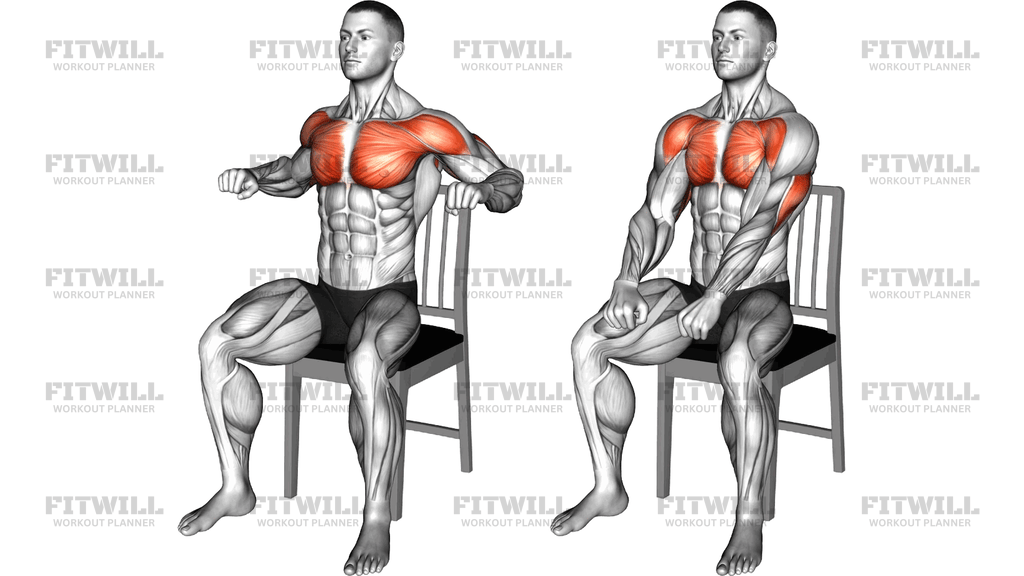
The Seated Decline Chest Press On A Chair is a bodyweight chest exercise performed sitting upright on an ordinary chair. Instead of pushing against external resistance, you generate tension by pressing your clenched fists down and forward at a decline angle, driving them toward the front of your thighs while your chest muscles resist and control the motion. The arms work against the resistance of the chest contraction itself, which makes this a self-resisted movement you can do anywhere with nothing more than a sturdy seat.
This exercise is especially useful for people who train at home, office workers looking for a discreet desk break, beginners learning to feel their chest working before touching weights, and anyone rehabbing back into pressing patterns after time away from the gym. Because the pressing path angles downward rather than straight ahead, the emphasis sits on the lower portion of the chest, the same region a decline bench press targets. The front shoulders and triceps assist throughout, and bracing your torso on the chair quietly works your core.
Setup matters more than it looks. Sit tall on the front half of the chair with feet flat on the floor and your spine neutral, because a slouched or rounded posture shifts work away from the chest and into the shoulders and neck. Bend your elbows roughly ninety degrees and keep them close to your ribs, forearms angled down toward your lap. That starting arm position is what creates the decline line of press.
To execute the rep, clench your fists and press your hands down and slightly inward toward your knees as if pushing a heavy object off your lap, squeezing your chest hard at the bottom of the motion. Pause briefly in the fully pressed position, then slowly release back to the start with your elbows staying near your torso. Breathe out as you press and in as you return, and keep each rep slow enough that you can feel the pecs doing the work rather than just swinging the arms.
A common mistake is letting the shoulders creep up toward the ears or allowing the torso to lean forward to cheat the arms through the range. Keep the shoulders pulled down and back and let the chest drive the movement. Because the resistance comes from your own muscular tension, the intensity is only as high as the squeeze you create, so commit to pressing hard on every repetition.
The main safety point is control. Since there is no external load, this is a very joint-friendly press, but forcefully snapping the arms down or hyperextending the elbows at the end of the range can still irritate the joint. Stop just short of locking out, keep tension in the chest the entire time, and stop the set if you feel any sharp discomfort in the shoulders or wrists.
[ Workout Log & Planner ]
Put your next workout in Fitwill
Keep your plan and training log ready when you are.


Instructions
- Sit on a sturdy chair with your feet flat on the floor about hip-width apart, positioned on the front half of the seat so your torso is upright and unsupported by the backrest.
- Bend your elbows to roughly ninety degrees and pin your upper arms against your sides, with your forearms angled down toward the front of your thighs to create the decline pressing line.
- Clench your fists and squeeze your chest to create firm tension in your hands and arms before the rep begins.
- Brace your core, pull your shoulder blades down and back, and keep your head in line with your spine.
- Press your fists down and forward toward your knees in a smooth arc, feeling your lower chest contract hard as the elbows straighten.
- Squeeze fully at the bottom of the press, stopping just short of locking the elbows so tension stays on the chest.
- Slowly release the press and let your arms travel back up along the same arc until your elbows return to the bent position at your sides.
- Exhale as you press down and inhale as you return to the start.
- Reset your posture between reps, checking that your shoulders have not risen toward your ears, then begin the next repetition.
- Complete your set, then stand up slowly and gently stretch the chest across your body to release the tension.
Tips & Tricks
- The exercise only works if you generate real tension, so press your fists together or against the fronts of your thighs firmly rather than moving your arms through empty air.
- If you feel the work mostly in the front of your shoulders, lower your elbows slightly and keep them tighter to your ribs to bring the angle back to the lower chest.
- Do not let your torso fold forward as you press; imagine a string pulling the crown of your head toward the ceiling so the chest does the pushing instead of body lean.
- Keep your wrists straight and fists firm. Bent-back wrists under hard tension are the most common source of discomfort in this movement.
- Slow the return phase down to two or three seconds. Because there is no external weight, the lowering portion is where you keep the chest under load.
- A firmer, higher chair keeps your hips above your knees and makes the decline angle cleaner; a soft couch will let you sink and flatten the pressing path.
- If the floor is slippery, brace your feet actively against it. This stabilizes your lower body so more effort goes into the press.
- Do not snap the elbows straight at the bottom of the press. Stop just short of full extension to protect the joint and keep the pecs loaded.
- For more intensity, hold the fully pressed position for five seconds on the final rep of each set instead of adding sloppy fast reps.
Frequently Asked Questions
What muscles does the Seated Decline Chest Press On A Chair work?
The lower chest is the primary muscle worked, since the downward pressing angle mimics a decline press. The front shoulders and triceps assist, and your core stabilizes your upright torso throughout.
How does this chair version differ from a decline bench press?
A decline bench press uses external weight and gravity, while the chair version relies on self-generated muscular tension with no equipment. It is far easier on the joints and more accessible, but it will not build the same maximal strength as loaded pressing.
Is the Seated Decline Chest Press On A Chair good for beginners?
Yes, it is an excellent first chest exercise because it teaches you to feel the pecs contracting without any load or setup complexity. Beginners should focus on a slow tempo and a hard squeeze rather than speed.
Why do I need to sit on the front half of the chair?
Sitting forward keeps your torso upright and unsupported, forcing your core and postural muscles to hold you tall. Leaning back against the backrest reduces chest involvement and makes it easier to slump.
What is the most common mistake in this exercise?
Letting the shoulders shrug toward the ears and moving the arms quickly without real chest tension. Keep the shoulder blades pulled down, and make every rep a deliberate, forceful press toward your knees.
Can I do this exercise every day?
Because the resistance comes from your own contraction and there is no external load, it recovers quickly and can be done frequently. Still, treat hard-squeezed sets like real training and give the chest a day of easy activity between intense sessions.
What can I substitute if I do not have a chair?
Any stable seat works, including a bench, ottoman, or exercise ball if you can sit upright on it. You can even perform the same downward press standing with a slight forward lean, though the seated version isolates the chest better.
How can I make the Seated Decline Chest Press On A Chair harder?
Slow the pressing phase to a three-second count, add a five-second isometric hold at the fully pressed position, or press your fists firmly against each other or your thighs to increase resistance. You can also pause briefly at the halfway point of each rep.
Is it safe for my shoulders and elbows?
It is generally very joint-friendly because there is no external load, but avoid locking the elbows forcefully at the bottom of the press and keep your wrists straight. If you have an existing shoulder injury, use gentle tension and a shorter range to start.
How many reps and sets should I do?
A practical starting point is two to three sets of ten to fifteen slow, hard-squeezed reps. Because the intensity depends on your effort, stop the set when you can no longer maintain a strong chest contraction with clean form.