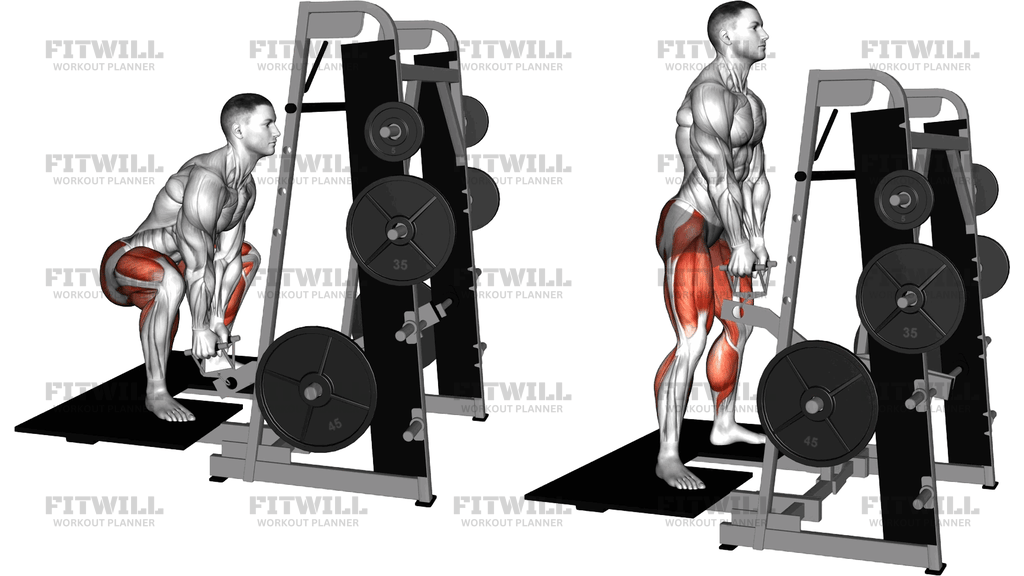
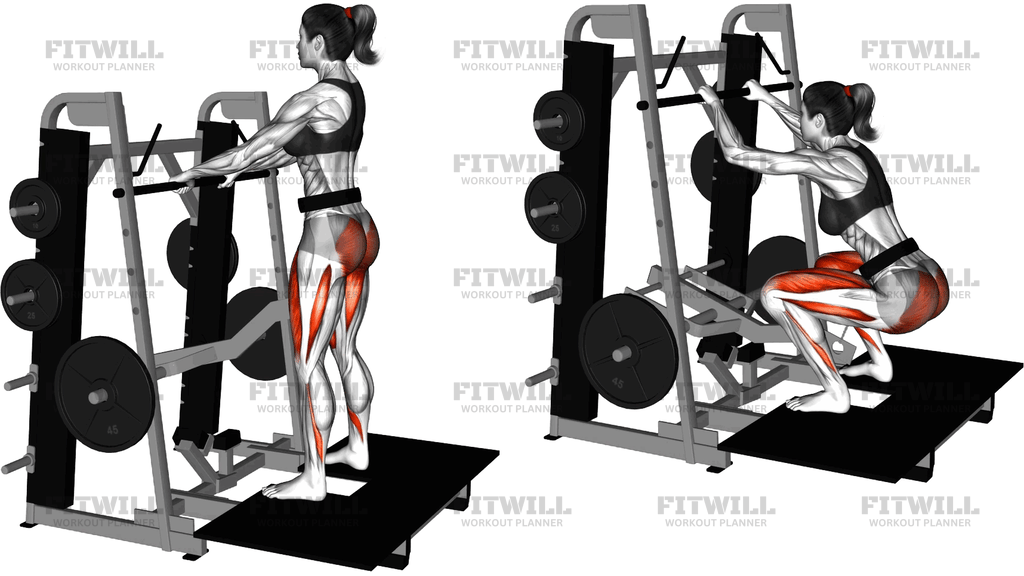
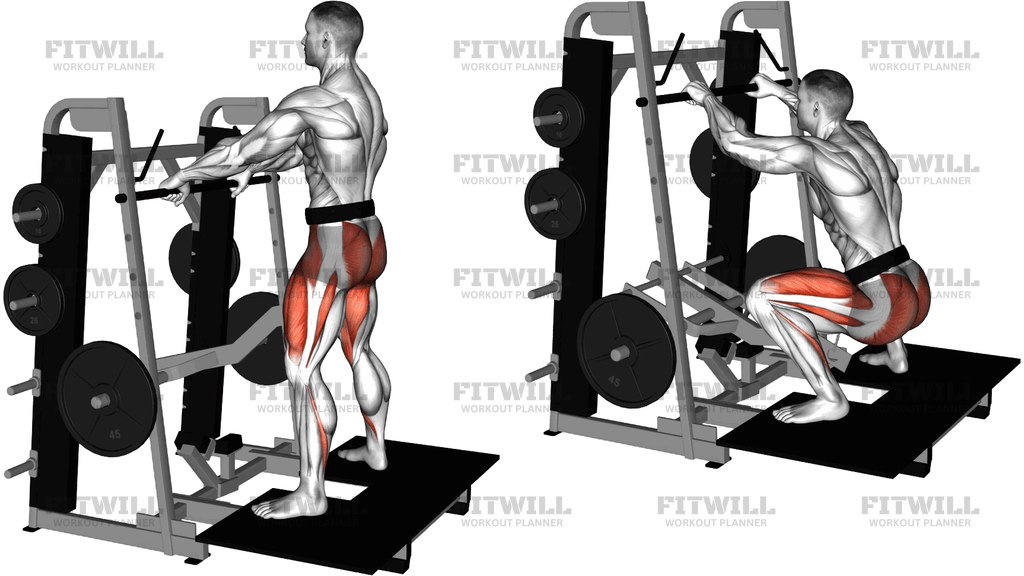
Lever Squat (Plate Loaded)
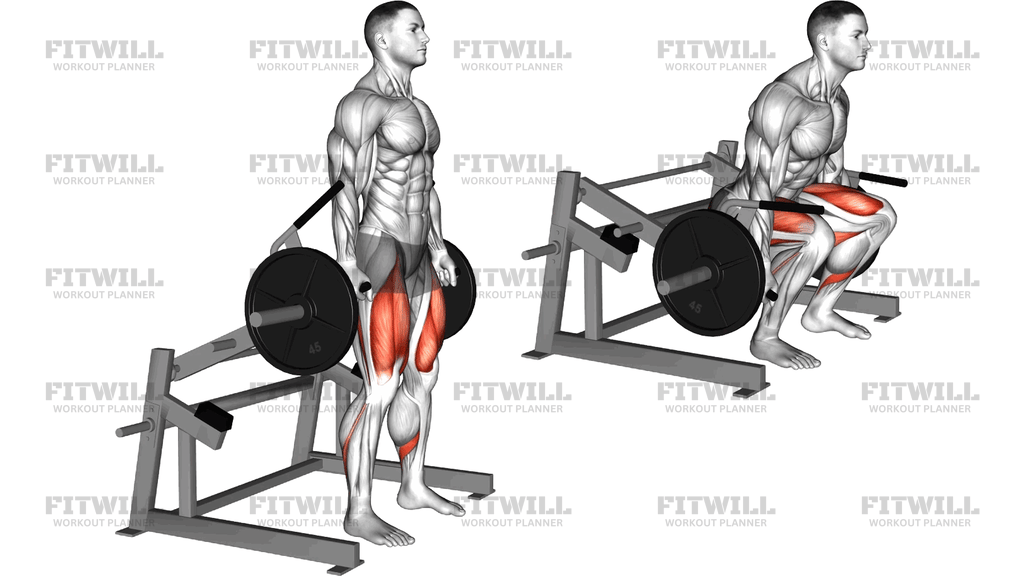
The Lever Squat (Plate Loaded) is a standing squat variation performed on a plate-loaded leverage machine. Instead of balancing a barbell across your back, the load rides on a lever arm with padded shoulder supports and hand grips, so the weight travels along a fixed arc while you squat straight down and drive back up. Plates are loaded directly onto the machine's weight horns, which makes resistance changes quick and removes the need for a rack, spotter, or barbell setup.
This movement is especially useful for lifters who want the squat pattern without the stability demands of a free-weight bar. The machine supports the load on your shoulders while your hands hold fixed grips, so you can push hard on your quads and glutes without worrying about balance or upper-back fatigue. That makes it a solid choice for beginners learning to squat, for intermediate lifters adding volume after barbell work, and for anyone training alone who wants a heavy leg stimulus safely.
The primary work is done by the quadriceps, which extend the knees as you rise from the bottom. The glutes and hamstrings assist strongly at the hip, particularly in the drive out of the hole, and the calves help stabilize the ankle as your body moves over your feet. Because your torso stays braced against the fixed path of the machine, the core works to hold your position rather than to control a swaying barbell.
Setup matters more than people expect on this machine. Your foot placement on the platform determines how much work goes to your quads versus your hips, and your shoulder position under the pads determines whether the load sits evenly or tilts to one side. Take a few seconds to place your feet shoulder-width apart with your whole foot flat, set the pads squarely on the meat of your traps, and choose a seat or platform setting that lets you reach a deep squat with your heels down.
To execute it well, keep your chest tall and grip the handles firmly as you bend at the hips and knees together, letting the machine's lever arm guide the arc. Descend until your thighs are at least parallel, drive the floor away through your whole foot, and stand fully upright without slamming the weight or locking your knees hard. The fixed path means your job is simply to apply force cleanly along it, so keep the tempo controlled and avoid using a bounce at the bottom.
You will see the Lever Squat (Plate Loaded) used as a main leg builder in machine-focused programs, as a high-volume finisher after squats or leg presses, and in commercial gyms where quick plate changes between sets save time. Its main safety advantage is the easy bail: if a rep gets too heavy, you can simply control the weight back to the start or set the lever down, rather than being pinned under a bar.
[ Workout Log & Planner ]
Put your next workout in Fitwill
Keep your plan and training log ready when you are.


Instructions
- Load plates evenly onto both weight horns of the leverage machine and adjust the platform or seat so your feet sit flat and your knees can bend deeply without jamming.
- Step onto the platform and place your feet shoulder-width apart, toes turned out slightly, with your whole foot in contact with the surface.
- Duck under the shoulder pads so they rest centered on your upper traps, grip the front handles firmly, and stand up to lift the lever arm off its rest.
- Take a breath into your belly, brace your core, and keep your chest tall with your gaze forward.
- Unrack fully and let the lever arm settle so you are supporting the load in a stable standing position.
- Bend at your hips and knees at the same time and squat down along the machine's arc until your thighs reach at least parallel.
- Keep your heels flat and your knees tracking over your toes throughout the descent; do not let them cave inward.
- Drive through your whole foot to extend your hips and knees and return to a full stand, exhaling as you push up.
- Complete all reps without re-racking, then step forward carefully and lower the lever arm back onto its rest before unloading plates.
- If you need to stop mid-set, control the weight down and set the lever gently back on its stop rather than dropping it.
Tips & Tricks
- Do not let the shoulder pads do the steering for you. The machine controls the arc, but you still need to keep your torso upright and your hips moving back, or the load will pitch you onto your toes.
- If your heels lift at the bottom, widen your stance slightly or check the platform setting. Elevating your heels is an option, but fix your setup before adding plates.
- Avoid slamming into the stop at the bottom of the arc. Touch and reverse, using muscle rather than rebound to restart each rep.
- Do not lock your knees hard at the top, especially on heavy sets. Stand tall but keep a small amount of tension in your legs between reps.
- Load plates symmetrically. An unevenly loaded lever squat pulls you to one side and puts uneven stress on your knees and hips.
- Push your knees out slightly as you descend so they track in line with your toes instead of drifting inward under load.
- Keep your hands as grips, not as a pull. Yanking on the handles to cheat yourself up takes work away from your legs and rounds your upper back.
- Start with a lighter weight than your barbell squat for the first session. The lever arm itself adds resistance, and the feel of the fixed path takes a rep or two to learn.
- Control the eccentric for two to three seconds. The machine's fixed path makes slow lowering comfortable, and it builds more leg strength than dropping fast.
Frequently Asked Questions
What muscles does the Lever Squat (Plate Loaded) work?
The quadriceps are the primary movers, extending your knees as you stand up out of the squat. Your glutes and hamstrings assist at the hips, and your calves stabilize the ankles, especially near the bottom of the range.
Is the Lever Squat (Plate Loaded) good for beginners?
Yes. The fixed path and shoulder-supported load remove the balance demands of a barbell squat, so beginners can learn depth and knee tracking with a low risk of losing the weight.
How is the Lever Squat (Plate Loaded) different from a barbell back squat?
The machine guides the weight along a set arc and carries the load on padded shoulder supports with fixed handles, so your stabilizers work less and you can focus on driving with your legs. A barbell squat demands more balance, core control, and upper-back strength.
How should my feet be positioned on the platform?
Place them shoulder-width apart with toes angled slightly out and your whole foot flat. A lower, narrower placement emphasizes the quads, while a slightly higher or wider placement shifts more work to the glutes and hamstrings.
Why do my heels rise at the bottom of the rep?
This usually means your stance is too narrow or you are descending with your knees forward instead of sitting your hips back. Widen your feet slightly, turn your toes out a touch, and check that the platform setting allows a deep squat with your heels down.
How deep should I squat on this machine?
Aim for thighs at least parallel to the platform, provided your heels stay flat and your lower back stays neutral. The machine's fixed arc supports you at the bottom, so most lifters can safely go deeper than they would with a barbell.
Do I still need to brace my core on a machine squat?
Yes. The machine controls the path of the weight, but it does not hold your torso rigid for you. Brace your core and keep your chest tall so the pads stay level and the load does not tip you forward.
What can I use instead of the Lever Squat (Plate Loaded)?
A Smith machine squat, hack squat, or leg press all train the legs along a guided path. For a free-weight option, a barbell or goblet squat covers the same knee and hip extension pattern with more stability demand.
Is it safe to train heavy alone on this machine?
Generally yes, because there is no bar to be pinned under. If a rep fails, you can control the lever arm down to its stop or simply stand up under the pads. Still, load plates evenly and never drop the arm onto its rest at speed.
Should I use the Lever Squat (Plate Loaded) before or after free-weight squats?
Use it after your main barbell or dumbbell work as a volume driver, or run it as your primary lift on days when you want heavy leg training without a spotter. Doing it first is fine too if machine work is the focus of your program.