Standing Wide Good Morning (Advanced)
The Standing Wide Good Morning is a bodyweight hip hinge performed with the feet set noticeably wider than shoulder width. Instead of loading a bar across your back, you rely on your own posterior chain to control the fold, which makes the pattern easy to feel but surprisingly demanding once you chase real depth. The wide stance shifts the emphasis toward the inner thighs and allows a deeper hip fold than a narrow-stance hinge, which is why this version sits at the advanced end of the good morning family.
This movement is useful for anyone who wants to build a strong, well-grooved hip hinge without equipment. It trains the hamstrings and glutes as the prime movers, loads the erector spinae isometrically as they hold your spine neutral under the fold, and stretches the adductors as the knees track outward over a wide base. Lifters often use it as a preparatory drill before barbell good mornings, wide-stance squats, or deadlift variations, and mobility-focused trainees use it to open the hips and lengthen the posterior chain.
The setup matters more than it looks. Because there is no external load, the only thing protecting your lower back is your own bracing and positioning. Your feet should be planted wide with toes turned out slightly, knees softly bent and pushed in the same direction as the toes. From there, the whole movement is a push of the hips back and up, not a bend of the waist. If you let the spine round early, the hamstrings stop working and the stress dumps into the lumbar discs and passive tissues.
Executed well, you hinge until your torso approaches your thighs and your head lowers toward the floor between your arms, keeping the knees bent and wide the entire time. The return is just as important: drive the hips forward, keep the chest long, and stand tall by squeezing the glutes rather than yanking the torso up with the lower back. Moving slowly through both halves of the rep is what turns this from a simple stretch into genuine posterior chain strength work.
Because the exercise is self-loaded and advanced in its depth demands, treat it as a skill as much as a strength movement. Start with a partial range you can control with a flat back, and only deepen the fold as your hips and hamstrings earn it. Breathe steadily, never hold your breath at the bottom, and stop the set the moment your spine begins to round or your knees collapse inward.
[ Workout Log & Planner ]
Put your next workout in Fitwill
Keep your plan and training log ready when you are.


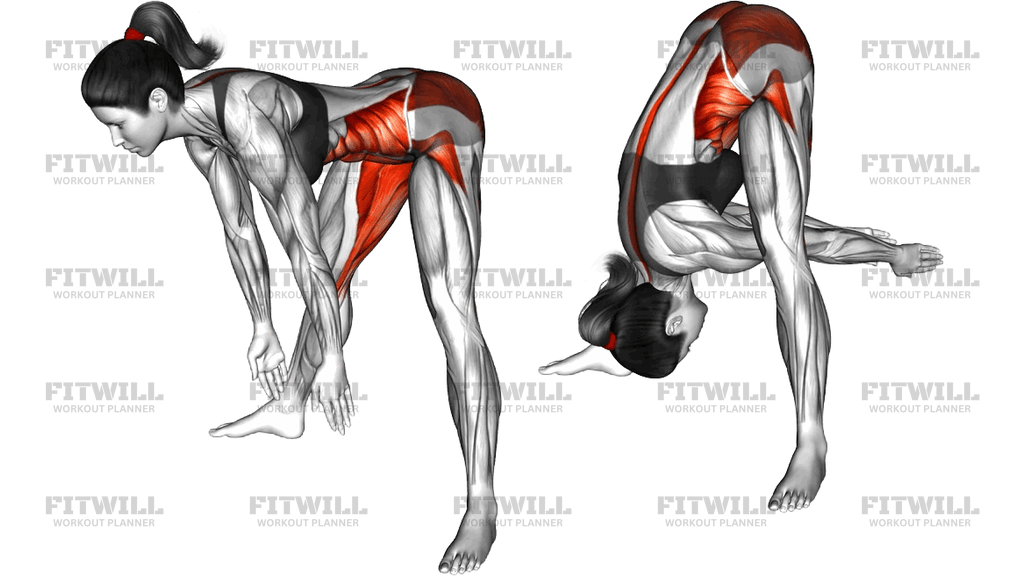
Instructions
- Stand with your feet set about one and a half shoulder widths apart, toes turned out slightly, and your weight spread evenly across both feet.
- Bend your knees slightly and push them outward so they track over your toes, keeping them soft for the entire set.
- Let your arms hang relaxed in front of or between your legs, and engage your core as if bracing for a light punch.
- Draw your shoulders back and lift your chest to set a long, neutral spine before any movement begins.
- Push your hips straight back and hinge forward, letting your torso lower between your arms while your hips stay high.
- Descend until you feel a strong stretch through the hamstrings and inner thighs, typically when your torso is close to parallel with the floor or deeper if your mobility allows.
- Pause briefly at the bottom with your back flat and head in line with your spine, relaxed but not collapsed.
- Exhale and drive your hips forward, leading the return with your glutes until you are standing fully upright.
- Reset your brace at the top, take a breath, and begin the next rep with the same deliberate hip push.
Tips & Tricks
- If your lower back rounds before you feel a hamstring stretch, you have gone past your current depth — shorten the range and rebuild it gradually.
- Knees drifting inward is the most common fault with the wide stance; cue yourself to press your knees toward your pinky toes throughout the fold.
- Think 'hips back' rather than 'chest down'. Reaching your head toward the floor by flexing the spine defeats the purpose of the hinge.
- Keep more knee bend than you would in a stiff-leg deadlift; the soft knees let you fold deeper while protecting the hamstrings at end range.
- Move at roughly a two-second descent and a two-second return. Rushing the bottom position is where rounded backs happen.
- If your heels lift as you fold, shift slightly more weight into the heels at the start and widen your toes a touch for balance.
- Tight adductors often limit this version more than tight hamstrings; a brief warm-up of side lunges makes the wide stance far more comfortable.
- Treat your first few reps as rehearsals with half the range, then progress to full depth within the same set once the pattern feels clean.
Frequently Asked Questions
Which muscles does the Standing Wide Good Morning work the most?
The hamstrings and glutes do the main work of controlling and reversing the hip fold, while the lower back muscles work isometrically to hold your spine neutral. The wide stance also puts a meaningful stretch and load on the adductors of the inner thighs.
Why use a wide stance instead of a regular good morning stance?
The wide foot placement lets the torso fold deeper between the legs, which lengthens the hamstrings and adductors more than a narrow stance. It also lowers the center of gravity, making the bodyweight version more stable at full depth.
Is the Standing Wide Good Morning suitable for beginners?
It is labeled advanced because the deep fold demands solid hip mobility and back control that most beginners have not built yet. Newer lifters should start with a shallow range, or practice a standard narrower bodyweight hinge first before adding the wide stance and depth.
Should my knees stay bent or straight during the movement?
Keep them softly bent and pushed outward for the entire rep. Straightening the knees entirely turns the movement into a hamstring stretch and pushes more strain into the lower back at the bottom.
How deep should I fold at the bottom?
Descend only as far as you can keep a flat back, which for most people is torso at or slightly below parallel to the floor. Extra depth means nothing if your spine rounds, so let mobility improve over weeks rather than forcing the fold.
What is the most common mistake in this exercise?
Rounding the lower back to reach deeper, usually because the hips have run out of room. The fix is to stop the descent at your clean range, keep the chest long, and rebuild depth gradually.
What can I use if I cannot reach a comfortable depth?
Bend your knees a bit more, narrow your stance slightly, or hold onto a sturdy support in front of you for balance. A resistance band looped around the hips can also add a gentle pull to guide the hinge without forcing range.
How does this differ from a barbell good morning?
Without the bar, the load is limited to your bodyweight, so the challenge comes from depth, control, and range rather than heavy resistance. It works well as a teaching and mobility drill alongside, or before, loaded good mornings.
Is it safe for people with lower back issues?
Anyone with an irritated or recently injured lower back should get clearance from a qualified professional before attempting deep hinges. If you do train it, keep the range shallow, the knees bent, and stop immediately if symptoms appear.
How many reps and sets should I do?
Two to four sets of eight to twelve slow reps works well as strength and mobility preparation. If you are using it mainly as a warm-up for lifting, one or two lighter sets of six to eight reps is enough.