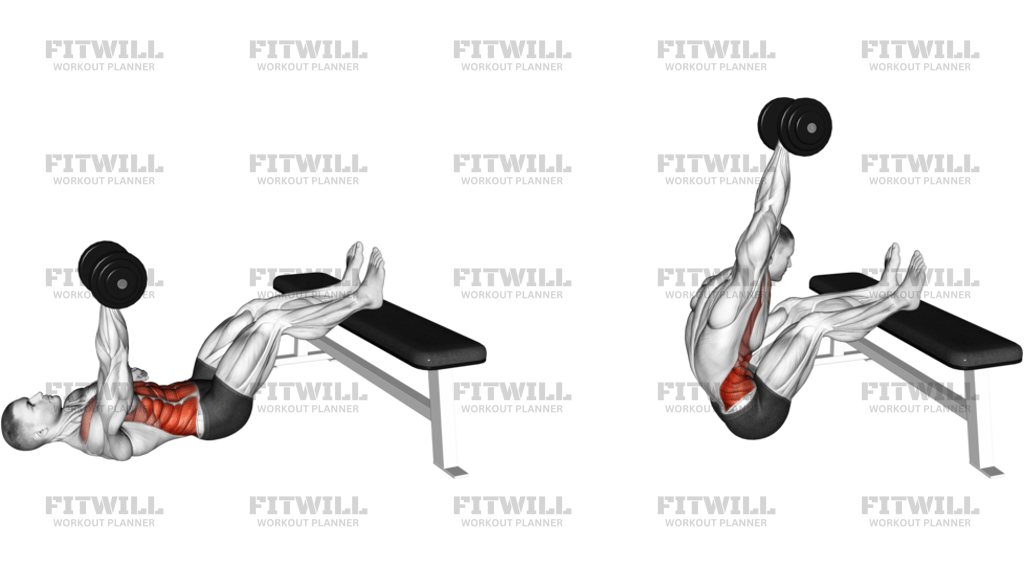
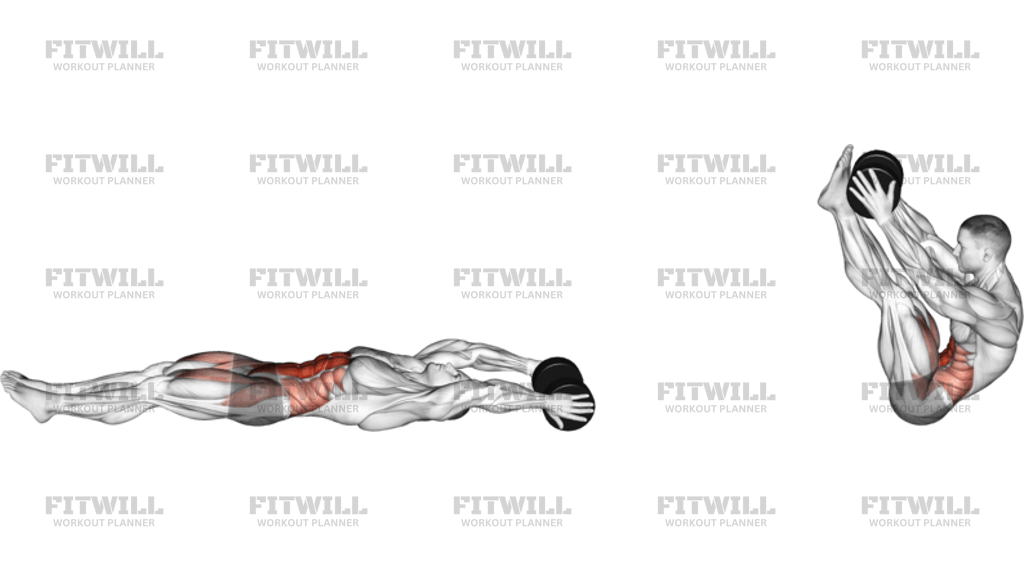
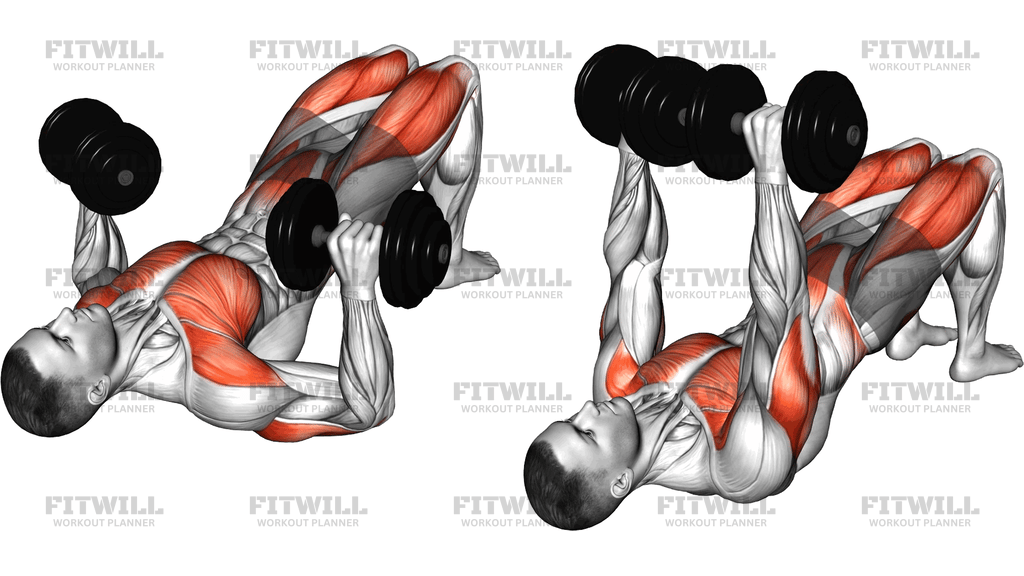
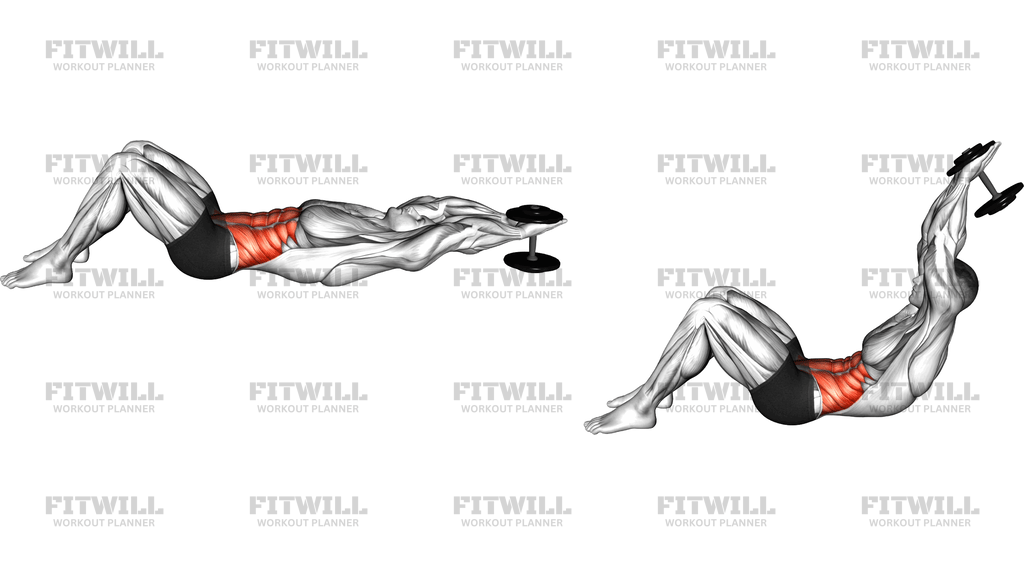
Weighted Dumbbell Lying Knee Raise
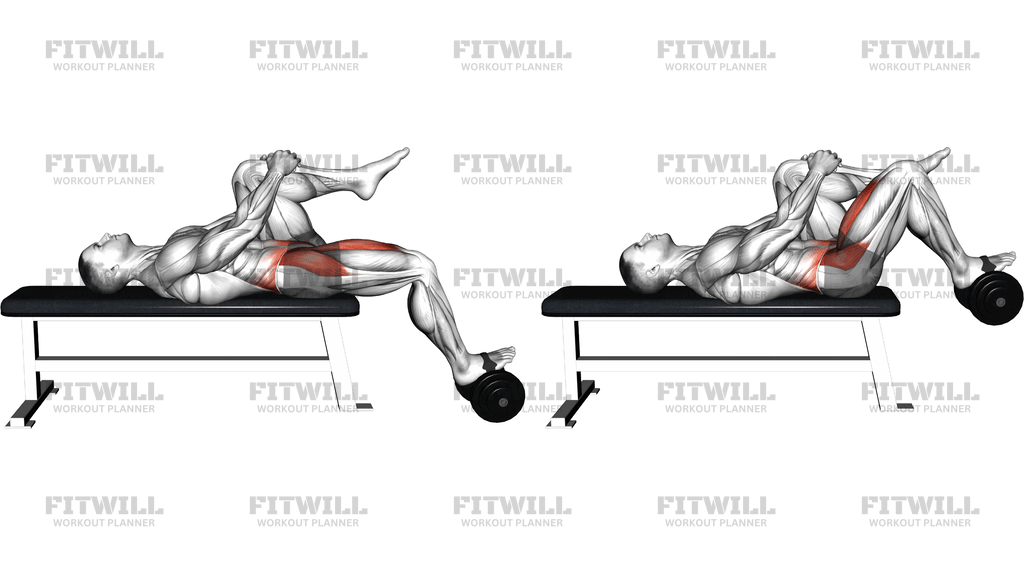
The Weighted Dumbbell Lying Knee Raise is a single-leg hip flexion exercise performed on a flat bench. You lie on your back with one knee pulled toward your chest and held there with your arms, while your other foot secures a dumbbell and hangs off the end of the bench. From there, you raise the weighted knee up toward your torso and lower it back down under control. It is a simple setup, but the position does something most standing or hanging leg raises cannot: it pins your pelvis flat against the bench, so the work stays in the hip flexors and lower abs instead of turning into a back-arching swing.
The muscles doing most of the pulling are the hip flexors, especially the iliopsoas and rectus femoris, which lift the thigh toward your torso. The lower abdominals work hard in an isometric role, holding your ribcage down and keeping your lower back in contact with the bench while one leg hangs loaded off the edge. The quadriceps assist by extending the knee to keep the dumbbell clamped between the feet, and the thigh and calf of the working leg have to stay tight so the weight does not slip.
This movement is a good fit for anyone who wants to load hip flexion without a captain's chair or hanging bar, and for lifters whose grip gives out before their hips do on hanging leg raises. It is also useful for runners, sprinters, and martial artists, since strong hip flexors drive knee drive and high knee lift. Because you train one side at a time, it exposes and helps correct a left-right difference in hip strength, which is common in people who favor one leg.
The setup is what makes or breaks this exercise. Your non-working knee must stay hugged to your chest for the entire set; if you let it drift away, your pelvis tilts forward and your lower back takes over. The bench should support your head, shoulders, and hips fully, with only the working leg hanging past the edge. The dumbbell sits vertically between your two feet, clamped by the soles, so choose a weight you can hold securely with your feet before you worry about the load itself.
To execute it well, think of driving your knee toward your chest rather than kicking your foot up. The working knee bends as it rises, so the dumbbell travels up with the shin and stays under your control. Pause briefly at the top, then lower the leg slowly until the thigh is roughly level with or slightly below the bench before starting the next rep. Letting the leg free-fall on the way down is the fastest way to lose the dumbbell and strain the front of the hip.
Keep the weight modest when you start. A dumbbell swinging between your feet at the end of a long lever puts real torque on the hip and lower back, and that torque grows quickly with load. Start with a light dumbbell for higher reps, master the clamping grip with your feet, and only add weight when every rep looks identical from top to bottom.
[ Workout Log & Planner ]
Put your next workout in Fitwill
Keep your plan and training log ready when you are.


Instructions
- Lie face up on a flat bench with your head, shoulders, and hips fully supported and your lower back pressed flat against the pad.
- Pull your left knee toward your chest and wrap both hands around your shin or thigh to hold it there for the whole set.
- Let your right leg hang off the end of the bench and clamp a dumbbell vertically between your feet, gripping it firmly with both soles.
- Brace your abdominal muscles and pull your ribcage down so your lower back stays in contact with the bench.
- Exhale and drive your right knee up toward your chest, bending the knee as it rises so the dumbbell travels with your shin.
- Stop when your knee is as close to your torso as it will go without your hips lifting off the bench, and hold for a short pause.
- Inhale and lower the weighted leg slowly and smoothly until the thigh is level with or slightly below the bench.
- Complete all repetitions on the right side, then switch: clamp the dumbbell between the other foot, hug the opposite knee, and match the rep count.
- Between sets, sit up before releasing the dumbbell from your feet so it never drops onto the floor from height or onto your leg.
Tips & Tricks
- The most common failure here is the non-working knee creeping away from your chest mid-set. Check it every couple of reps; if your hands are loosening, reset it before continuing.
- If the dumbbell feels like it is slipping, your feet are holding it too far forward on the toes. Clamp it with the arches and soles of both feet and squeeze the whole time.
- Do not let your hips roll or lift off the bench as the knee comes up. If they do, the weight is too heavy or you are yanking the leg up instead of flexing the hip.
- Lower the leg over a full two to three seconds. The dumbbell creates a long lever arm, and dropping the last third of the range is where most people strain the front of the hip.
- Keep a slight bend in the working knee the entire time. Fully straightening it turns the move into a straight-leg raise and shifts tension toward the quad and knee.
- Start with a very light dumbbell, even 2-5 kg. Because the load sits at the end of your leg, it feels far heavier than the same weight would in your hands.
- If your lower back lifts or feels pinched, press it harder into the bench and hug the non-working knee tighter; if that does not fix it, reduce the range rather than forcing depth.
- Move one side at a time without rushing the switch. Sit up between sides rather than swapping the dumbbell while you are half-lying and unstable.
- Alternate which leg starts each session so the weaker side is not always training second and fresher.
Frequently Asked Questions
Which muscles does the Weighted Dumbbell Lying Knee Raise work?
The primary movers are the hip flexors, mainly the iliopsoas and rectus femoris, which lift the weighted knee toward your chest. The lower abdominals work isometrically to keep your pelvis and lower back flat on the bench throughout the set.
Why do I have to hold my other knee to my chest during the Weighted Dumbbell Lying Knee Raise?
Hugging the non-working knee tilts your pelvis backward and pins your lower back flat against the bench, which removes the arch that lets the lower back take over. It also keeps your torso stable so the hip flexors do the actual lifting.
How do I keep the dumbbell from falling between my feet?
Clamp it vertically between the soles and arches of both feet with a constant squeeze, and keep a slight bend in your working knee so your feet stay in contact with it. Start light until the foot grip feels automatic, and sit up before releasing it between sets.
Is the Weighted Dumbbell Lying Knee Raise good for beginners?
Yes, provided you begin with a very light dumbbell or no weight at all. The bench position is easier to control than a hanging bar, so beginners can learn clean hip flexion here before progressing to hanging leg raises.
How heavy should the dumbbell be for the Weighted Dumbbell Lying Knee Raise?
Use a weight you can control for 10-15 slow reps without your lower back lifting or your hips rolling off the bench. Because the dumbbell hangs at the end of a long lever, even a light load feels substantial, so progress in small jumps.
What is the most common mistake in this exercise?
Letting the leg free-fall on the way down, which swings the dumbbell and strains the front of the hip. The lowering phase should take two to three seconds with the knee staying bent.
What can I substitute for the Weighted Dumbbell Lying Knee Raise?
A bodyweight lying knee raise with no dumbbell works the same pattern for beginners, and a hanging knee raise or captain's chair knee raise loads the same hip flexion in a vertical position. Ankle-strap cable knee raises are another option once you want more load.
How many sets and reps should I do?
Two to four sets of 10-15 controlled reps per side is a solid working range. Because the range is short and the hip flexors fatigue quickly under load, favor smooth reps over grinding out extra weight.
Is the Weighted Dumbbell Lying Knee Raise safe for my lower back?
It is generally back-friendly because the bench supports your spine and the hugged knee keeps your pelvis neutral. Keep your lower back in contact with the bench, control the descent, and stop the set if you feel pinching rather than muscular effort.