Neutral Wrist Roller
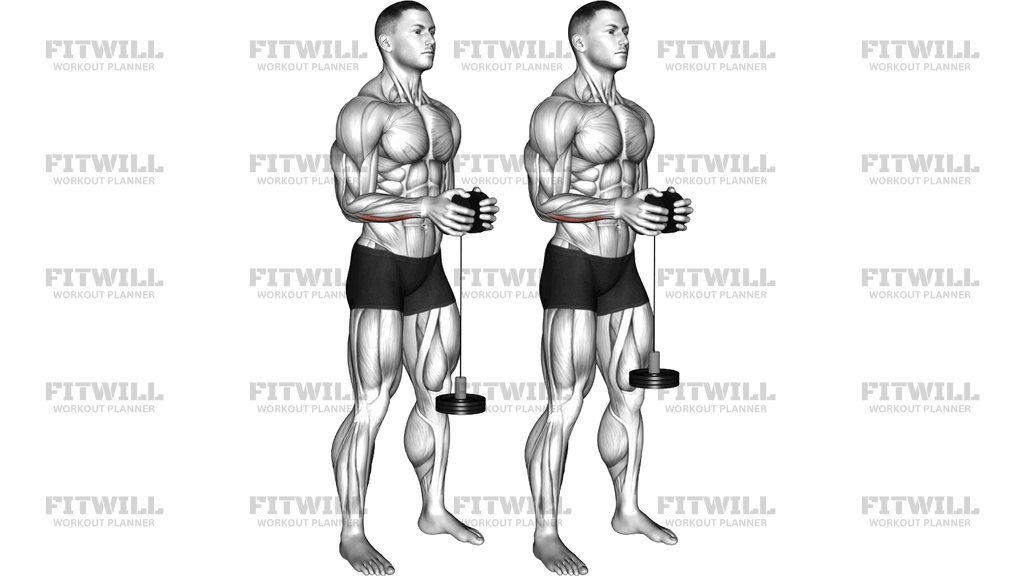
The Neutral Wrist Roller is a standing forearm and grip exercise performed with a weighted roller device: a handle or cylindrical grip attached to a rope that hangs down to a weight plate. Unlike the classic palms-down wrist roller, here you hold the handle with a neutral grip, palms facing each other, which shifts more of the work toward the brachioradialis and the muscles that run along the top and outside of the forearm while still taxing the wrist flexors and your ability to hold on.
This movement is useful for anyone whose grip gives out before their back or pulling muscles do. Climbers, lifters who struggle to hold heavy bars during rows or deadlifts, and racket sport players all benefit from direct forearm work. Because the neutral hand position is also the strongest and most comfortable position for many people, it is a good entry point if a standard wrist roller bothers your wrists or feels awkward.
The setup matters more than it looks. The plate should hang freely from the rope without touching your legs, and your forearms should stay roughly parallel to the floor with elbows tucked at your sides. If the roller drifts away from your body or your elbows drop, your shoulders and biceps start stealing the work and the rolling motion becomes a messy pull instead of a wrist extension and flexion pattern.
To execute it well, roll the handle away from you with small, even turns until the weight reaches the top of the rope, then reverse the direction and roll it back down under control. The lowering portion is where most of the muscle-building value lives, so resist the plate on the way down rather than letting it unwind quickly. Keep your chest tall, breathe steadily, and let the forearms do the turning.
A common use case is as a finisher at the end of an upper-body or pulling session, when one to three trips up and down the rope are enough. Start with a light plate, often 2.5 to 5 kg, because the leverage of the rope makes even small loads feel heavy after a few turns. Stop the set when your grip starts to slip, not when your forearms simply burn; a dropped or jerked plate is a sign you went too heavy or too long.
For safety, keep the plate clear of your feet and legs at all times and stand on a flat, non-slip surface. If you feel sharp wrist or elbow discomfort rather than working muscle fatigue, reduce the load or shorten the rope travel before continuing.
[ Workout Log & Planner ]
Put your next workout in Fitwill
Keep your plan and training log ready when you are.


Instructions
- Load a small weight plate onto the pin of the wrist roller and confirm it is secured so it cannot slide off during the set.
- Stand upright with feet about hip-width apart and take a neutral grip on the handle, palms facing each other and hands roughly shoulder-width apart.
- Raise the handle to chest height and extend your arms forward so the plate hangs on the rope without touching your legs.
- Pin your elbows against your sides and keep your forearms roughly parallel to the floor, with shoulders relaxed and chest tall.
- Brace your core lightly and take a breath before the first turn.
- Roll the handle away from you using small, alternating wrist turns, letting each hand take its turn wrapping the rope until the plate reaches the top.
- Pause briefly at the top with the rope fully wound.
- Reverse the direction and roll the handle back toward you, lowering the plate slowly and controlling every turn instead of letting the rope unwind.
- Exhale steadily through the rolling and keep breathing rather than holding your breath.
- Once the plate reaches the floor or the lowest point, lower the handle to your thighs, shake out your forearms, and rest before the next set.
Tips & Tricks
- Choose a plate light enough that you can complete a full up-and-down trip with smooth turns; if your hands start sliding on the handle, the load is too heavy for your current grip.
- The most common mistake is letting the elbows drift forward and turning the set into a front raise. Keep the upper arms glued to your ribs so only the wrists and forearms do the rotating.
- Keep the turns small and even. Big, rushed winding motions let the plate swing and turn the exercise into a momentum game.
- On the way down, actively squeeze the handle and resist each turn. Letting the rope free-spool removes most of the training effect.
- If your wrists ache in a palms-down position on a standard roller, the neutral grip here should feel better, but shorten the range slightly until your forearms adapt.
- Stand far enough from the rack or plate stack that the rope hangs straight down; a rope dragging against your legs changes the resistance mid-turn.
- Chalk or a dry towel on your hands helps if sweat makes the handle slippery late in a set.
- Do this exercise last in your session. Pre-fatiguing your grip first will weaken every pull or row exercise that comes afterward.
- If your shoulders fatigue before your forearms, lower the handle slightly and reduce the rope length you wind per set rather than dropping your elbows.
Frequently Asked Questions
Which muscles does the Neutral Wrist Roller work?
It primarily targets the forearms, with strong involvement of the brachioradialis and wrist flexors, plus the gripping muscles of the hands. The biceps and shoulders only assist with holding the position, not with the rolling itself.
How is the Neutral Wrist Roller different from a standard wrist roller?
The neutral grip, with palms facing each other, places your forearms in a stronger position and shifts more emphasis to the brachioradialis along the top of the forearm. It is often more comfortable for people whose wrists protest in the classic palms-down position.
Is the Neutral Wrist Roller suitable for beginners?
Yes, as long as you start with a very light plate. The leverage of the rope is deceptive, so begin with around 2.5 kg and only wind a short section of rope until your forearms and grip adapt.
How heavy should the plate be?
Pick a weight you can roll to the top and back down under control with smooth, even turns. If the rope free-spools on the way down or your hands start slipping, drop the load.
Why does the plate keep swinging when I roll?
Swinging usually comes from turning the handle too fast, taking big jerky turns, or letting the handle drift away from your body. Slow down, keep your elbows pinned to your sides, and make small consistent rotations.
Can I do the Neutral Wrist Roller without a dedicated roller?
You can improvise with a short sturdy stick or handle, drill a hole through it, and tie a rope with a plate to it, but a purpose-built roller with a secure plate pin is safer and easier to load.
How many sets and reps should I do?
One to three rounds of a full up-and-down trip works well, usually as a finisher after pulling or upper-body training. Rest about 60 to 90 seconds between rounds so your grip recovers enough to stay controlled.
Should my elbows move during the exercise?
No. Keep your elbows tucked at your sides and your forearms parallel to the floor. If your elbows lift or travel forward, your shoulders and biceps are taking over the work.
Is it safe if I have wrist or elbow discomfort?
Mild muscular fatigue is normal, but sharp or pinpoint pain in the wrist or elbow joint is not. Reduce the weight, use smaller turns, and stop the exercise if discomfort persists.
What can I use instead if I have no wrist roller?
Heavy dumbbell holds, farmer carries, or reverse curls with a barbell train the grip and brachioradialis in a similar way, though nothing fully replaces the rolling extension and flexion pattern of the Neutral Wrist Roller.