Lying Hip Internal Rotation
Lying Hip Internal Rotation is a supine, body-weight drill for the rotator muscles of the hip. You lie on your back with the knees bent and feet flat, then slowly sweep both knees a few inches toward one side and back through center to the other, keeping the upper body and pelvis quiet. Each sweep carries one knee toward the midline of the body, which takes that hip through internal rotation while the opposite hip moves through external rotation, so both rotational ranges get trained in a single controlled pass.
This movement is especially useful for people whose hips have become rotationally stiff from long hours of sitting, driving, or repetitive linear training like running and cycling. It also suits lifters who want to warm up the hips before squats or deadlifts, and older adults who need a low-load way to keep rotational hip range available. Because you are lying down, the spine is supported and the demand on balance is zero, which makes the rotation easy to feel and easy to regulate.
The primary work comes from the hip rotators, particularly the tensor fasciae latae and the front fibers of the gluteus medius on the internal rotation side, with the deep rotators on the opposite hip controlling the return. The abdominals, especially the obliques, work isometrically to hold the ribcage and pelvis still while the legs move. That combination — moving hips on a stable trunk — is exactly what makes the drill valuable for control, not just range.
Setup matters more than it looks. If the shoulders lift, the pelvis tilts, or the feet slide across the floor, the rotation stops coming from the hip and starts coming from the low back, which changes the entire effect. Keep the knees bent to roughly the same angle throughout, the heels planted, and the low back in contact with the floor, and let the rotation travel only as far as you can keep those anchors.
Execute the sweep slowly — about two to three seconds out, a brief pause, two to three seconds back through center to the other side. Exhale as the knees rotate, inhale as they return. Eight to twelve sweeps per side for one to three rounds is plenty; this is a control exercise, not a rep-count challenge.
Stop at the first point of pinch or strain rather than pushing toward the floor. The goal over weeks is a wider, smoother arc with a still pelvis, not a deeper arc achieved by twisting the trunk to get there.
Fitwill
Log Workouts, Track Progress & Build Strength.
Achieve more with Fitwill: explore over 9600 exercises with images and videos, access built-in and custom workouts, perfect for both gym and home sessions, and see real results.
Start your journey. Download today!




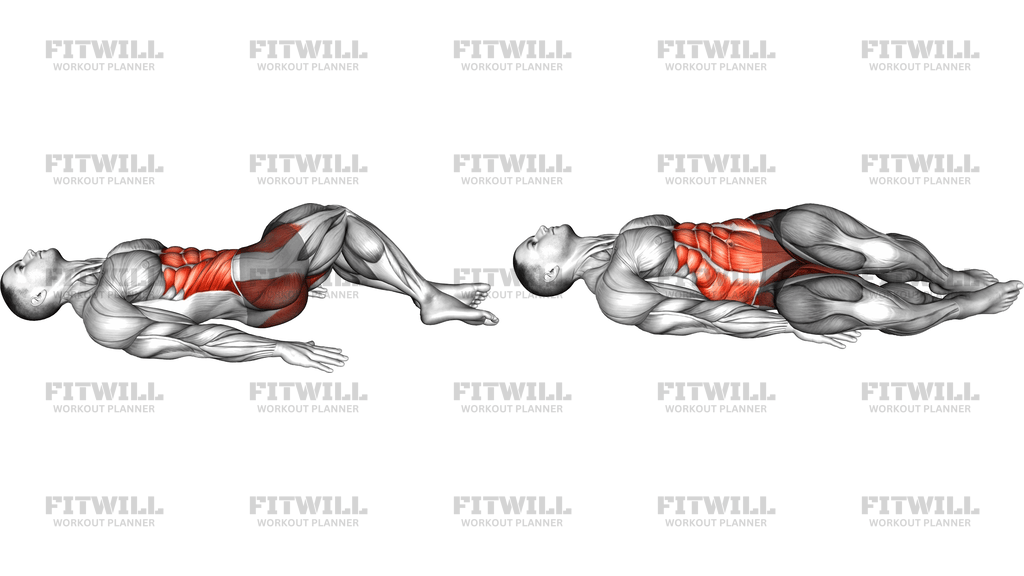
Instructions
- Lie on your back on an exercise mat with your arms resting at your sides, palms facing down, and your shoulders relaxed into the floor.
- Bend your knees and plant your feet flat on the floor about hip-width apart, heels roughly a hand's length from your glutes.
- Lightly brace your abdominal wall so your ribs settle down and your low back stays in contact with the mat.
- Keep both knees bent at the same angle and gently press them toward each other so they stay together as one unit.
- Slowly rotate both knees a few inches toward one side, letting the feet pivot on the balls of the feet without sliding across the floor.
- Pause briefly at the end of the rotation, keeping both shoulders and both sides of the pelvis flat against the mat.
- Control the knees back through center without resting, then continue the same slow arc to the opposite side.
- Exhale as the knees rotate away from center and inhale as they return through the middle.
- Alternate sides for equal reps, or complete all reps on one side before switching, then release the brace and stretch the legs out to reset.
Tips & Tricks
- The most common fault is the opposite shoulder peeling off the mat as the knees rotate — widen your arms slightly and press the back of that shoulder down to keep the rotation at the hip.
- If your low back starts to arch or twist, shorten the arc. A four-inch controlled sweep beats a floor-touch achieved by rolling the pelvis.
- Do not let the feet slide. If they creep across the mat, the friction is doing the stabilizing instead of your hip rotators — press the balls of the feet lightly into the floor.
- Keep the knees bent the entire time. Straightening the legs mid-rep turns this into a very different stretch and loads the knee rather than the hip.
- Move slower than feels necessary. Most people rush the return through center, which is where the internal rotators should be working eccentrically.
- A small yoga block or folded towel held between the knees keeps them traveling as one unit and instantly cleans up sloppy reps.
- If one side rotates noticeably further than the other, work to the range of the stiffer side rather than flogging the mobile side.
- Treat this as a warm-up or finisher, not a max-effort drill — the hip rotators are small muscles and respond better to tempo than to load.
Frequently Asked Questions
Which muscles does Lying Hip Internal Rotation work?
The hip internal rotators lead the movement, mainly the tensor fasciae latae and the anterior fibers of the gluteus medius, while the rotators on the opposite hip control the return. The obliques and deep core hold the pelvis and ribcage still throughout.
Why are both knees rotating when the exercise is called Lying Hip Internal Rotation?
When the knees sweep together to one side, the knee crossing toward your midline puts that hip through internal rotation while the other hip rotates externally. Alternating sides lets you train internal rotation on each hip within the same rep.
Do I need any equipment for Lying Hip Internal Rotation?
No. Just floor space, and an exercise mat makes it more comfortable for the spine and tailbone. Some people add a small block between the knees to keep them together.
How far should my knees lower toward the floor?
Only as far as you can keep both shoulders and both sides of the pelvis flat against the mat. For many people that is just a few inches each way, and that is a productive range.
Is Lying Hip Internal Rotation a strength exercise or a stretch?
It can serve both. Slow controlled reps with a deliberate return build rotational strength and control, while longer held pauses at the end range give a gentle mobility stretch through the hip capsule and rotators.
My lower back pinches when my knees rotate — what should I change?
Reduce the arc, re-brace so your low back stays flat on the mat, and make sure the rotation is coming from the hips rather than the pelvis rolling. If the pinch persists, stop and get the movement assessed by a qualified professional.
Can beginners do Lying Hip Internal Rotation?
Yes, it is one of the most beginner-friendly hip rotations because the floor supports the spine and there is no external load. Start with a small arc, eight reps per side, and expand the range only as control improves.
How is the lying version different from seated hip internal rotation?
Lying down removes the balance and postural demands of sitting, so it is easier to isolate the rotation at the hip joint. The seated version challenges the same rotators but adds a trunk-stabilization component.
When should I do Lying Hip Internal Rotation in my workout?
It works well as a hip warm-up before squats, deadlifts, or running, or as a gentle mobility finisher on lower-body days. One to three rounds of eight to twelve controlled sweeps per side covers most needs.
How do I know if my feet are doing too much of the work?
Watch your feet during a set — if they slide across the mat or one heel lifts early, the pivot is happening under your foot instead of at your hip. Lighten the pressure through the feet and re-anchor the balls of the feet before continuing.