Cable High Pulley Straight Bar Overhead Triceps Ex
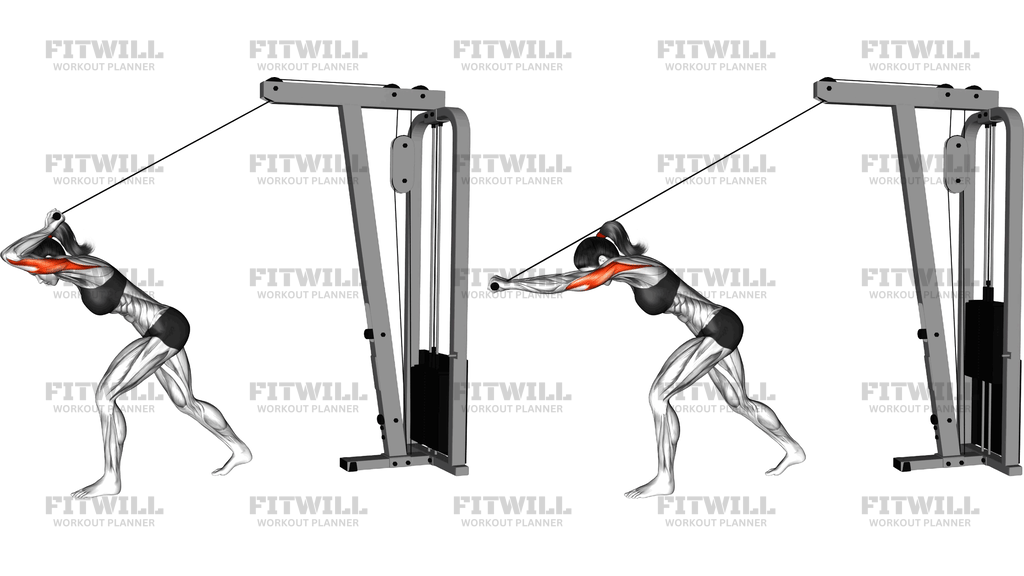
The Cable High Pulley Straight Bar Overhead Triceps Extension is a cable-based triceps exercise performed facing away from a high pulley. You grasp a straight bar attached to the upper pulley, bring it behind your head, and extend your elbows to press the bar forward and up against the cable's resistance. Unlike a standing pushdown, the overhead position puts the shoulder in flexion, which stretches the long head of the triceps and makes it work through a longer range.
This movement is a strong choice for anyone who wants to prioritize the long head of the triceps, which makes up most of the upper arm's visible mass. Bodybuilders use it to add arm size, and general lifters use it to balance out pressing work, since the triceps handle elbow extension in every press. The bent-over, split-stance setup also teaches you to stabilize your trunk while your arms move independently of it.
The cable's resistance comes from above and behind you, which changes the feel compared to dumbbells or an EZ bar. Tension stays on the triceps at both the stretched position behind your head and the locked-out finish in front, because gravity is not limiting factor—the pulley is. That constant tension is the main reason to choose this version over free-weight overhead extensions.
Setup matters more here than in most triceps work. If you stand too close to the machine the cable will drag the bar backward; too far and you lose tension at the start. A moderate distance with a staggered stance and a forward hip hinge gives the cable a clear path over your shoulder and keeps your lower back out of a strained position. Expect to adjust your distance from the pulley on your first few sessions until the start and end positions both feel loaded.
Execution should feel like a hinge with moving elbows, not a press. Your upper arms stay fixed beside or slightly above your ears while only the forearms swing through the arc. Keep your ribs down and brace your core, because the forward lean plus overhead cable pull will try to pull you into an overarched spine. Move deliberately, squeeze the triceps at full extension, and control the bar back behind your head rather than letting the stack yank you into the stretch.
Use this exercise as a secondary or finisher after presses or close-grip work, typically for sets of 8 to 15 reps. If your shoulders feel pinched at the deep stretch, shorten the range slightly or soften the forward lean until you find a comfortable arc.
[ Workout Log & Planner ]
Put your next workout in Fitwill
Keep your plan and training log ready when you are.


Instructions
- Attach a straight bar to the high pulley of a cable machine and set the pulley near the top position.
- Stand facing away from the machine, grip the bar with an overhand grip slightly narrower than shoulder width, and raise it over your head so it rests behind your neck.
- Step forward into a staggered stance with one foot ahead of the other, then hinge forward at the hips so your torso leans forward at roughly 45 degrees, keeping a straight back.
- Point your elbows forward and upward so they sit beside your head, and keep them fixed in that position throughout the set.
- Brace your core and pull your ribs down before each rep so the cable's overhead pull does not arch your lower back.
- Extend your elbows to swing the bar forward and up in an arc until your arms are straight and in line with the cable, pausing briefly with the triceps squeezed.
- Slowly bend your elbows to let the bar travel back behind your head until you feel a deep stretch in the triceps, resisting the stack's pull on the way down.
- Exhale as you extend the bar forward, inhale as you lower it back behind your head.
- Complete all reps with one foot forward, then switch your stance or continue symmetrically if you prefer a square stance, keeping your hips hinged the entire time.
- When finished, step back toward the machine and lower the bar with control rather than releasing it mid-air.
Tips & Tricks
- The most common mistake is turning this into a pressdown: once your torso rises upright, the overhead stretch on the long head disappears. Hold the forward hinge for every rep.
- If the cable rubs your head or shoulders or pulls the bar off-line, you are standing too close or too far from the pulley. Adjust your distance so the cable runs straight over your shoulder at both ends of the rep.
- Flared elbows drifting sideways shorten the triceps' work. Keep your elbows pointed forward and roughly shoulder-width apart so the forearms do all the moving.
- Your lower back is the weak link in this setup. If you feel it straining, hinge a little deeper at the hips and squeeze your glutes, or lighten the weight until your core can hold the position.
- Do not chase depth at the stretch if your shoulders complain. Stop the bar behind your head at a point where your elbows stay comfortable—overhead cable work does not require maximal range to be effective.
- Full elbow lockout is part of the exercise: many lifters stop a few degrees short. Straighten completely at the front and hold for a beat to finish the triceps contraction.
- Use a full grip with your thumbs wrapped around the bar. An open-thumb grip behind your head with a stack under tension is a needless risk.
- Keep your neck neutral by looking at the floor a short distance ahead of you instead of craning up to watch the machine.
- Start lighter than you think you need. The bent-over position plus the cable's overhead line makes moderate loads feel heavy on the trunk before your triceps fail.
Frequently Asked Questions
Which muscles does the Cable High Pulley Straight Bar Overhead Triceps Extension work?
The triceps brachii are the prime movers, with the long head receiving extra emphasis because the shoulder-flexed, overhead position places it under a deep stretch. Your core and hip stabilizers work isometrically to hold the hinged, staggered-stance posture.
Why is this version done bent over instead of standing upright?
The forward hinge creates room for the bar to travel in a full arc behind your head and aligns your torso better with the cable's line of pull. Standing too upright makes the movement cramped and shifts work away from the stretched position.
Is the Cable High Pulley Straight Bar Overhead Triceps Extension suitable for beginners?
Yes, provided you start with a light weight and learn the hinged setup first. Beginners often need a few sessions to find the right distance from the pulley and to keep the lower back neutral under the cable's pull.
How far should I stand from the cable machine?
Stand far enough forward that the cable runs straight over your shoulder and stays taut when the bar is behind your head, but not so far that you feel dragged backward. If the cable scrapes your head or the bar drifts, adjust your distance.
What is the most common mistake with this exercise?
Letting the elbows drift forward and back so the shoulders do the work instead of the triceps. Pin your upper arms beside your head and move only from the elbow joint.
Can I use a rope or handle instead of the straight bar?
Yes, a rope attachment works with the same setup and allows a slightly different wrist angle at lockout, which some lifters find friendlier on the elbows. The straight bar keeps the grip fixed and the path simple, so it is a good place to start.
My lower back feels strained during the set. What should I change?
Check that you are hinging at the hips rather than rounding or overarched, brace your core before each rep, and reduce the weight. A staggered stance also helps you hold the position with less spinal stress.
How does this exercise differ from a standing triceps pushdown?
The pushdown keeps your upper arms at your sides, which minimizes long-head stretch, while the overhead version flexes the shoulders and loads the triceps from a lengthened position. Using both in a program covers the muscle from different angles.
How many reps and sets should I do?
Two to four sets of 8 to 15 reps works well, usually after your main pressing or close-grip movements. The cable's constant tension makes moderate loads productive, so prioritize controlled reps over maximum weight.
Is it safe to let the bar go behind my head with the stack under tension?
It is safe when the weight is controlled and your grip is secure, but never release the bar mid-rep or use a load you cannot slowly return. Keep a full overhand grip and control the bar all the way back behind your head on every rep.