Sitting Lotus Rest Pose
Sitting Lotus Rest Pose is a classic cross-legged seated position in which each foot rests on top of the opposite thigh, with the soles turned upward and the spine held tall. Despite its calm appearance, it places a significant demand on the hips: the thighs must rotate outward, the knees fold fully, and the ankles extend over the opposite leg. For that reason, it is treated less as an exercise to force and more as a restorative position to settle into gradually.
This pose is useful for anyone who spends long hours sitting in chairs, runners and lifters whose hips tend to be tight, and practitioners of yoga or meditation who want a stable, symmetrical seat for breathing work. Because the crossed legs create a wide, tripod-like base, the torso has far less to do than in a chair seat, which makes it easier to sit upright with minimal effort for extended periods.
The main areas worked are the external rotators and adductors of the hips, along with the muscles around the knees and ankles that adapt to the folded position. You will also feel gentle work in the mid and upper back as they hold the chest open, and in the core as it maintains a neutral, upright spine without any backrest to lean on.
Setup matters more in this pose than in almost any other seated position. If the hips are not warm enough or the knees are pushed down before they are ready, the lower back rounds and the knees take strain they are not built to absorb. Sit on the front edge of a folded blanket or firm cushion so the hips sit slightly higher than the knees, and let the legs arrange themselves rather than forcing the feet into place.
To execute it well, sit on your elevated seat, draw one heel in toward the lower belly, then bring the opposite foot across so it rests on the top of the opposite thigh, sole facing up. Rest the backs of the hands on the knees, lengthen through the crown of the head, and let the shoulders drop away from the ears. Breathe slowly through the nose and allow the hips to release a little more with each exhale. Never bounce or press the knees toward the floor; gravity and time do the work.
If full lotus is not available to you, half lotus with one foot on the thigh and the other tucked underneath, or simple cross-legged sitting, are excellent substitutes that deliver much of the same hip mobility benefit. Come out of the pose slowly, straighten one leg at a time, and pause before switching sides. Any sharp sensation in the knee or ankle is a clear signal to ease out immediately.
[ Workout Log & Planner ]
Put your next workout in Fitwill
Keep your plan and training log ready when you are.


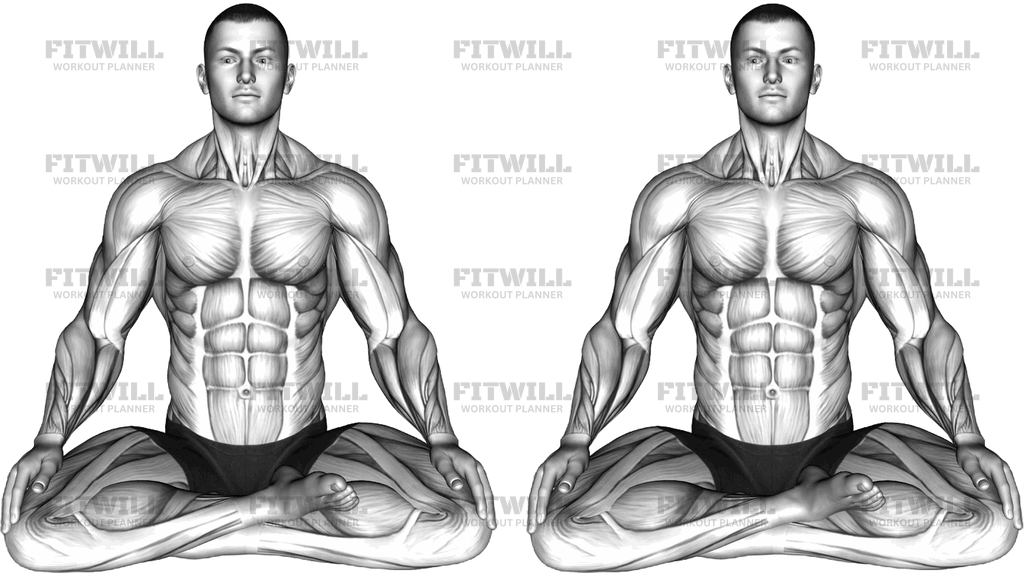
Instructions
- Sit on the front edge of a firm cushion or folded blanket so your hips are slightly higher than your knees, with your legs extended in front of you.
- Bend your right knee and draw the heel in toward your lower belly, letting the right knee fall out to the side.
- With your hands supporting the right foot and ankle, bring the right foot across and place the outer edge of the foot high on the left thigh, sole facing upward.
- Bend the left knee and, supporting the ankle with both hands, guide the left foot on top of the right thigh in the same way, so both shins cross in front and both soles face up.
- Slide the sitting bones apart and root them evenly into the cushion, then lengthen the spine from the pelvis up through the crown of the head.
- Rest the backs of your hands on your knees, palms down, with the shoulders relaxed away from the ears and the chest open.
- Take slow, even breaths through the nose, letting the hips soften a little more on each exhale while keeping the spine tall.
- Hold the position for 30 seconds to several minutes, depending on comfort, without pressing the knees toward the floor.
- To finish, support one foot at a time with your hands, gently lower the legs to the floor, and straighten both legs fully before repeating on the opposite side first.
Tips & Tricks
- If your knees float well above the floor, add height under the hips before anything else. Elevation reduces how far the hips must rotate and immediately relieves knee strain.
- A common mistake is yanking the feet into position by pulling on the toes or arch. Always lift and guide the foot with one hand under the heel and one on the ankle.
- If one knee feels pinched or sore, come out of the pose rather than pushing through. Knee discomfort in Sitting Lotus Rest Pose almost always means the hips need more preparation, not more force.
- Warm the hips first with a few rounds of seated external rotations or bound angle pose. Trying to enter lotus cold is the fastest route to a strained groin.
- Keep weight slightly forward on the sitting bones. Sitting too far back on the tailbone rounds the lower back and shifts the effort away from the hips.
- Alternate which leg crosses on top each session. Favoring the same side every time builds an asymmetry that becomes harder to unwind later.
- If the feet cannot reach the thighs, use half lotus with one foot on the thigh and the other tucked in. The pose should match your hips today, not a target shape.
- Avoid forcing the soles to face upward. A foot resting lower on the leg with a neutral sole is fine until ankle mobility improves.
- Come out of the pose slowly and straighten the legs one at a time. Standing up or unfolding both legs at once can aggravate a knee that has been folded for several minutes.
Frequently Asked Questions
Which muscles and joints does Sitting Lotus Rest Pose target?
It primarily challenges the hip external rotators and inner thigh muscles, including the adductors, while the deep hip flexors and glutes adapt to the folded position. The back and core work quietly to keep the torso upright without a chair or backrest.
Is Sitting Lotus Rest Pose safe for beginners?
Beginners should start with simple cross-legged sitting or half lotus, where one foot rests on the floor. Full lotus demands substantial hip rotation, and forcing it before the hips are ready usually loads the knees instead.
Why should my hips be higher than my knees in this pose?
Sitting on a cushion tilts the pelvis slightly forward, which lets the spine stay upright and reduces how far the hips must externally rotate. Without that height, the lower back rounds and the knees take extra stress.
I feel discomfort in my knee, not my hip. Is that normal?
No. The knee is a hinge joint and should not feel pinched or twisted in this position. Come out of the pose slowly, add more height under the hips, or switch to half lotus until your hips open further.
How long should I hold Sitting Lotus Rest Pose?
Start with 30 to 60 seconds per side and build toward several minutes as comfort allows. The pose is meant to be a stable resting seat, so duration should grow through comfort, not through enduring pain.
Can I use this pose as a substitute for seated meditation posture?
Yes, that is one of its main uses. The wide crossed-leg base supports the torso with minimal muscular effort, which makes it easier to focus on breathing or meditation. Use a cushion if full lotus is not yet available.
What should I do if I cannot get my feet onto my thighs at all?
Sit cross-legged with both feet on the floor, or use half lotus with just one foot raised. Progress to full lotus over weeks or months as hip mobility improves; there is no benefit to skipping stages.
How often should I practice Sitting Lotus Rest Pose?
Daily practice is reasonable since the pose is gentle when matched to your current mobility. Even a few minutes after a warm shower or light activity helps the hips gradually accept the position.
Should I press my knees down toward the floor in this pose?
No. Pressing the knees down transfers force into the knee joint and can strain the inner thigh attachment. Let gravity and relaxed breathing ease the knees lower over time.