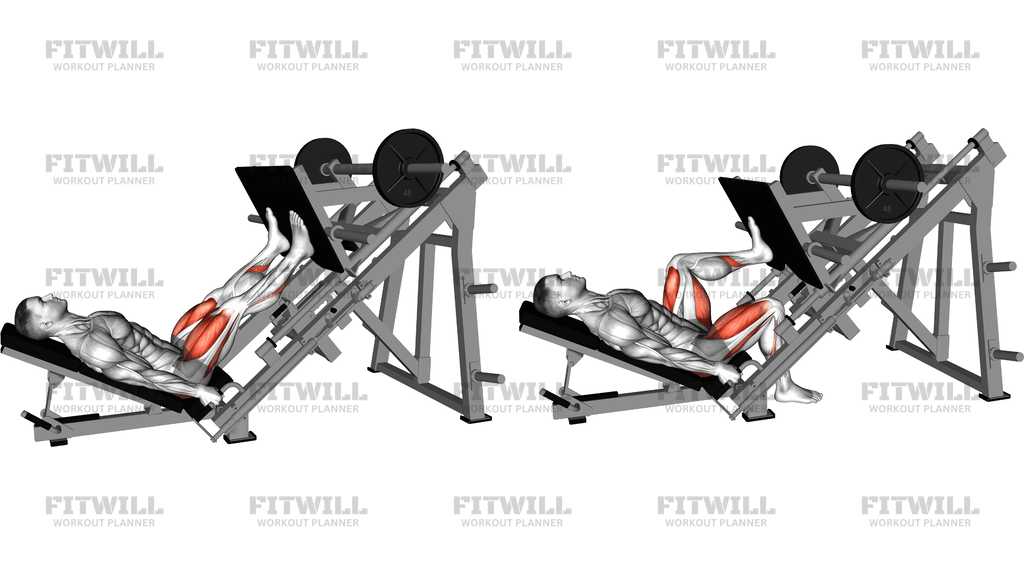
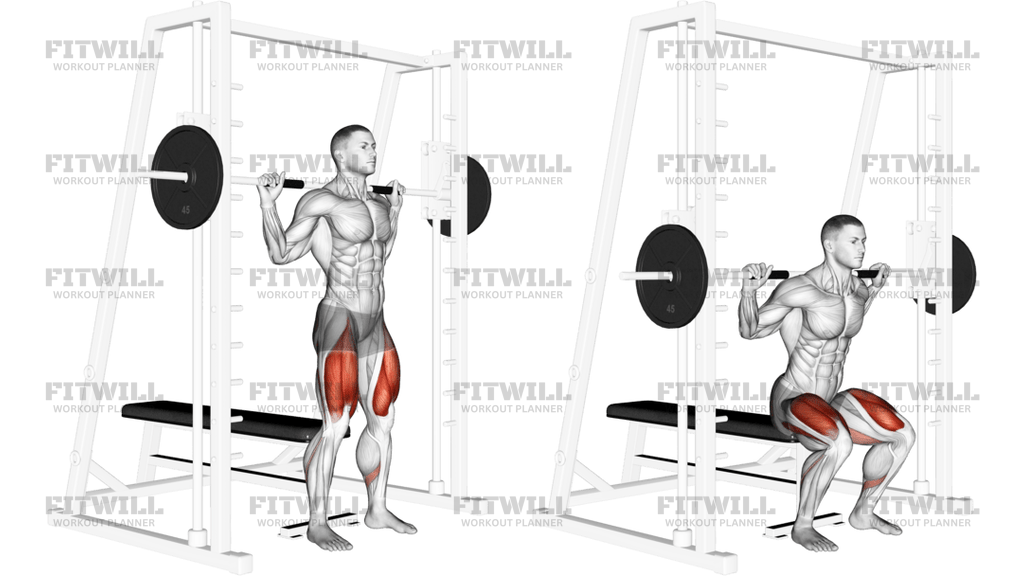
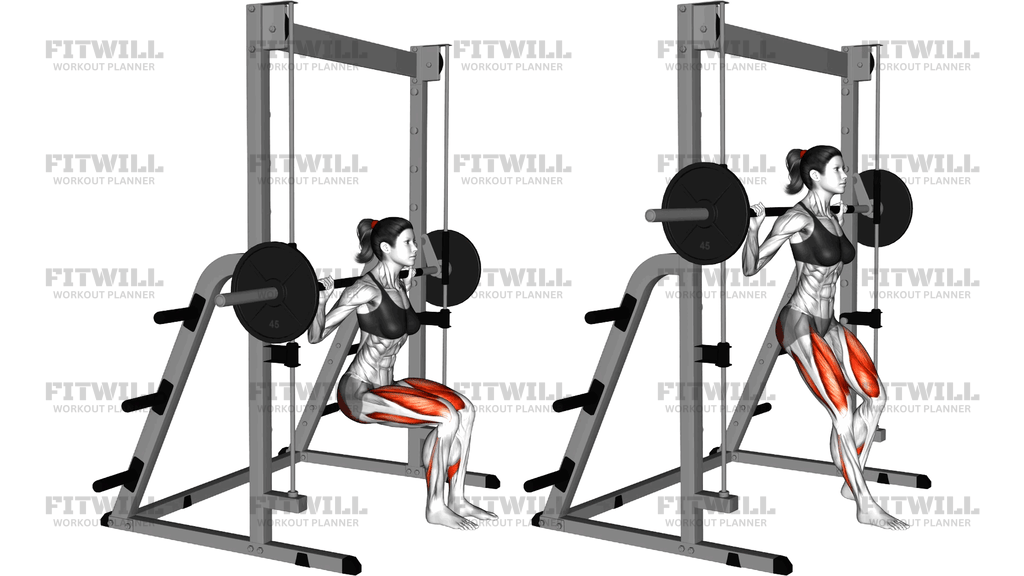
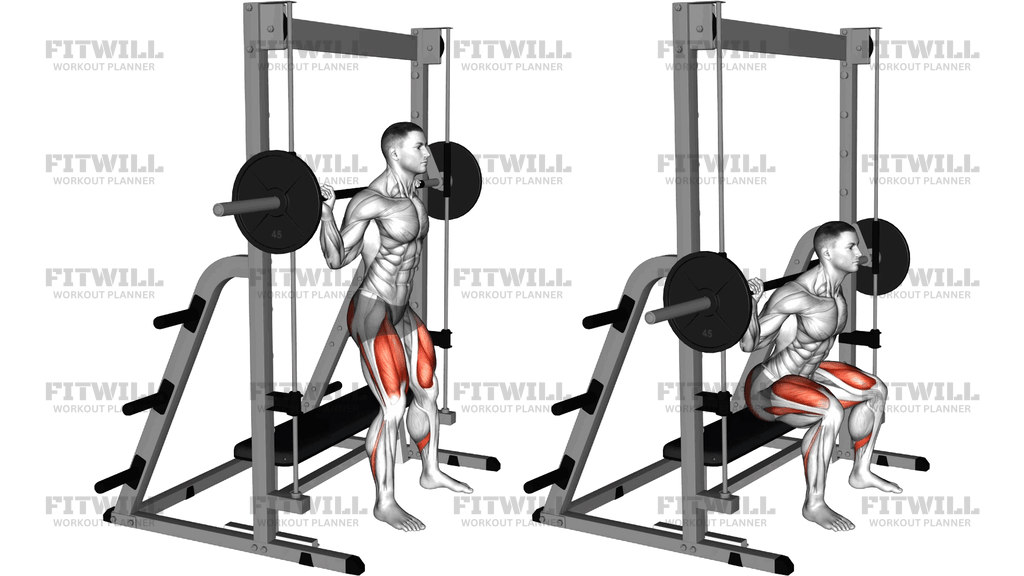
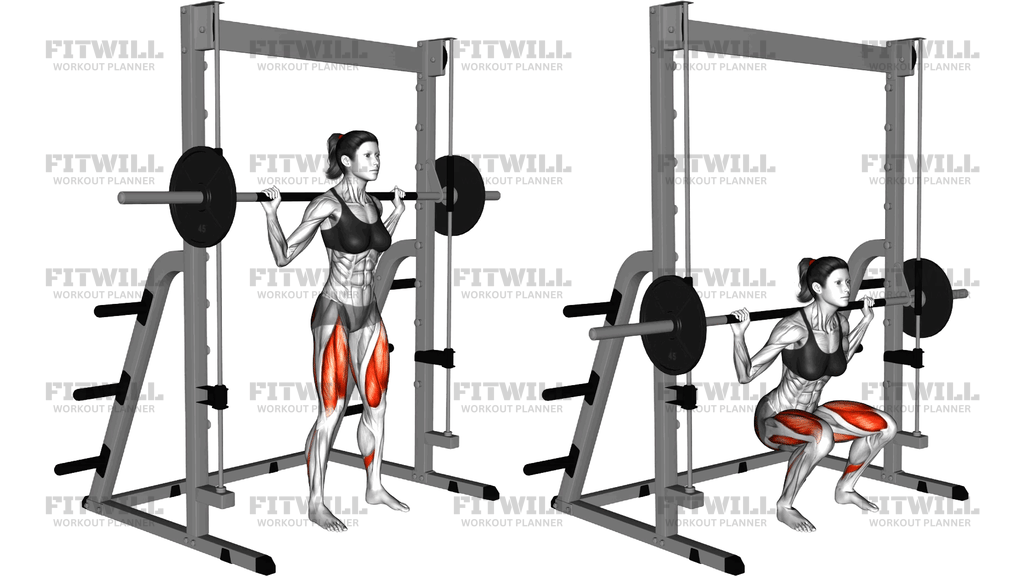
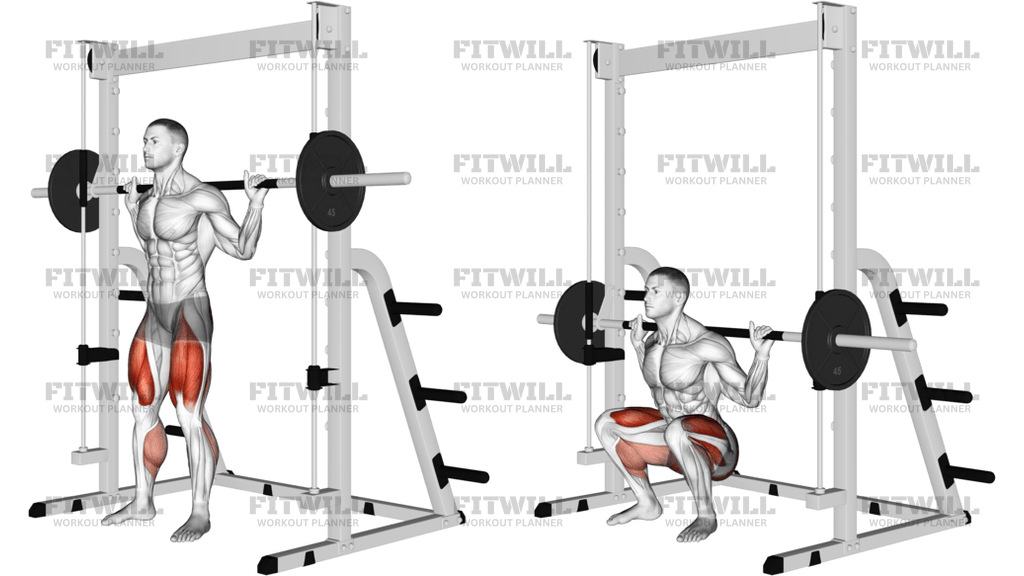
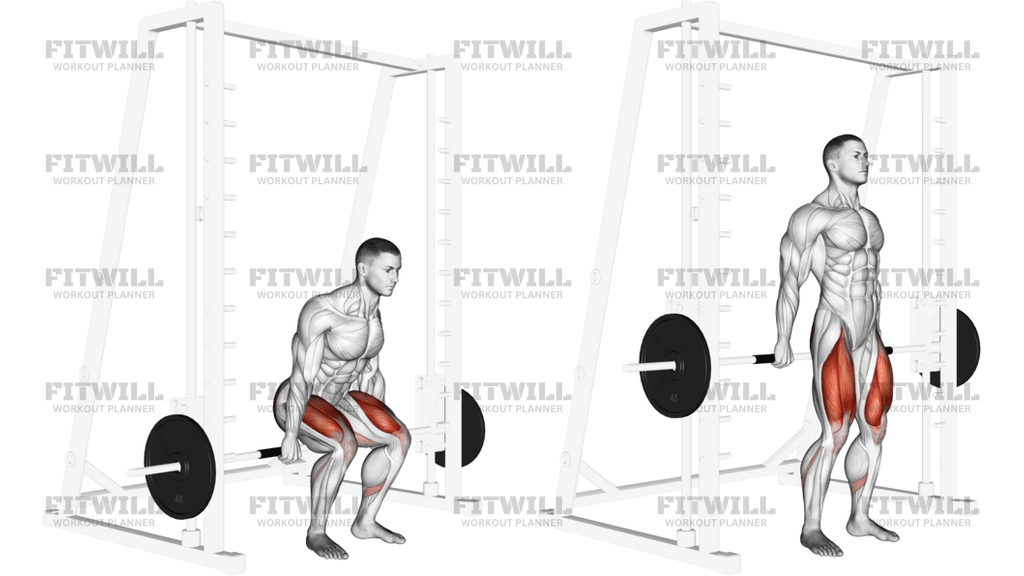
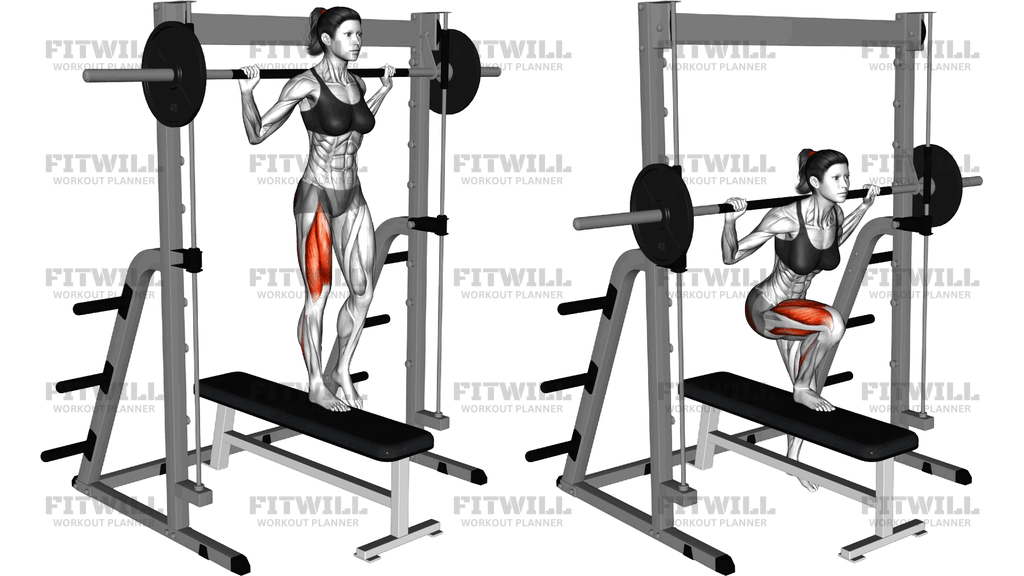
Smith Elevated Split Squat
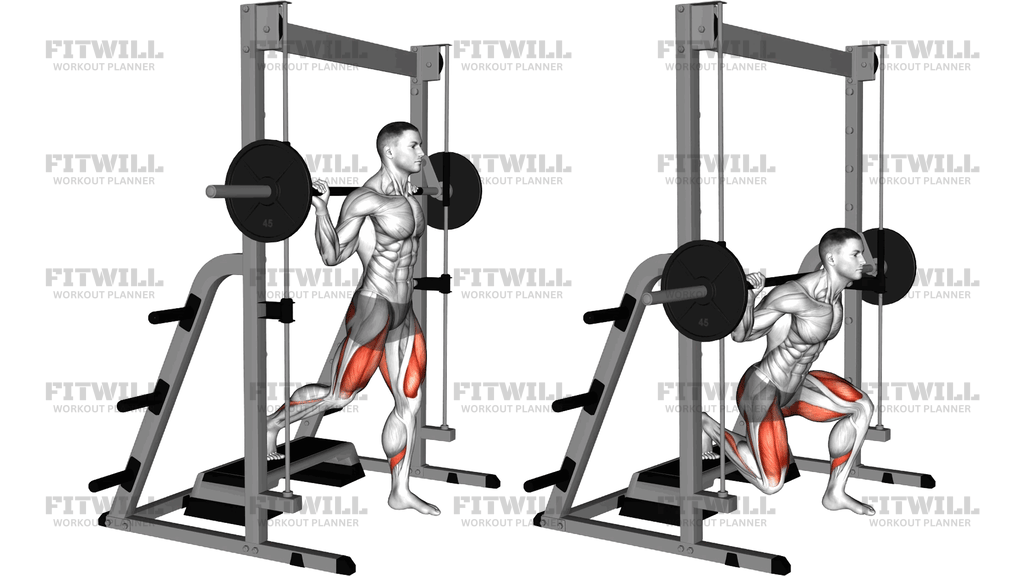
The Smith Elevated Split Squat is a single-leg strength exercise performed with the bar of a Smith machine resting across your upper back and your rear foot elevated on a step platform or low box behind you. Your front foot stays flat on the floor while you lower your body until the front thigh is roughly parallel to the ground, then drive back up through the front leg. The fixed bar path of the Smith machine removes the balance demands of a free-weight split squat, letting you concentrate entirely on loading the working leg.
This movement primarily targets the quadriceps of the front leg, with the glutes and hamstrings of that same leg contributing heavily as you rise from the bottom. The elevated rear foot shifts more load onto the front leg and increases the demand on the hip flexors and quads of the trailing leg as they stretch under load. Because each side works independently, the exercise also exposes and helps correct left-to-right strength differences that bilateral squats can hide.
The setup matters more here than in most machine work. Rear foot height typically falls between knee height and mid-shin; the higher the platform, the deeper the hip flexion and the more the glutes and hamstrings of the front leg get involved. The Smith bar should be set so that when you stand with feet split, the bar naturally stays close to your vertical line of support through the entire descent. Getting this position wrong forces you to reach for the bar or lean excessively, which steals tension from the target leg.
Execution is about controlled depth and a stable front knee. Lower until your rear knee nearly touches or lightly kisses the floor, keeping the front shin close to vertical and your torso upright with a slight forward lean at most. Push the floor away through the whole front foot, exhaling as you rise. Avoid letting the front heel lift or the front knee collapse inward at the bottom.
This exercise suits lifters who want quad-dominant single-leg work without the balance struggle of dumbbell Bulgarian split squats, and it works well as an accessory after heavier squats or as a primary lower-body lift on its own. Because the Smith machine includes safety stops, it is also a practical option for training close to failure on one leg without a spotter. Start with a modest load and master the foot positions before chasing weight, since small stance errors multiply quickly under a heavy bar.
[ Workout Log & Planner ]
Put your next workout in Fitwill
Keep your plan and training log ready when you are.


Instructions
- Set the Smith machine bar at roughly upper-back height and load plates evenly on both sides, then set a step platform or low box one to two feet behind the bar.
- Step under the bar, place it across your upper traps, grip the bar with a slightly wider than shoulder-width overhand grip, and unrack it by standing tall and rotating the bar to release the safety hooks.
- Step your front foot forward two to three feet so it lands flat on the floor, then reach back with your other leg and place the top of that foot or the ball of it on the step platform behind you.
- Adjust your front foot distance so your shin stays close to vertical when you lower, and center the front foot so the bar tracks over the middle of it.
- Brace your core, lift your chest, and look straight ahead to set a neutral spine before the first rep.
- Bend the front knee and hip to lower your body straight down, letting the rear knee travel toward the floor until it is just above or lightly touches the ground.
- Pause briefly at the bottom, then drive through the heel and midfoot of the front leg to push back up to the starting position without locking the front knee.
- Inhale as you lower and exhale as you press up, keeping the breath steady through each rep.
- Complete all reps on one leg, re-rack the bar by rotating it back onto the hooks while standing tall, then switch sides and repeat.
- Reset your stance fully between sets rather than hopping your feet around, since consistent foot placement keeps the movement repeatable.
Tips & Tricks
- If your front heel lifts at the bottom, move the front foot an inch or two forward; a shortened stance is the most common cause of heel lift in this setup.
- Watch that the front knee tracks over the second and third toes; if it caves inward, consciously spread the floor with your foot as you descend.
- Keep most of your weight on the front leg, roughly 80 percent or more; the rear foot on the platform is a support point, not a working leg.
- The Smith bar moves in a fixed vertical line, so you cannot lean it back for balance like a barbell; stay positioned slightly ahead of the bar line from the first rep onward.
- Do not bounce the rear knee off the floor; a soft touch and brief pause build more control than rushing the rep.
- Higher platform angles stretch the rear hip flexor hard, so if you feel a pinching sensation at the front of the trailing hip, lower the platform height before loading more.
- Grip the bar firmly and pull your elbows slightly down and back to keep your upper back tight, which prevents the bar from rolling forward as you lean into the descent.
- Set the Smith machine safety stops below the bar's lowest position so that if you lose footing, the bar has somewhere to catch other than you.
- If your rear foot slips on the platform, place the shoelace side of the foot down instead of the toes, or use a platform with a textured surface.
Frequently Asked Questions
What muscles does the Smith Elevated Split Squat work?
The quadriceps of the front leg do most of the work, with strong contributions from the glutes and hamstrings as you drive up from the bottom. The rear leg's hip flexors and calves help stabilize the trailing position.
How is the Smith Elevated Split Squat different from a Bulgarian split squat with dumbbells?
The Smith machine fixes the bar on a vertical track, so you spend almost no effort balancing the weight side to side or front to back. This makes it easier to load the front leg hard and progress in small weight increments, though it sacrifices some free-weight carryover.
How high should the platform be for the rear foot?
Most lifters do well with a step platform around knee height or slightly lower. A higher surface increases the stretch on the rear hip and shifts more emphasis to the front leg's glutes and hamstrings, but only use a height that lets you keep a vertical front shin.
Is the Smith Elevated Split Squat good for beginners?
Yes, and it is often friendlier than a free-weight split squat because the fixed bar path removes balance demands. Beginners should start with just the unloaded bar or light plates to learn the foot positions before adding significant load.
Where exactly should the bar sit on my back?
Rest it across your upper traps, the same shelf used for a back squat, not on your neck. Pull your shoulder blades together and keep your elbows down so the bar stays secure through the descent.
Why does my rear knee hurt when I do this exercise?
Pressure on the kneecap of the trailing leg usually comes from dropping the knee hard onto the floor or from a rear foot position that is too high. Lower the platform height, place the laces of that foot flat on the surface, and control the descent so the knee touches down softly if at all.
Should I do both legs in one set or finish one side first?
Finish all reps on one leg, then re-rack the bar and switch sides. This keeps setup consistent and lets you match the weaker leg's rep count rather than letting fatigue drift between sides.
How far forward should my front foot be from the Smith bar?
Far enough that when you descend, your front shin stays close to vertical and your knee does not shoot far past your toes. For most people this lands the front foot two to three feet ahead of the bar.
What can I use if I do not have a Smith machine?
A barbell or a pair of dumbbells performed as a standard Bulgarian split squat trains the same pattern, with the tradeoff of greater balance demands. A leg press or a lunge variation can substitute when rear-foot elevation is not available.
Are there any safety precautions specific to this exercise?
Set the Smith machine's safety stops so the bar can catch the weight if you lose your footing, since exiting a split squat under load is awkward. Keep the front knee tracking over the foot and avoid adding weight until you can control the full depth on both sides.