Wide Stance Thoracic Rotation
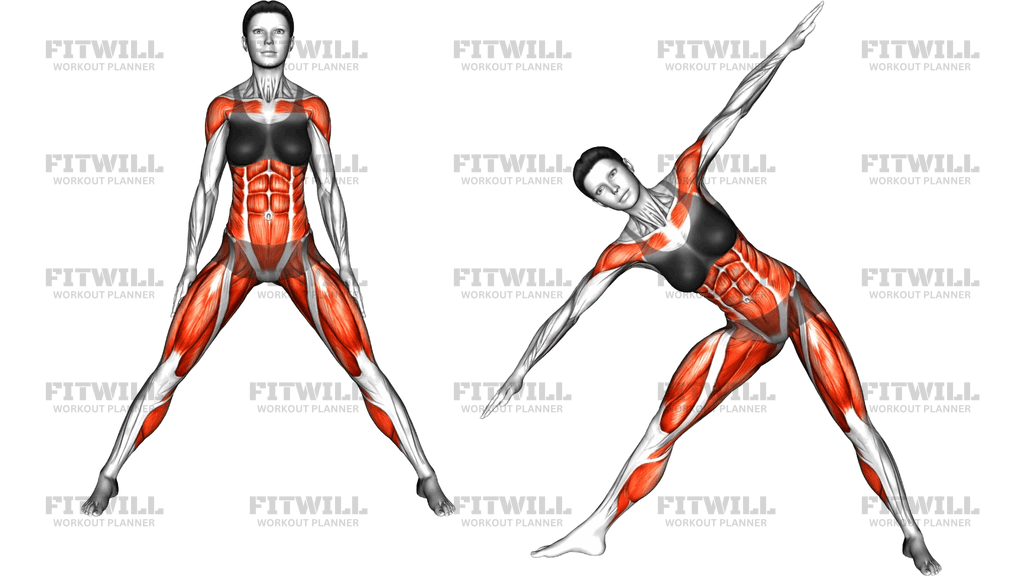
The Wide Stance Thoracic Rotation is a body-weight mobility drill that combines a wide-legged forward fold with a rotating reach through the upper spine. You set your feet much wider than your shoulders, hinge forward at the hips, and then sweep one arm down toward the floor or opposite foot while the other arm rotates up and open toward the ceiling. The result is a stretch that travels through the mid-back, the sides of the waist, the lats, and the backs of the legs all at once.
Most adults lose rotational range in the thoracic spine long before they notice it, usually from long hours seated at a desk or behind a wheel. Because the lower back and hips are pinned in place by the forward-fold position, this drill forces the rotation to come from the mid-back where it belongs. That makes it a favorite warm-up for golf, tennis, baseball, throwing sports, and any strength session involving presses, rows, or overhead work.
The wide stance does more than just stretch the hamstrings and adductors. It lowers your center of gravity, gives you a stable base, and creates room for the torso to rotate without the hips twisting along. One hand stays anchored down toward the floor, which acts as a reference point so the turning happens in the ribs and shoulder blade rather than as a whole-body wobble.
To perform it well, hinge from the hips with a long, neutral spine rather than rounding into a slouch. Let the head hang heavy so the neck stays relaxed, and move the rotating arm slowly, letting the eyes follow the hand. The arm that reaches up should stay long and open through the chest rather than collapsing inward. Depth matters less than smoothness; a smaller, controlled turn with steady breathing beats a forced yank toward the ceiling every time.
This movement fits naturally at the start of a workout, between heavy sets to keep the mid-back loose, or as part of an evening wind-down. Because it loads the hamstrings and inner thighs in a lengthened position, ease into it gradually, especially on cold mornings or after long sitting sessions. If you feel pinching in the shoulder or strain in the lower back rather than a comfortable stretch through the back and sides, reduce the depth of the fold or the height of the reach.
[ Workout Log & Planner ]
Put your next workout in Fitwill
Keep your plan and training log ready when you are.


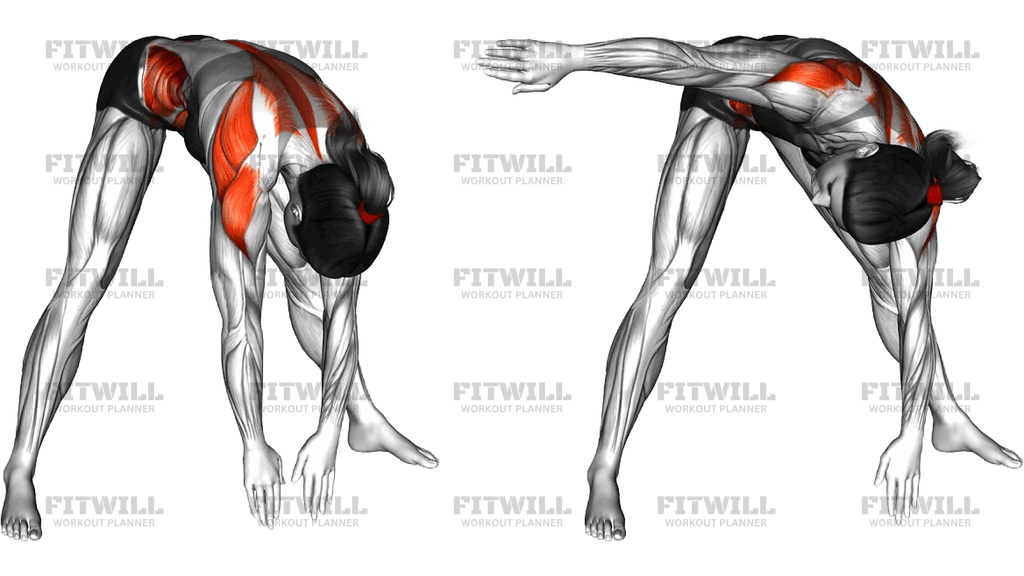
Instructions
- Stand with your feet roughly one and a half shoulder-widths apart, toes angled slightly inward, and soften your knees.
- Hinge forward at the hips and fold your torso down between your legs, letting both arms hang toward the floor with a long, flat back.
- Relax your head and neck so they hang heavy, and settle your weight evenly across both feet.
- Reach your right hand down toward the floor or across toward your left foot to anchor the shoulder blade of that side.
- Begin rotating your upper spine open by sweeping your left arm out and up, letting the ribs and shoulder blade turn with it while your hips stay square.
- Follow the moving hand with your eyes so the neck rotates in rhythm with the thoracic spine, and hold the open position for two to three calm breaths.
- Exhale slowly as you rotate open, and inhale as you lower the arm back down to the hanging position under control.
- Complete the desired number of rotations on the left side, then anchor the left hand down and repeat the sequence rotating to the right.
- To finish, walk your feet in slightly, place both hands on your thighs, and use your legs to roll the torso back up to standing, keeping the spine long.
Tips & Tricks
- The most common mistake is twisting from the lower back because the fold is too shallow. Hinge deeper at the hips first so the lumbar spine is locked into flexion and the rotation has to come from the ribs.
- If your hamstrings pull your pelvis under and round your back aggressively, bend the knees more. A soft knee in this drill protects the lower back without removing the stretch.
- Do not force the top arm toward the ceiling. Opening it out to the side at roughly shoulder-line height, as in the mid-range of the sweep, keeps the shoulder joint in a comfortable path.
- Keep the anchored hand reaching actively toward the floor instead of just resting it. That downward reach is what stops the opposite shoulder blade from collapsing.
- If balance is shaky, shorten the stance slightly or place a hand on a low bench. Stability in the legs matters more than depth for this movement.
- Let the head hang rather than craning it up to watch the arm. Only rotate the gaze as far as the neck turns comfortably; the eyes can lead the hand, not chase it.
- Move at half the speed you think you need. Rushing the sweep usually means the ribs are not rotating and the shoulder is doing all the work.
- If you feel a pinching sensation at the front of the rotating shoulder, lower the angle of the reach and think about turning the thumb of that hand toward the floor as the arm opens.
- Breathe out fully at the end of each rotation. The ribs settle a little further into the turn on each exhale, which is where the real range is found.
Frequently Asked Questions
What does the Wide Stance Thoracic Rotation primarily stretch?
It targets the rotational muscles of the mid-back and the sides of the waist, including the obliques, along with the lats and rear shoulders. The wide forward fold also lengthens the hamstrings and inner thighs at the same time.
Why does the Wide Stance Thoracic Rotation use such a wide stance instead of a normal shoulder-width stance?
The wide stance lowers the torso deeper between the legs and pins the hips in place, which stops them from twisting during the rotation. That forces the turn to come from the thoracic spine rather than the lower back.
Is the Wide Stance Thoracic Rotation suitable for beginners?
Yes, as long as the range is kept modest and the knees stay soft. Beginners often benefit most from it because prolonged sitting reduces mid-back rotation early in life, and this drill addresses that with no equipment.
How is the Wide Stance Thoracic Rotation different from a standing open-book or quadruped rotation?
The wide forward fold adds a strong posterior-chain stretch and removes the hips from the equation, while quadruped and open-book variations support the torso and suit people who cannot fold comfortably. Choose the folded version when the hamstrings and mid-back need attention together.
Should I hold the Wide Stance Thoracic Rotation at the top or move through repetitions?
Both work. Moving slowly through controlled repetitions warms the spine up before training, while holding the open position for two or three breaths per side works well as a standalone flexibility session.
My hand cannot reach the floor during the Wide Stance Thoracic Rotation. Is that a problem?
Not at all. The reaching hand does not need to touch anything; simply reaching toward the floor or across toward the opposite foot creates the anchoring effect. A yoga block or low bench under that hand works fine.
Why do I feel the Wide Stance Thoracic Rotation mostly in my hamstrings instead of my back?
That usually means the fold is shallow and your hamstrings are limiting how far the hips hinge. Bend the knees noticeably and fold deeper so the pelvis can tilt properly, which takes tension off the hamstrings and lets the ribs rotate.
Can the Wide Stance Thoracic Rotation help before golf or tennis?
It is a common warm-up for rotational sports because it opens the exact range the swing demands. Do eight to ten smooth rotations per side before playing to prime the mid-back.
Is it safe to do the Wide Stance Thoracic Rotation with lower back issues?
The folded, hip-locked position is generally gentle on the lumbar spine, but anyone with an active back problem should move within a pain-free range and keep the rotation shallow. Stop and consult a professional if the drill provokes symptoms.
How many sets of the Wide Stance Thoracic Rotation should I do?
One to three rounds of six to ten controlled rotations per side is plenty for most people. Use more reps and lighter holds before workouts, and longer holds of twenty to thirty seconds when training flexibility.