Sitting Alternate Palm Push And March On A Chair
Sitting Alternate Palm Push And March On A Chair is a seated, low-impact coordination drill that combines an alternating forward palm press with a slow knee lift on the opposite side. You sit upright on a sturdy chair with your hands raised to shoulder height and palms facing forward, then extend one arm forward as if pushing something away from your chest while the opposite knee lifts toward you. The two sides trade roles in a steady rhythm, which keeps your upper body pressing while your lower body marches underneath you.
This movement works the chest and front of the shoulders as the pressing muscles, with the triceps finishing each arm extension. The marching knee lift recruits the hip flexors, and holding your torso tall while one leg moves challenges the abdominal muscles to keep your spine from swaying. Because you alternate sides, your core also works to resist rotation every time one arm and one leg move independently of the other pair.
It is a genuinely useful exercise for beginners, older adults, anyone returning from a layoff, and people who train at a desk or in a small space with no equipment beyond a chair. Seated marching alone is a common warm-up, but adding the palm press turns it into a full-body coordination task that raises your heart rate without any jumping or joint pounding.
Setup matters more than it looks. A chair without wheels, with your feet flat on the floor and your sit bones planted evenly, gives you a stable base so the pressing and lifting come from your muscles rather than from rocking your body. Sitting too far forward or slouching back onto the tailbone shortens the press and makes the knee lift feel unstable, so take a moment to stack your ribs over your hips before you start.
To execute it well, think of two separate but linked actions: the arm punches straight forward from the shoulder at chest height, and the knee rises only as high as you can lift it without your lower back rounding or your torso dumping backward. Exhale as the arm extends and the knee lifts, inhale as each side returns. The rhythm should feel smooth, like a slow cross-body march done entirely from your chair.
Common use cases include seated warm-ups, active recovery between heavier exercises, desk-break routines, and low-impact conditioning circuits for seniors or rehab clients. Move deliberately rather than quickly at first; once the opposite arm and leg pattern feels automatic, you can speed up slightly or add more repetitions to make it a light conditioning challenge.
[ Workout Log & Planner ]
Put your next workout in Fitwill
Keep your plan and training log ready when you are.


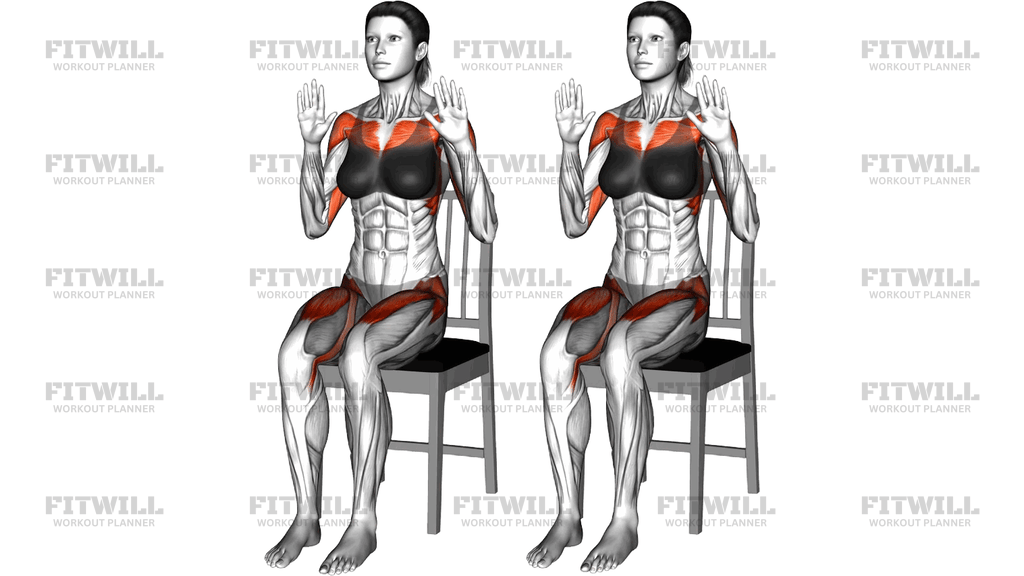
Instructions
- Sit on a sturdy, armless chair with your feet flat on the floor about hip-width apart and your sit bones planted evenly on the seat.
- Sit tall with your ribs stacked over your hips, then raise both arms so your elbows are bent to roughly 90 degrees, upper arms relaxed at your sides, and palms facing forward at about ear-to-shoulder height.
- Brace your abdominals lightly as if preparing for a gentle nudge, and keep your shoulders down away from your ears.
- Press your right palm straight forward, extending the arm fully at chest height, as if pushing a door open away from your body.
- At the same moment, lift your left knee upward a few inches off the chair's natural leg position, keeping your torso upright and tall.
- Pause briefly at the end position with the right arm extended and the left knee lifted, feeling the chest and front of the shoulder engaged.
- Bend the right elbow to bring the palm back to the start while lowering the left foot back to the floor with control, then immediately switch sides.
- Exhale as each arm presses and the opposite knee rises; inhale as that pair returns to the starting position.
- Continue alternating arm-and-leg pairs for your target number of repetitions or a set time, keeping the rhythm even from side to side.
- To finish, complete the last repetition on both sides, place both feet flat, lower your hands to your lap, and sit still for a breath before standing.
Tips & Tricks
- The most common error is leaning your torso backward as the knee lifts; if you feel yourself tipping, reduce the knee height until you can stay stacked over your sit bones.
- Avoid letting the pressing hand drift above shoulder height or drop below chest level; imagine pushing a wall directly in front of the middle of your chest.
- Do not let the shoulders creep up toward the ears during the press, which is easy to do with hands held high; drop and relax the shoulder blades between reps.
- If your chair slides or feels tippy, place it against a wall so it cannot rock as you alternate sides.
- Keep both hands up and palms forward even when one arm is resting; letting the idle hand fall breaks the rhythm and shortens the chest work on each side.
- Speed is the usual culprit when the pattern falls apart; slow down until opposite arm and knee always move together before adding pace.
- Keep the marching knee moving straight up rather than swinging outward, which keeps the work in the hip flexors instead of the outer hip.
- If your lower back arches as the leg lifts, tighten the abdominal brace slightly and shorten the lift range rather than stopping the exercise altogether.
- For a light conditioning effect, count continuous alternating reps for 30-60 seconds instead of counting single reps per side.
Frequently Asked Questions
What muscles does Sitting Alternate Palm Push And March On A Chair work?
The primary movers are the chest and front shoulders during the palm press, assisted by the triceps extending the arm. The marching knee lift brings in the hip flexors, and the abdominals stabilize your torso as opposite limbs move.
Why does the palm press pair with the opposite knee instead of the same side?
Opposite arm and leg moving together is the natural cross-body pattern your body uses in walking and running, and it forces your core to control rotation. Same-side pairing feels awkward and trains less useful coordination.
Is this exercise suitable for complete beginners and older adults?
Yes. It is seated, low-impact, and requires only a stable chair, which makes it a common choice for seniors, beginners, and people easing back into training. Start with a slow tempo and a modest knee height.
How high should I lift my knee during the march?
Lift it only as high as you can while keeping your torso upright and your lower back neutral. For most people that is a few inches to thigh-level; height matters far less than keeping your posture tall.
Can I do Sitting Alternate Palm Push And March On A Chair every day?
Yes, the load is light enough that most people can use it daily as a warm-up, posture break, or gentle circulation booster. If your shoulders feel sore from pressing, give them a rest day.
What kind of chair should I use?
Use a sturdy, armless chair without wheels, ideally with a firm seat, placed on a non-slip surface or against a wall. Office chairs with casters or soft folding chairs can slide or tip as you alternate sides.
Why do my shoulders rise up toward my ears when I press?
The hands are held at shoulder height, so the upper traps tend to take over. Before each rep, consciously drop your shoulder blades down your back and keep the press traveling straight forward from the chest rather than upward.
What can I substitute if I do not have a suitable chair?
You can perform the same alternating palm press and march while seated on a bench, an exercise ball, or the edge of a stable bed, or stand holding a wall or counter for balance. The movement pattern stays the same.
How many repetitions should I do?
A practical starting point is 10-15 controlled presses per side, or 30-45 seconds of continuous alternating reps. Build volume gradually as the coordination feels automatic.
Is it safe for my lower back?
For most people, yes, because the movement is seated and controlled. The main caution is arching or rounding your back as the knee lifts; brace your abdominals and limit the knee height to keep the work out of your spine.