Sitting Shrug On A Chair
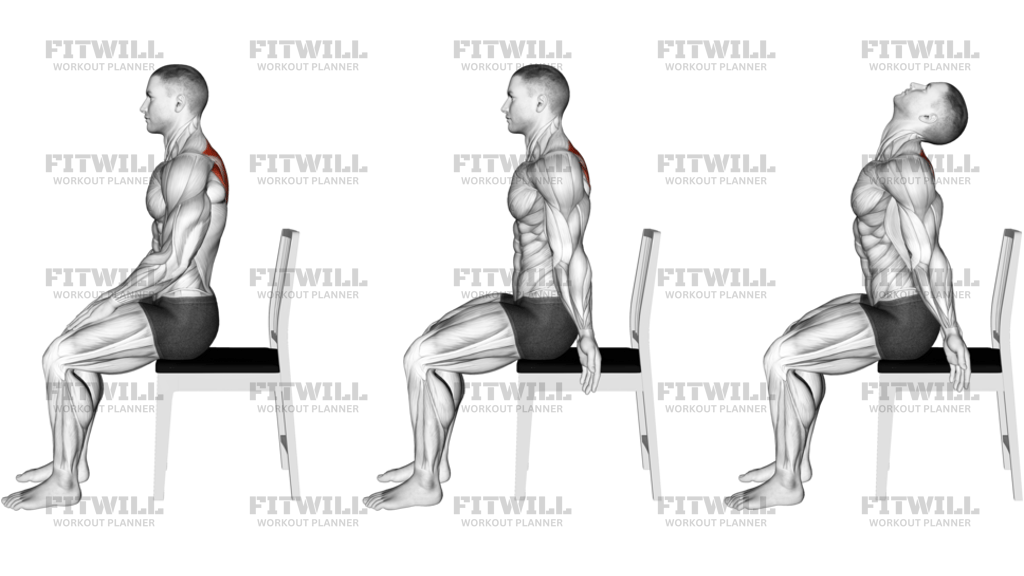
The Sitting Shrug On A Chair is a simple body-weight shrug performed from an upright seated position, with the hands resting on the hips and the shoulders lifted straight up toward the ears. Because the arms stay relaxed at the sides and no external load is involved, the entire focus stays on the upper trapezius, the diamond-shaped muscle that runs from the top of the spine and shoulder blades up to the base of the skull.
This movement is especially useful for people who carry tension in the neck and shoulder area from long hours of sitting, driving, or desk work, as well as beginners who want to learn how to isolate the traps before adding weight. Office workers, older adults, and anyone rehabbing general stiffness around the neck and upper back can benefit from practicing it with just a sturdy chair. It also works well as a warm-up activation drill before heavier barbell or dumbbell shrugs.
The seated setup matters more than it might seem. Sitting removes momentum from the legs and hips, so you cannot bounce or swing the shoulders upward the way people often do with loaded shrugs. With your weight settled into the chair and your hands braced lightly on your hips, the only way to lift the shoulders is through a clean, deliberate contraction of the upper traps.
To perform it well, sit tall near the front edge of the chair with feet flat on the floor and knees bent roughly ninety degrees. Place your palms on your hips with elbows pointing outward, keep your chin level, and shrink the gap between your shoulders and ears by pulling the shoulders straight up. Hold the top briefly, then lower the shoulders back down with control until you feel them fully release.
The most common error is letting the head drift forward or tipping the chin up as the shoulders rise, which shifts work into the neck and reduces trap isolation. Another is rolling the shoulders backward in big circles instead of shrugging vertically. Keep the path straight up and straight down, breathe steadily, and aim for smooth, moderate reps rather than forcing a painful range. Stop if you feel sharp pain or dizziness.
[ Workout Log & Planner ]
Put your next workout in Fitwill
Keep your plan and training log ready when you are.


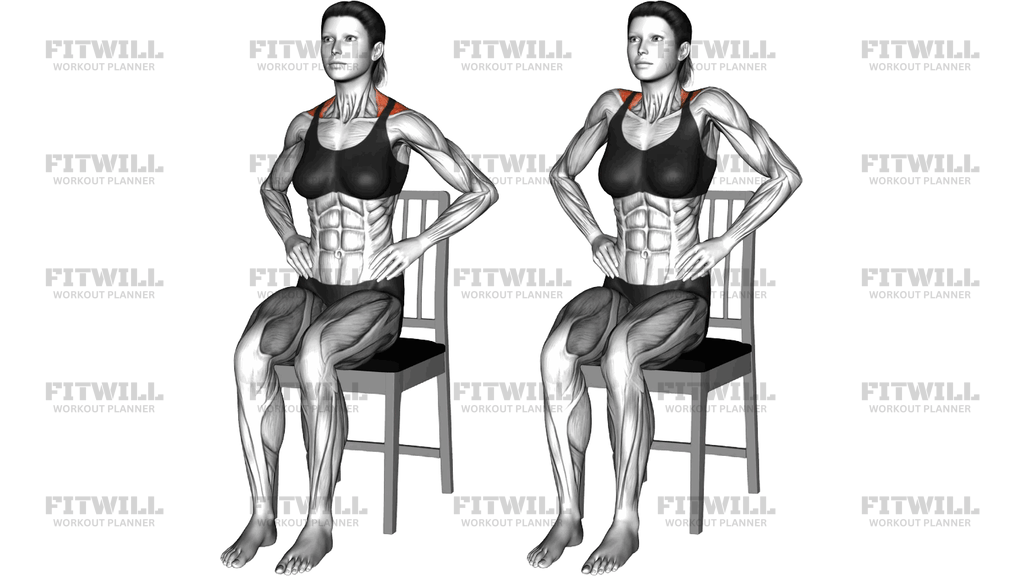
Instructions
- Sit on a sturdy chair with your feet flat on the floor, hip-width apart, and your knees bent about ninety degrees.
- Sit tall through the spine and place your palms on your hips with your fingers pointing forward and elbows out to the sides.
- Engage your core lightly and keep your chin level, eyes forward, so your head stays stacked over your shoulders.
- Let your shoulders hang in a relaxed starting position, creating as much space as comfortable between your ears and shoulders.
- Exhale and pull both shoulders straight up toward your ears as high as you can without tipping your head or leaning back.
- Pause for one to two seconds at the top, feeling the contraction across the tops of your shoulders and the base of your neck.
- Inhale and lower your shoulders back down in a slow, controlled motion until they are fully relaxed.
- Complete your target repetitions, keeping the movement vertical the entire time rather than rolling the shoulders.
- After the last rep, drop the shoulders, shake out the neck and arms briefly, and reset your posture before the next set.
Tips & Tricks
- Imagine trying to touch your ears to the ceiling, not to each other — this keeps the shrug vertical instead of collapsing your neck forward.
- Press your palms firmly into your hips; this stabilizes the arms and stops them from swinging or assisting the lift.
- If your chin juts forward at the top, cut the range in half and rebuild it while keeping the head still.
- Do not roll the shoulders in circles during this exercise — the seated shrug is a straight up-and-down movement, and rolling turns it into a loose shoulder rotation.
- Keep the lower back neutral; arching and lifting the chest turns the shrug into a back extension and steals work from the traps.
- A slow two-second lowering phase makes this light drill surprisingly effective — many people rush the descent and lose half the benefit.
- Keep your weight evenly spread across both sitting bones; shifting to one hip usually comes with an uneven, one-sided shrug.
- If a chair with a backrest forces you to slump, move to the front edge of the seat so your torso can stay upright.
Frequently Asked Questions
Which muscles does the Sitting Shrug On A Chair work?
The upper trapezius does the main work of lifting the shoulders. The levator scapulae and middle trapezius assist, and the shoulders and forearms help stabilize while your hands press into your hips.
Is the Sitting Shrug On A Chair good for beginners?
Yes, it is one of the easiest ways to learn trap isolation because there is no load to compensate with. Mastering the vertical shrug pattern seated makes weighted dumbbell or barbell shrugs much cleaner later.
Why should my hands be on my hips for this exercise?
Placing the palms on the hips fixes the arms so they cannot swing or pull, and it gives your torso a stable anchor. That forces the shoulders themselves to do the lifting rather than momentum from the arms.
Should I roll my shoulders during the Sitting Shrug On A Chair?
No, keep the movement straight up and straight down. Shoulder rolling changes it into a rotation drill and typically reduces the trap contraction while encouraging a forward head position.
How many repetitions should I do?
For muscle endurance and tension relief, 12 to 20 slow repetitions for two or three sets works well. Because the resistance is only your body weight, higher reps with a brief hold at the top are more productive than heavy, jerky efforts.
Can I do this exercise at my desk during the workday?
Yes, any stable chair without wheels works. It is a discreet way to break up long sitting periods, though keep the reps controlled so you are shrugging deliberately rather than fidgeting.
Why do I feel this in my neck instead of my shoulders?
That usually means your head is drifting forward or your chin is tipping up as you lift. Keep the head stacked over the ribcage, shorten the range slightly, and think of lifting the shoulder blades rather than reaching the head upward.
What can I use if I do not have a suitable chair?
Any firm, stable seat works, including a bench or the edge of a sturdy stool. Avoid soft sofas or chairs with wheels, since an unstable surface makes it hard to keep the torso upright.
Is it safe to do the Sitting Shrug On A Chair every day?
For most people, yes — it is a low-load, short-range movement and tolerates frequent practice well. If you have a known neck or shoulder condition, check with a qualified professional before adding it to your routine.