Sitting Hip Rotation On A Chair
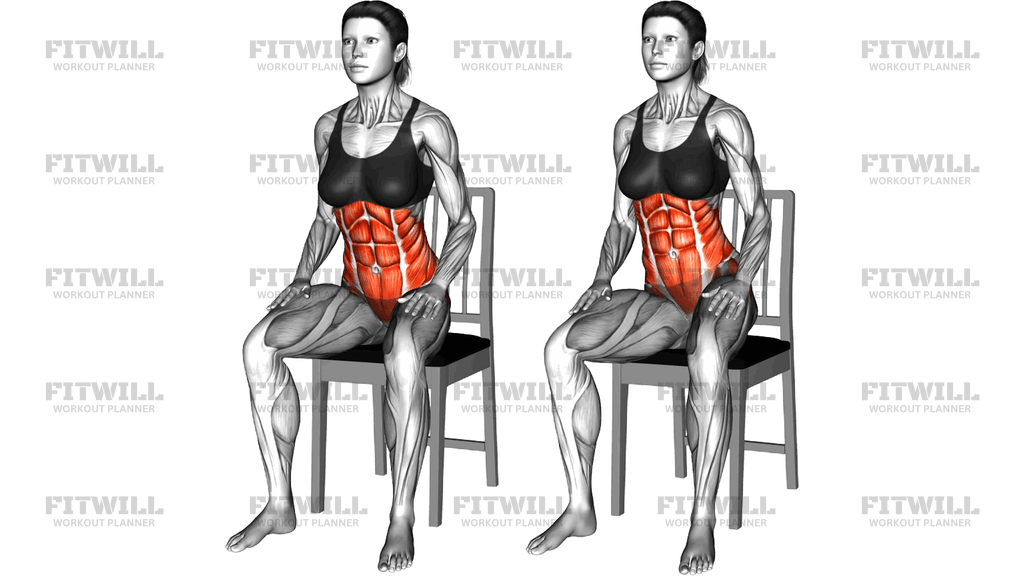
The Sitting Hip Rotation On A Chair is a simple seated mobility drill where you rotate both knees side to side while keeping your upper body tall and facing forward. You only need a sturdy chair with a firm seat, which makes this one of the easiest hip movements to slot into a desk break, a warm-up, or a recovery day. Despite how basic it looks, the rotation travels through the hip joints, the outer hips, and the waist, so a surprising amount of controlled work happens with each repetition.
This movement is especially useful for anyone who spends long hours sitting. When you stay in a chair all day, the hips adapt to one position and the deep hip rotators and outer hip muscles get stiff from lack of use. Rotating the legs gently while seated restores motion in exactly the range that desk life takes away. It is also a common choice in rehab-style programming and for older adults, because the chair provides full support and there is no load on the spine or knees.
The muscles doing the work are mainly the obliques on the sides of your waist, which control the rotation and keep your torso from twisting along with your legs. The hip rotators and glutes on the outer hips move the legs through the arc, while the deep core stays engaged to hold your ribcage steady. Because your hands rest on your thighs and your feet stay planted, the movement stays small and honest — you can feel exactly where the hips move well and where they resist.
Setup matters more than most people expect. Sit on the front half of the seat so your torso can stay upright, place both feet flat on the floor about hip-width apart, and keep your knees and thighs together. If you sprawl back into the chair or let the feet slide around, the rotation turns into a slouched sway that does little for the hips. A tall spine with relaxed shoulders gives the waist room to work and keeps the rotation happening at the hips where it belongs.
To execute the movement, brace your core lightly, then let both knees travel together to one side as far as feels comfortable, keeping the upper body pointing straight ahead. Pause briefly at the end of the range, then bring the knees back through center and over to the other side. The path should be smooth and unhurried, with your hands resting lightly on your thighs to guide rather than push the legs. One full side-to-side trip counts as one repetition, and slower tempo generally means better quality here.
Use the Sitting Hip Rotation On A Chair as a warm-up before lower-body training, as a movement break between long blocks of sitting, or as part of a daily mobility routine. Stop short of any pinching in the groin or sharp twisting sensations in the lower back, and let the range improve gradually over weeks rather than forcing it in a single session.
[ Workout Log & Planner ]
Put your next workout in Fitwill
Keep your plan and training log ready when you are.


Instructions
- Sit on the front half of a sturdy chair with your back upright and off the backrest.
- Place both feet flat on the floor about hip-width apart, and rest your hands lightly on top of your thighs.
- Draw your knees and thighs together so they touch, and gently brace your core to keep your ribcage stacked over your pelvis.
- Relax your shoulders down and keep your chest and eyes facing straight ahead for the entire set.
- Slowly rotate both knees together to the right, letting them lower toward the floor as far as your hips comfortably allow.
- Pause for a moment at the end of the rotation, keeping your torso square and resisting the urge to twist your shoulders.
- Bring the knees back through center with control, then rotate them together to the left side.
- Continue alternating side to side in a smooth, pendulum-like rhythm, with each direction taking about two seconds.
- Exhale as the knees rotate out to a side and inhale as they return through the middle.
- Complete your repetitions, then sit upright and let your legs settle before standing up.
Tips & Tricks
- If your torso starts turning with your legs, hold the edge of the seat with one or both hands to anchor the shoulders and force the motion into the hips.
- Slouching is the most common fault in this drill — think of growing tall through the crown of your head before each repetition so the waist does the work instead of a rounded back.
- Do not force the knees down toward the seat; the goal is a comfortable arc, and pinching at the front of the hip or in the groin means you have gone past your useful range.
- Keep the feet planted throughout. If your feet slide or lift, the rotation is leaking into the ankles and knees instead of rotating at the hips.
- Squeeze the knees together the whole time. Letting them drift apart turns the movement into separate leg swings and reduces the work on the outer hips and waist.
- Start with a smaller range and expand it over a couple of weeks — the deep hip rotators respond better to repeated gentle motion than to one aggressive stretch.
- If one side clearly rotates further than the other, spend a few extra slow repetitions on the stiffer side, but keep both sides in the routine.
- Breathe steadily instead of holding your breath at the end range; holding tension makes the hips guard and shrink the rotation.
- Use a chair without wheels, or push it against a wall, so the seat does not roll out from under you mid-rotation.
Frequently Asked Questions
What muscles does the Sitting Hip Rotation On A Chair work?
The main effort comes from the obliques on the sides of your waist as they control the rotation, supported by the deep hip rotators and glutes on the outer hips. Your core also works quietly to keep the torso facing forward while the legs turn.
Is the Sitting Hip Rotation On A Chair a stretch or a strength exercise?
It sits mainly in the mobility and stretching category, using light, repeated rotations to free up the hip joints. The obliques do some low-level conditioning work, but the primary goal is restoring hip range rather than building strength.
Can beginners do the Sitting Hip Rotation On A Chair?
Yes, it is one of the most beginner-friendly hip drills available because the chair fully supports your weight and there is no load involved. Beginners should simply use a smaller range and focus on keeping the torso square.
Should my feet stay on the floor during the Sitting Hip Rotation On A Chair?
Yes, keep both feet flat and planted throughout the set. Moving feet turn the drill into a leg swing and shift the rotation away from the hips, which defeats the purpose.
Why does my lower back feel the Sitting Hip Rotation On A Chair instead of my hips?
That usually means your torso is twisting or your pelvis is tipping to help the knees travel further. Sit taller, brace the core lightly, and reduce the range until the motion feels like it comes from the hip sockets.
How many repetitions of the Sitting Hip Rotation On A Chair should I do?
Ten to fifteen controlled side-to-side repetitions works well as a warm-up or desk break. You can repeat the set two or three times a day, especially if you sit for long stretches.
What can I use if I do not have a suitable chair?
Any firm, stable seat such as a bench or the edge of a sturdy ottoman works, as long as your feet can rest flat on the floor and your thighs are roughly parallel to the ground. Avoid soft couches and rolling office chairs.
Is it normal for one side to rotate further than the other in this drill?
Mild side-to-side differences are very common and usually settle with consistent practice. Work both sides evenly, add a few extra gentle repetitions to the stiffer side, and avoid comparing ranges within a single session.
Is the Sitting Hip Rotation On A Chair safe if I have hip or back issues?
Because it is seated, unloaded, and slow, most people tolerate it well, but you should keep the range pain-free and stop if you feel pinching, sharp twinges, or radiating symptoms. Check with a qualified professional first if you have a recent injury or a diagnosed hip or spinal condition.