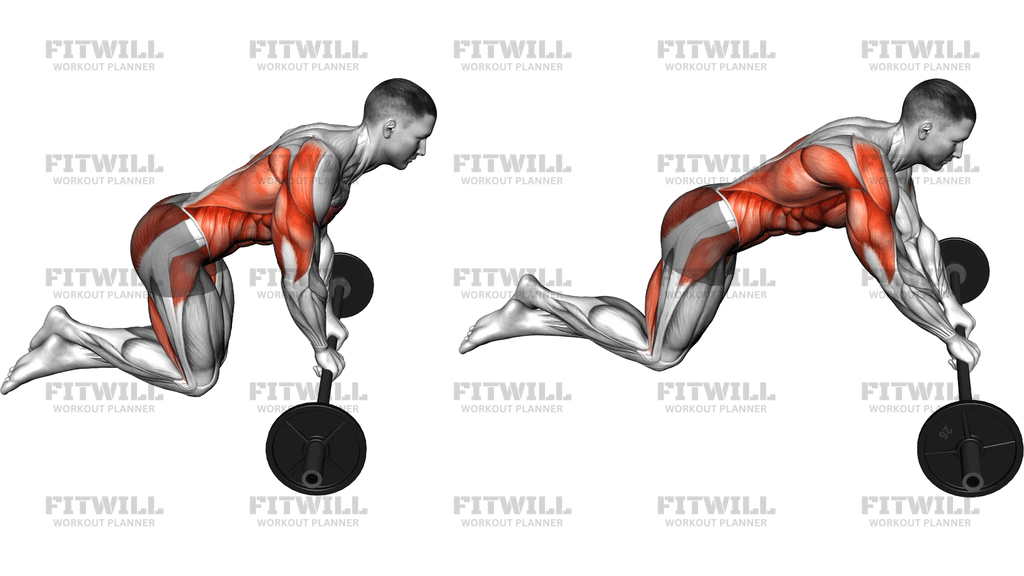
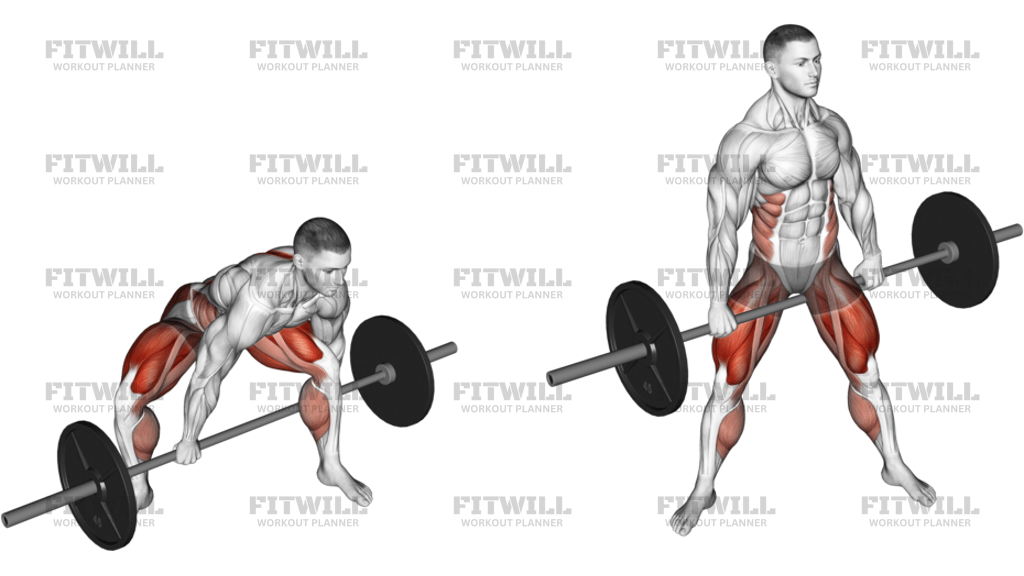
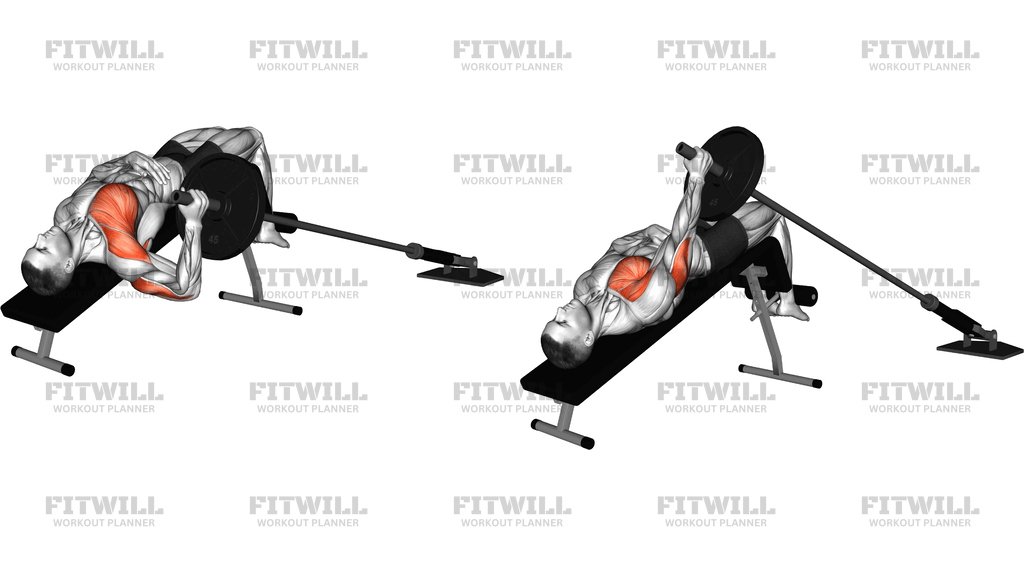
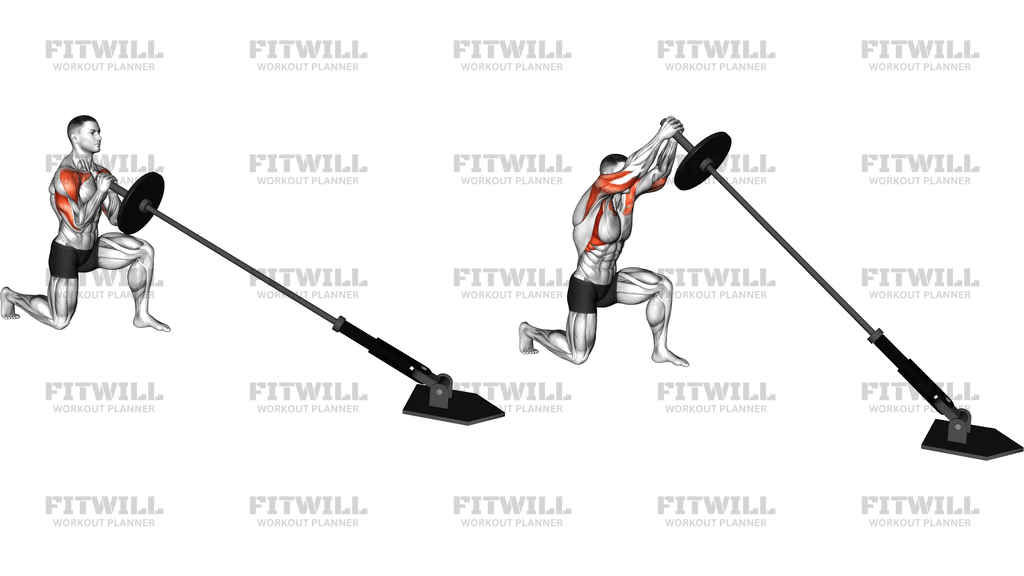
Landmine Sitting 180s
Landmine Sitting 180s are a rotational core exercise performed seated on a bench with the end of a barbell anchored in a landmine attachment or wedged into a corner. You grip the free sleeve with both hands, start with the bar low beside one hip, then sweep it up and across your body in a wide arc until it finishes high on the opposite side, tracing roughly a 180-degree path from start to finish. The anchored pivot point forces the bar to travel on a fixed arc, so your trunk has to do all of the steering, decelerating, and controlling.
The seated position is what makes this variation distinct. With your legs stabilizing you on the bench and no ability to cheat by twisting your hips or driving through your feet, the rotation has to come almost entirely from your trunk. The obliques on both sides work hard, the front of the shoulders and chest help lift and guide the sleeve, and your grip and arms stay busy just holding the bar on its path. The abdominals also work eccentrically as you lower the bar back down the same arc under control.
This movement suits lifters who want rotational strength that carries over to throwing, swinging, punching, or changing direction, but who find standing rotational landmine work limited by balance or lower-body fatigue. Because the bench removes the standing stability demand, you can load the rotation more directly and focus on the quality of the arc. It is also a reasonable option for people returning from lower-body training who still want to train the trunk hard without more leg work.
Setup matters more than it looks. Sit far enough from the anchor that the loaded sleeve has clearance to pass in front of your knees and torso without clipping your thighs, and keep your feet flat and wide enough to give you a stable base. Your hips should stay planted and squared to the front the whole time; if your pelvis rotates with the bar, the trunk is no longer doing the work. Keeping the bar close to your body through the middle of the arc protects your shoulders and keeps the resistance where your core can handle it.
Execute the rep by rotating your shoulders and trunk deliberately rather than throwing the bar. Move it from one hip up across the chest to the opposite upper corner, pause briefly at the top, then reverse the exact same path. The descent deserves as much attention as the lift, since the obliques get a strong eccentric challenge there. Work in moderate rep ranges, somewhere around 8 to 12 rotations per side, and complete all reps on one side before switching, or alternate sides rep by rep if you prefer.
Keep the weight honest. A plate or two on the sleeve is plenty for most people, and the seated variation tends to feel heavier than standing landmine work because nothing absorbs the load for you. If you find yourself leaning far back, twisting your hips off the bench, or letting the bar drift away from your body, reduce the load and rebuild the pattern before adding weight again.
Fitwill
Log Workouts, Track Progress & Build Strength.
Achieve more with Fitwill: explore over 9600 exercises with images and videos, access built-in and custom workouts, perfect for both gym and home sessions, and see real results.
Start your journey. Download today!




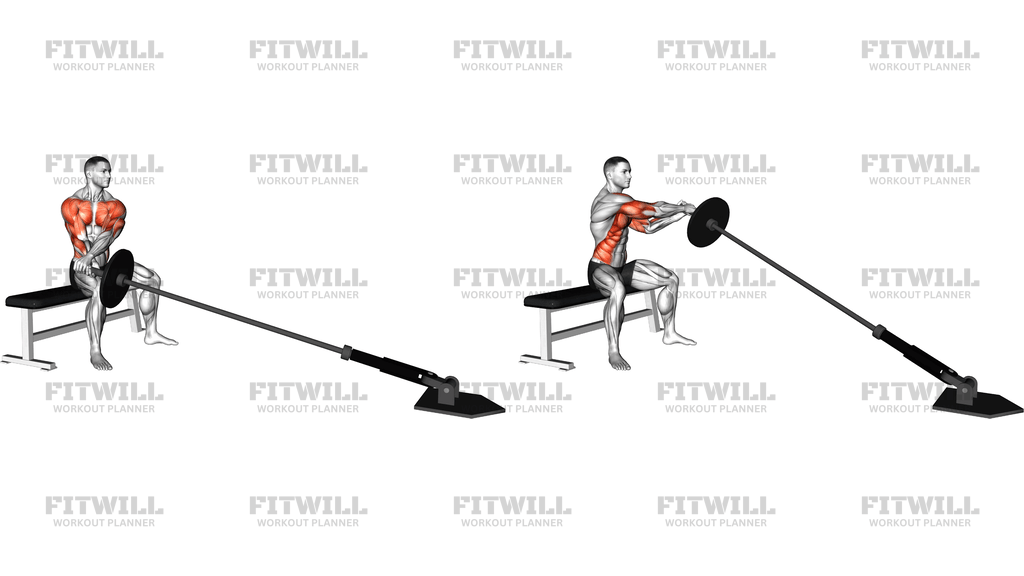
Instructions
- Set one end of a barbell into a landmine attachment or firmly into a corner, and load a plate or two onto the free sleeve.
- Sit on a flat bench placed perpendicular to the bar, far enough back that the sleeve can pass in front of your knees and torso without hitting your thighs.
- Plant both feet flat on the floor about hip-width apart and sit tall with your chest up and hips squared to the front.
- Clasp both hands together around the sleeve near its end, lifting it to rest beside one hip with your shoulders rotated toward that side.
- Brace your trunk as if preparing to take a light punch, and keep your pelvis fixed to the bench throughout the set.
- Rotate your shoulders and trunk to sweep the bar up and across your body in a smooth arc, letting your arms extend as it rises toward the opposite upper side.
- Pause briefly at the top with the bar high on the opposite side and your torso rotated to face it.
- Reverse the exact same path, lowering the bar under control back to the starting hip rather than letting it drop.
- Exhale as you sweep the bar across, and inhale on the controlled return.
- Complete all reps on one side, re-grip, and repeat on the other, or alternate sides rep by rep.
Tips & Tricks
- Keep the sleeve within arm's reach of your chest through the middle of the arc. Letting the bar drift forward turns it into a shoulder press and takes tension off the obliques.
- Watch your knees. If your thighs are in the bar's path, slide the bench back a few inches before adding weight.
- If your hips twist off the bench each rep, wedge your feet wider and consciously squeeze your glutes to lock the pelvis down before you start rotating.
- Do not grip the sleeve with a white-knuckle death grip. A firm but relaxed hold lets your shoulders move freely through the arc.
- The eccentric half of the rep is where most of the trunk work happens. If the bar free-falls on the way down, the weight is too heavy.
- Start with the bar on your weaker or less coordinated side first so the stronger side never sets an unbalanced rep count.
- Move the bar with your ribcage and shoulders, not by pulling with your arms. The arms should connect you to the bar, not steer it.
- If your lower back rounds at the bottom position, shorten the arc slightly by starting the bar a touch higher on the hip until your trunk control improves.
- Wipe sweat from your hands between sets. The smooth sleeve can slip when your grip gets damp, especially as the bar rises overhead on the far side.
Frequently Asked Questions
Which muscles do Landmine Sitting 180s work the most?
The obliques and deep abdominal muscles do the bulk of the work rotating and controlling the bar, while the front shoulders, chest, and triceps assist in lifting and guiding the sleeve through the arc.
Why sit on a bench instead of doing this exercise standing?
Sitting removes the balance and leg-stabilization demands of the standing version, so the trunk has to produce all of the rotation. This lets you focus on oblique strength and load the movement more directly.
Is Landmine Sitting 180s suitable for beginners?
Yes, as long as beginners start with just the empty sleeve or a single small plate and master the hip-still, smooth-arc pattern first. The seated setup is actually quite forgiving compared to standing rotational lifts.
How far should the bench be from the landmine anchor?
Sit far enough back that the sleeve clears your knees and thighs on both sides of the arc. If the plate or sleeve touches your legs at any point, slide the bench back a few inches.
What is the most common mistake with this exercise?
Letting the hips rotate off the bench so the legs and pelvis do part of the turning. Pin your pelvis in place and let the shoulders and ribcage create the rotation.
Should I complete all reps on one side or alternate?
Either works. Finishing one side before switching makes fatigue easier to track and keeps form honest, while alternating rep by rep keeps the sides even and mimics some sport patterns more closely.
How much weight should I load on the sleeve?
Start with one small plate. Because nothing absorbs the load for you in the seated position, the bar feels heavier than in standing landmine work, and control matters far more than load here.
What can I use if I do not have a landmine setup?
You can wedge the barbell end securely into a corner with a towel to protect the wall, or substitute a seated cable woodchop, which provides a similar resisted rotational pattern.
How many sets and reps should I do?
Two to four sets of 8 to 12 controlled rotations per side works well for most lifters, prioritizing a smooth arc and a controlled return over speed or load.
Are there any safety concerns I should watch for?
Keep the bar close to your body through the middle of the arc to protect the shoulders, make sure the anchored end cannot slip, and stop short of any position where your lower back rounds or the bar pulls you out of your seat.