Resistance Band Bent Over Single Arm Triceps Kickb
The Resistance Band Bent Over Single Arm Triceps Kickback is a unilateral triceps exercise performed from a hip-hinged stance, with a band anchored at roughly waist height in front of you. You grab the band with one hand, keep your upper arm pinned against your side, and extend your elbow straight back until the arm lines up with your torso. Because the band runs horizontally behind you, the resistance pulls your arm forward, which means your triceps have to work hardest right where the elbow reaches full extension.
This movement suits anyone who wants focused triceps work without a cable stack or dumbbells. It is especially useful for home training, for fixing size or strength differences between left and right arms, and for lifters who feel elbow discomfort with pressing but still want direct triceps volume. Since you work one arm at a time, it is easy to spot and correct a weaker side before the gap grows.
The bent-over stance is what separates this from a standing kickback. Hinging forward at the hips while keeping your back flat and knees softly bent tilts your torso toward horizontal, which forces the triceps to extend the elbow against resistance through a fuller range instead of letting gravity or posture shorten the movement. Your rear shoulder and upper back work isometrically to hold the arm position and keep your torso from rotating toward the working side.
Setup matters more than most people expect. Anchor the band at about the height of your working arm when hinged, stand far enough back that there is tension before your first rep, and brace your core so the pull of the band does not round your lower back. A slack start or a rounded spine are the two most common setup errors, and both quietly steal work from the triceps.
To execute it well, think of your elbow as a hinge glued to your ribs. Straighten the arm fully and squeeze the back of the upper arm for a beat, then let the band draw your forearm back forward under control until the elbow reaches roughly 90 degrees. Keep the motion isolated to the elbow joint; if your torso swings or your shoulder travels backward, the triceps are no longer doing the work.
Use this exercise as an accessory after your main presses or pulls, typically for 2 to 3 sets of 10 to 15 controlled reps per arm. The band's smooth resistance makes it a good choice for finishing a session, warming up the elbows before pressing, or adding triceps volume without stressing the joints.
[ Workout Log & Planner ]
Put your next workout in Fitwill
Keep your plan and training log ready when you are.


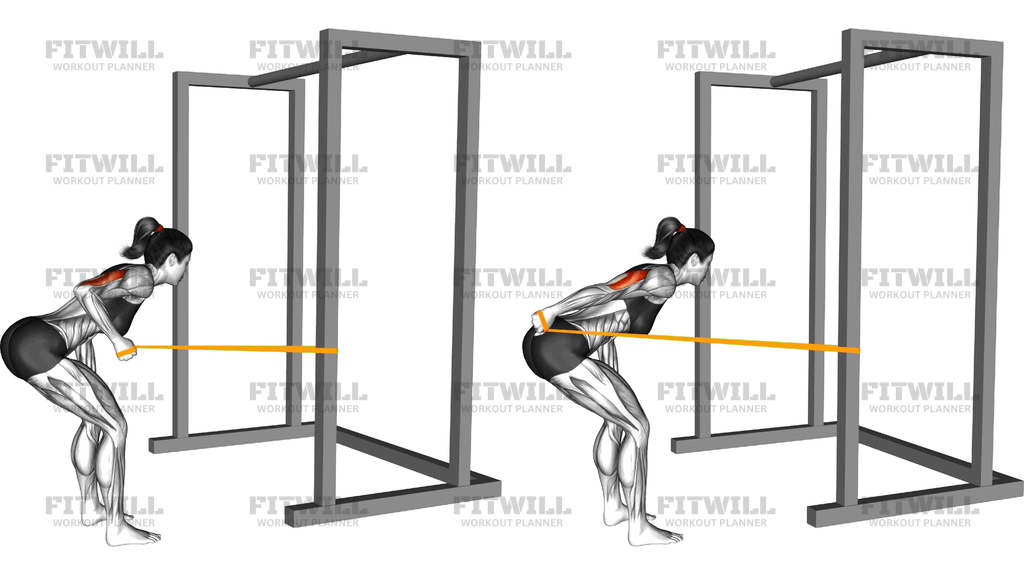
Instructions
- Anchor a resistance band to a sturdy rack or post at about waist height, then stand facing the anchor point.
- Hinge forward at the hips with a flat back and soft knees until your torso is angled toward the floor, and grab the free end of the band with your right hand using a neutral grip, thumb up.
- Step back until the band is taut with your arm hanging straight down under your shoulder, and tuck your upper arm against your ribs.
- Brace your core and squeeze your shoulder blades so your torso stays square and does not twist toward the working arm.
- Extend your right elbow straight back until your arm is in line with your torso and you feel a strong squeeze at the back of the upper arm.
- Pause briefly at full extension with the elbow locked out, keeping the wrist straight and in line with the forearm.
- Slowly bend the elbow and let the band pull your forearm back forward until it reaches about 90 degrees, without letting your upper arm drift away from your side.
- Exhale as you extend the elbow back, and inhale as you return the forearm forward.
- Complete all reps on the right arm, then re-grip with your left hand and match the rep count.
- To reset, step toward the anchor before releasing the band so it does not snap back toward you.
Tips & Tricks
- If your torso rotates toward the working arm during the extension, the band tension is too heavy or the elbow is drifting; drop to a lighter band and keep the upper arm welded to your ribs.
- A common miss is shortening the lockout by stopping just short of full extension, which skips the hardest part of the band's resistance; push until the elbow is completely straight on every rep.
- If your lower back rounds as the band pulls you forward, hinge a little less and tighten your abs before grabbing the band, or step slightly closer to reduce the pull at the start.
- Letting the elbow flare out to the side turns this into a partial shoulder movement; check that your upper arm stays parallel to your torso from start to finish.
- Keep the wrist neutral rather than flicking the hand backward at the end, since snapping at the wrist shifts tension away from the triceps.
- Because the band pulls your arm forward, control the return for two to three seconds instead of letting it snap back; the lengthening phase is where much of the triceps work happens.
- If you feel the band slip out of your grip when your palm gets sweaty, loop it around your hand once or use a version with a handle.
- Chalk-tight reps beat loose high reps here: if you cannot pause for one full second at lockout, the band is too strong.
- Match reps between arms by counting to the weaker side first, so the strong arm does not quietly set a higher standard.
Frequently Asked Questions
Which muscles does the Resistance Band Bent Over Single Arm Triceps Kickback work?
The triceps on the back of the working upper arm are the prime mover, especially at full elbow extension. Your rear shoulder and upper back also work isometrically to hold your arm position and keep your torso from twisting.
Why bend over instead of doing a standing Resistance Band Single Arm Triceps Kickback?
The hip hinge places your torso closer to horizontal, so the band pulls your arm forward through a longer range and the triceps work harder near lockout. Standing upright often lets posture shorten the movement and reduce tension at the working angle.
How high should I anchor the band for the Resistance Band Bent Over Single Arm Triceps Kickback?
Anchor it at about waist height, close to where your hanging hand sits when you are hinged. This keeps tension even through the whole rep instead of dead at the bottom or overpowering at the top.
Is this exercise good for beginners?
Yes, the band provides smooth, joint-friendly resistance and the single-arm setup makes it easy to learn with light tension. Beginners should master keeping the upper arm against the ribs before adding a thicker band.
What is the most common mistake in the Resistance Band Bent Over Single Arm Triceps Kickback?
Letting the elbow drift away from the body or swinging the torso to help the arm extend. Both turn a triceps exercise into a partial shoulder and torso movement, so pin the elbow and stay square.
Can I train both arms at the same time?
You can hold both ends of the band and kick back together, but the single-arm version lets you focus on each side, correct imbalances, and keep better tension with one anchored line.
What can I substitute if I do not have a band?
A single dumbbell kickback from the same bent-over position is the closest match, or a one-arm cable kickback with a handle set at low height if you have a cable machine.
How many sets and reps should I do?
Two to three sets of 10 to 15 controlled reps per arm works well as a finishing or accessory movement. Rest about 30 to 60 seconds between sides.
Is it safe if I have elbow discomfort?
The band's resistance is gentle at the start of the range, which many people find comfortable, but stop if you feel sharp pain and check with a qualified professional before continuing.
How do I release the band safely at the end of a set?
Step toward the anchor point first so the tension comes out of the band, then let go. Releasing under full tension can snap the band back toward your face.