Sitting Delts Stretch On A Chair
The Sitting Delts Stretch On A Chair is a simple cross-body shoulder stretch performed from an upright seated position. You sit tall on a chair with your feet flat on the floor, bring one arm straight across your chest at shoulder height, then use the opposite hand to gently pull that arm closer to your torso. The result is a clean, targeted stretch through the back and side of the working shoulder, with the deltoid clearly taking the main load of the position.
This is one of the most practical shoulder stretches you can do because the setup asks almost nothing of you: any stable chair without arms will do, there is no floor work, and the whole stretch takes less than a minute per side. That makes it a go-to for office workers who sit at a desk all day, lifters between pressing sets or after a heavy shoulder or chest session, and anyone easing back into training after time off. Older adults and beginners also tend to do well with it, since the chair provides balance support and the intensity is entirely in your own hands.
The main tissue under stretch is the posterior deltoid, along with the lateral deltoid fibers, and the position also lengthens muscles that cross the back of the shoulder joint such as the infraspinatus and teres minor, with the rear portions of the upper back and traps working under a mild stretch as well. Because the arm is held horizontally across the body, the stretch follows the line of the shoulder's horizontal adduction, which is exactly the range that gets tight from bench pressing, push-ups, swimming, throwing, and long hours of typing with rounded shoulders.
Seated posture matters more here than it might seem. Sitting down removes the tendency to sway, shrug, or lean back to escape the stretch, so the shoulder has to take the position honestly. Keep your ribs stacked over your hips and resist the urge to rotate your torso toward the stretching arm; if your trunk twists, the shoulder stops getting the full benefit. A tall spine and a still torso turn a casual arm pull into a precise shoulder stretch.
To perform it well, draw the arm across at shoulder height rather than letting it drift downward, and pull with the opposite hand just behind or just above the elbow, never on the joint itself. The stretch should feel like a firm but comfortable pull along the back of the shoulder and outer upper arm. Hold, breathe slowly, release with control, and repeat on the other side. If you feel pinching in the front of the shoulder or any tingling down the arm, back off the pull or reduce how far the arm crosses until the sensation is a clean stretch again.
[ Workout Log & Planner ]
Put your next workout in Fitwill
Keep your plan and training log ready when you are.


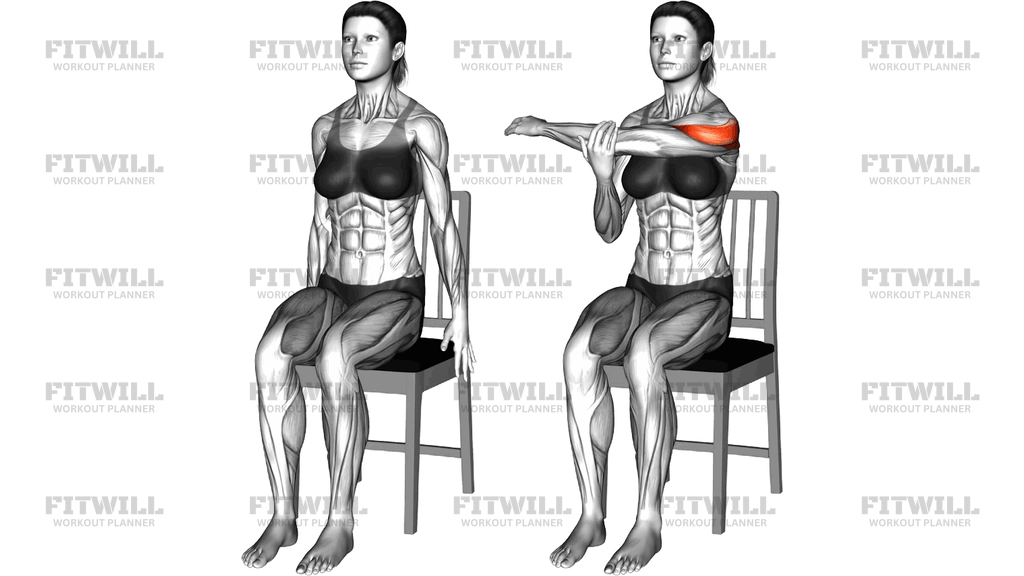
Instructions
- Sit on a stable, armless chair with your feet flat on the floor about hip-width apart and your sitting bones planted evenly on the seat.
- Sit tall with your ribs stacked over your hips, shoulders relaxed down away from your ears, and your gaze level.
- Raise your right arm straight out in front of you at shoulder height, then sweep it horizontally across the front of your chest so your upper arm lies over your sternum, palm facing down or neutral.
- Reach your left hand across and grip the outside of your right upper arm, just above the elbow, keeping your right elbow straight but not locked.
- Exhale and use the left hand to gently draw the right arm closer toward your chest, keeping both shoulders level and your torso facing forward.
- Hold the end position for 20 to 30 seconds, breathing slowly and letting the stretch deepen slightly on each exhale without forcing it.
- Release the grip slowly and let the right arm return to your side with control rather than snapping it back.
- Repeat the stretch on the left arm, holding for the same duration to keep both shoulders even.
- Complete 2 to 3 rounds per side if the shoulders feel particularly tight, resetting your seated posture between rounds.
Tips & Tricks
- The most common mistake is pulling on the elbow joint itself, which loads the elbow instead of stretching the shoulder. Grip the upper arm just above the elbow so the pull transfers to the deltoid.
- Keep the stretching arm at shoulder height. If the arm drifts down toward your waist, the stretch shifts away from the rear deltoid and loses most of its value.
- Do not let your torso rotate to follow the arm. Square your chest to the front of the chair; the stillness of the trunk is what keeps the stretch honest.
- If you feel a pinch at the front of the shoulder, back the arm off a few degrees rather than pushing through it. A cross-body stretch should feel like a pull, not a compression.
- Avoid shrugging the stretching shoulder up toward your ear as you pull. Drop that shoulder blade down first, then deepen the stretch for a cleaner line of tension.
- Keep the pulling hand's wrist straight and pull with the arm, not by bending the wrist, especially if you already spend long hours typing.
- For a slightly stronger stretch, gently round your upper back forward a small amount while holding the arm across, but stop well before you slump in the chair.
- Warm shoulders stretch better. After pressing or pulling workouts the tissue responds quickly, but on cold mornings do a few easy arm swings first so the first hold is not a shock.
- Match the hold time on both sides even if one shoulder feels tighter. The tighter side may need a second round rather than a longer first one.
Frequently Asked Questions
Which muscles does the Sitting Delts Stretch On A Chair target?
The primary target is the deltoid, especially the posterior deltoid at the back of the shoulder, with the lateral deltoid fibers contributing. Muscles crossing the back of the joint, such as the infraspinatus and parts of the upper back and traps, also receive a secondary stretch.
Why perform this stretch seated on a chair instead of standing?
Sitting removes the balance and sway component, so you cannot lean or step away from the stretch, which keeps tension on the shoulder. It also makes the movement accessible anywhere a chair is available, including an office or living room.
Should my elbow be bent or straight during the cross-body position?
Keep the stretching arm essentially straight, with the elbow soft rather than locked. Bending the elbow shortens the line of the arm and reduces the stretch through the shoulder.
How long should I hold the Sitting Delts Stretch On A Chair?
Aim for 20 to 30 seconds per side, and repeat 2 to 3 rounds if the shoulders feel tight. Longer, gentler holds are preferable to short, forceful pulls.
I feel the stretch in my elbow instead of my shoulder. What am I doing wrong?
You are most likely pulling directly on the elbow joint. Move your opposite hand to grip the upper arm just above the elbow so the drawing force crosses the shoulder joint, where you want the stretch.
Can beginners do this stretch safely?
Yes. The intensity is fully controlled by how hard you pull with the opposite hand, and the chair supports your posture. Beginners should simply start with a lighter pull and stop at the first point of a clear, comfortable stretch.
When is the best time to use this stretch?
It works well after pressing or pulling workouts, after long desk sessions with rounded shoulders, and as part of a general mobility routine. It is also useful between heavy bench or overhead press sets to keep the rear shoulder from stiffening up.
Can I do the Sitting Delts Stretch On A Chair if my shoulder hurts?
Discomfort in the shoulder joint itself is a signal to ease off or skip the stretch, not to push through it. A mild muscular pull is fine, but pinching, sharp pain, or tingling down the arm means you should reduce the range or consult a qualified professional.
What can I use if I do not have a chair available?
The same cross-body arm position works standing, or sitting on a bench, bed edge, or stability-friendly seat. The key elements stay the same: tall torso, arm across the chest at shoulder height, and the pull applied to the upper arm rather than the elbow.
Is it normal for one shoulder to feel tighter than the other?
Yes, side-to-side differences are very common, especially if you favor one arm in sport or work. Stretch both sides for equal hold times and give the tighter side an extra round rather than overloading it in a single hold.