Sitting Hands Behind Chest Stretch On A Chair
The Sitting Hands Behind Chest Stretch On A Chair is a seated chest opener that uses nothing more than a sturdy chair and your own hands. You sit upright near the front edge of the seat, clasp your hands together behind your lower back, and gently draw your shoulder blades together while lifting your chest toward the ceiling. The stretch targets the pectoral muscles across the front of the chest along with the front of the shoulders, both of which tend to get short and tight from long hours of sitting, typing, or driving.
This movement is especially useful for anyone who spends most of the day at a desk. When you sit hunched over a keyboard, your shoulders roll forward and the chest muscles adaptively shorten, which pulls you into that rounded, closed-off posture. Reversing that position a few times a day helps restore length in the chest and encourages the shoulders to sit back where they belong. It is also a comfortable option for older adults, people recovering general upper-body stiffness, or anyone who finds standing chest stretches hard to balance through.
The setup matters more than it looks. Sitting tall on the front half of the chair gives your arms room to travel behind your body, while a braced core and level hips stop your lower back from arching excessively to fake extra range. Because the chair supports your weight, you can focus entirely on the position of the shoulder blades and the opening of the chest rather than on staying upright.
To perform it well, keep the movement in the shoulders and chest rather than the neck. Lift through the sternum, let the collarbones widen, and only pull the clasped hands away from your body until you feel a comfortable stretch across the chest and the front of the shoulders. Hold for twenty to thirty seconds while breathing steadily, then release slowly and let the shoulders settle back before repeating. Two to three rounds is plenty.
A simple safety note: if you feel pinching in the front of the shoulder, tingling in the arms, or strain in the lower back, ease off the intensity or reduce how far you draw the hands back. The stretch should feel like a broad opening across the chest, never a sharp pull. Because it requires no equipment beyond a stable chair, this is one of the easiest stretches to slot into a workday, a warm-up, or a cool-down.
[ Workout Log & Planner ]
Put your next workout in Fitwill
Keep your plan and training log ready when you are.


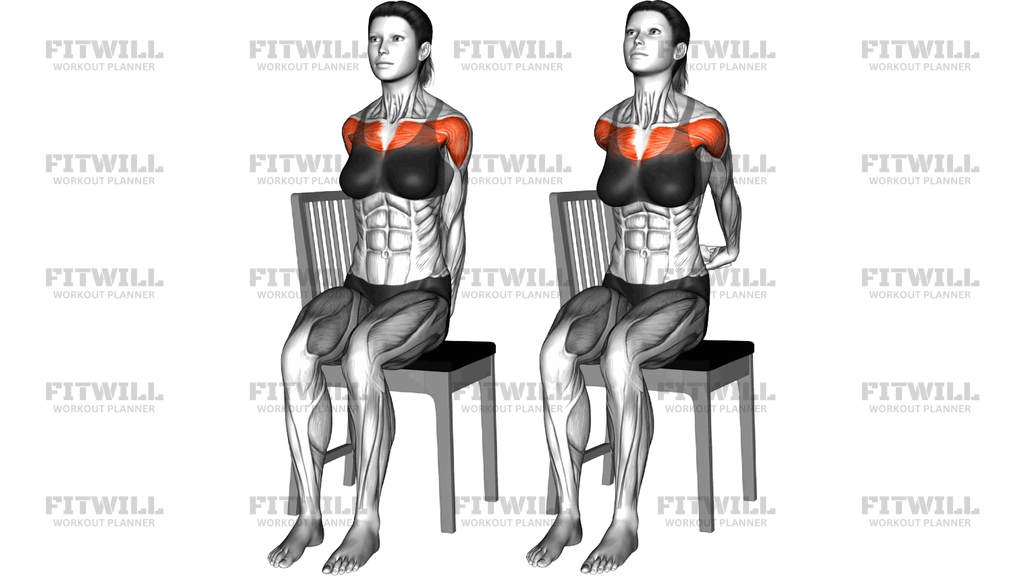
Instructions
- Sit on a sturdy armless chair with your feet flat on the floor, hip-width apart, and scoot onto the front half of the seat so your back is free of the backrest.
- Reach both arms behind your body and clasp your hands together at the level of your lower back, interlacing your fingers if that feels comfortable.
- Sit up tall and brace your abdominal muscles lightly to keep your ribs stacked over your pelvis instead of letting your lower back arch.
- Roll your shoulders up, back, and down so the shoulder blades draw toward each other and the chest begins to open.
- Keeping your hands clasped, straighten your elbows as much as is comfortable and gently lift your hands away from your lower back while raising your chest toward the ceiling.
- Stop when you feel a steady stretch across the chest and the front of the shoulders, and hold that position for 20 to 30 seconds without letting your chin jut forward.
- Breathe slowly and evenly throughout the hold, exhaling as you lift the chest a little further on each breath if the stretch allows.
- To release, slowly lower the hands back toward your lower back, bend the elbows, unclasp the fingers, and let your shoulders return to a relaxed position.
- Rest for a few breaths, shake out the arms if needed, and repeat for 2 to 3 total holds.
- Return your hands to your lap and recheck your seated posture before standing up from the chair.
Tips & Tricks
- Do not let your ribs flare and your lower back collapse into a deep arch; the extra range feels bigger but comes from the spine, not the chest. Brace the core and lift from the sternum instead.
- If clasping the fingers behind your back is difficult, hold a small towel between both hands so you can keep the arms straight without forcing shoulder rotation.
- Keep the neck long and the gaze level. Craning the chin toward the ceiling is a common way people chase a stronger chest stretch and end up with neck tension instead.
- Try resting the backs of your hands on the chair seat behind your hips first if full reach behind the back is too much; this lets you learn the chest-opening position with less shoulder demand.
- Keep both sitting bones evenly weighted on the chair. Leaning to one side to gain range usually means one shoulder is doing the stretching while the other hides.
- Ease into the intensity over the first few seconds of the hold. Yanking the hands back quickly tends to make the front of the shoulder guard rather than release.
- If your elbows bend during the hold, the stretch often drifts into the arms; think about pressing the inner wrists together and lengthening the arms to keep tension on the chest.
- Use this stretch between long blocks of desk work rather than only in a workout setting, since the chest tightens again within hours of rounded sitting.
Frequently Asked Questions
Which muscles does the Sitting Hands Behind Chest Stretch On A Chair target?
It primarily stretches the pectoral muscles across the front of the chest, with the front of the shoulders and, to a lesser degree, the biceps at the front of the arms also lengthening as the arms extend behind the body.
How long should I hold the Sitting Hands Behind Chest Stretch On A Chair?
A hold of 20 to 30 seconds works well for most people, repeated 2 to 3 times. If your chest is very tight, start with shorter 15-second holds and build up as the position becomes comfortable.
Is a special chair needed for the Sitting Hands Behind Chest Stretch On A Chair?
Any stable, armless chair with a firm seat is fine. Avoid chairs with wheels or a swivel base, and skip chairs with side arms since they block your hands from reaching behind your body.
Why do I feel this stretch in my shoulders instead of my chest?
The front of the shoulder is often tighter than the chest, so it takes over when the arms extend back. Reduce how far you lift the hands, keep the elbows slightly soft, and focus on drawing the shoulder blades together to shift the sensation back to the chest.
My lower back arches a lot when I clasp my hands behind my back. Is that a problem?
Some natural curve is fine, but a big arch means the spine is substituting for tight shoulders. Lightly brace your abdominal muscles and sit tall so the opening comes from the chest rather than the lower back.
Can beginners do the Sitting Hands Behind Chest Stretch On A Chair?
Yes, and it is actually one of the most beginner-friendly chest stretches because the chair supports your weight. Beginners can simply keep the hands lower, closer to the hips, and shorten the hold until flexibility improves.
What can I use instead of clasping my hands if that position is uncomfortable?
Hold a small towel, stick, or resistance band between both hands behind your back. This reduces how far the shoulders must rotate while still letting you open the chest.
How often should I do the Sitting Hands Behind Chest Stretch On A Chair?
Once a day is a reasonable minimum for desk workers, and it can safely be done more often, such as between meetings or after long stretches of typing, as long as the stretch stays comfortable.
When should I avoid the Sitting Hands Behind Chest Stretch On A Chair?
Skip it or scale it back if you have an acute shoulder injury, recent chest or shoulder surgery, or if the position causes pinching, numbness, or tingling. A comfortable stretching sensation is expected; sharp pain is not.
Should I breathe in a specific way during the stretch?
Breathe normally and steadily through the nose, avoiding breath-holding. Many people find that exhaling slowly while gently lifting the chest helps the shoulders drop and deepens the stretch naturally.