Dumbbell Standing Shoulder External Rotation At 90
The Dumbbell Standing Shoulder External Rotation At 90 is a targeted rotator cuff exercise performed with the upper arm elevated to shoulder height and bent to 90 degrees, then rotated outward so the forearm travels from pointing forward to pointing straight up. You stand tall with a light dumbbell in one hand, hold your elbow level with your shoulder the entire time, and let the rotation happen at the shoulder joint itself. It looks simple, but it is one of the most demanding positions for the small muscles that steer the upper arm in the socket.
This movement primarily trains the external rotators of the shoulder, especially the infraspinatus, with support from the posterior deltoid and the muscles that stabilize the shoulder blade. Because the arm works at 90 degrees of abduction, the rotator cuff has to control the humeral head against the pull of the dumbbell through a full arc of rotation. That makes the exercise harder than arm-at-side versions and places a strong demand on shoulder stability rather than raw strength.
This exercise is especially useful for overhead athletes such as baseball players, volleyball players, swimmers, and tennis players, whose external rotators take heavy loads during throwing and swinging. It is also a smart addition for anyone building balanced shoulder strength, since most pressing and pulling work trains the bigger muscles while the rotator cuff gets little direct attention. Lifters recovering general shoulder nagging often use it as a low-load strength tool, though anyone with pain should clear the movement with a qualified professional first.
The setup matters more here than in most dumbbell exercises. If your elbow drifts below shoulder height, drops toward your side, or flares forward, the angle changes and the rotator cuff loses its working position, letting larger muscles take over. Keep the upper arm fixed in its abducted position and treat it as the hinge around which the forearm swings. A light dumbbell is not a sign of an easy exercise; at this leverage, even a few kilograms can be challenging.
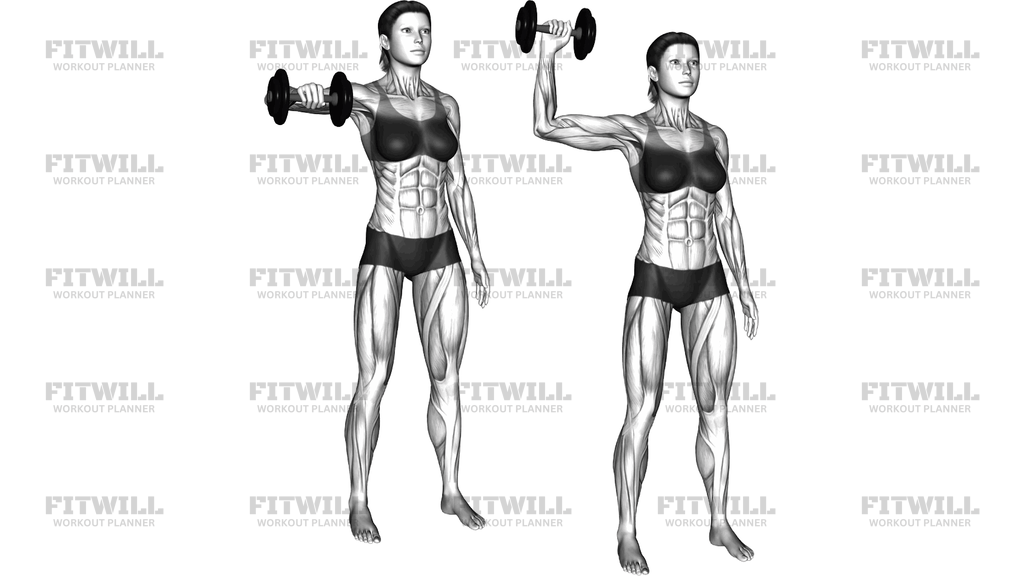
To execute it well, stand with feet about hip-width apart, brace your trunk, and raise the working arm straight out to the side until your elbow is at shoulder height. Bend the elbow to 90 degrees so the forearm points forward, then rotate at the shoulder until the forearm points toward the ceiling, keeping your wrist neutral and your torso still. Pause briefly at the top, then lower the forearm back to the forward position under control. Expect to work in modest rep ranges with light weight, focusing on smooth tempo rather than load.
In practice, this exercise fits well as a warm-up activation drill before pressing days or as an accessory movement at the end of upper-body sessions. It pairs naturally with internal rotation work and face pulls to cover the shoulder from all angles. The main safety points are simple: keep the weight light enough that your torso never twists, stop short of any pinching sensation at the front of the shoulder, and prioritize controlled tempo over reaching full rotation at all costs.
[ Workout Log & Planner ]
Put your next workout in Fitwill
Keep your plan and training log ready when you are.


Instructions
- Stand upright with your feet hip-width apart, holding a light dumbbell in one hand with a neutral, comfortable grip.
- Raise the working arm straight out to your side until your upper arm is parallel to the floor, then bend your elbow to 90 degrees so your forearm points forward, perpendicular to the floor.
- Brace your core lightly and keep your head, torso, and hips facing straight ahead so the rotation comes only from the shoulder.
- Check that your elbow stays level with your shoulder and fixed in place; this is the hinge for the entire movement.
- Rotate your upper arm outward so your forearm sweeps upward from the forward position until it points toward the ceiling, keeping your wrist straight.
- Pause for a beat at the top with the forearm vertical, squeezing the back of the shoulder rather than shrugging.
- Slowly reverse the rotation, lowering the forearm back to the starting forward position over two to three seconds.
- Exhale as you rotate up, inhale as you return, and keep your breathing steady rather than holding your breath.
- Complete all repetitions on one side, then lower the arm, reset your posture, and switch to the other arm.
Tips & Tricks
- Choose a much lighter dumbbell than you would for a lateral raise; at 90 degrees of abduction, the rotator cuff is working at a mechanical disadvantage and heavy weight forces cheating.
- If your torso leans back or twists as the forearm rises, the weight is too heavy or your core is unbraced; reduce the load and think about keeping your chest pointing forward.
- Watch your elbow in a mirror: if it drops toward your side mid-set, the position has changed and the exercise becomes a different movement. Reset the arm between reps if needed.
- Keep the wrist neutral rather than letting the dumbbell pull your hand back or curl it under; a bent wrist shifts stress away from the shoulder.
- Avoid shrugging the working shoulder toward your ear as you rotate; think of lengthening the arm out to the side instead of lifting it.
- If full rotation to vertical causes a pinching feeling at the front of the shoulder, work within a shorter arc and gradually increase range over sessions.
- Slow the lowering phase down deliberately; most of the rotator cuff's benefit in this position comes from controlled eccentric work, not the lift itself.
- Do this exercise after heavier pressing or pulling when the shoulder is warm, or use very light sets as part of a pre-training activation routine.
- Fatigue in the small shoulder muscles shows up fast; if your form breaks after eight to ten reps, end the set rather than pushing to failure.
Frequently Asked Questions
Which muscles does the Dumbbell Standing Shoulder External Rotation At 90 work?
It primarily targets the external rotators of the rotator cuff, especially the infraspinatus, with help from the posterior deltoid. The muscles around the shoulder blade also work to keep the whole arm position stable.
Why is the arm held at 90 degrees instead of at my side?
Elevating the upper arm to shoulder height changes the leverage and the line of pull, making the rotator cuff work harder through the rotation. It also closely matches the arm positions used in throwing and overhead sports.
How heavy should the dumbbell be for this exercise?
Start very light, often just one to three kilograms, and only add weight when you can keep your elbow at shoulder height and your torso still for all reps. Most people need far less weight here than for other shoulder exercises.
Is the Dumbbell Standing Shoulder External Rotation At 90 suitable for beginners?
Yes, beginners can do it, but the 90-degree arm position makes it more advanced than side-lying or elbow-at-side rotations. New lifters may want to master an easier external rotation variation first, or simply use a very light dumbbell and strict form.
My elbow keeps dropping during the set. How do I fix it?
That is a sign of fatigue or too much weight. Lighten the load, do fewer reps per set, and mentally anchor the elbow at shoulder height; a mirror or a partner check helps you catch it early.
Can I do this exercise standing without any back support?
Yes, standing is the standard setup, and it adds a small core and postural demand because nothing braces your torso. Keep your feet planted hip-width apart and your trunk braced so the rotation happens only at the shoulder.
What can I substitute if I do not have a dumbbell?
A resistance band anchored at elbow height works well and lets you keep the same arm position with a lighter, smoother load. Cable handle rotations are another option, though the dumbbell version is simplest to set up.
Should my forearm stop at vertical, or can I rotate further?
For most people, rotating until the forearm points toward the ceiling is the right end position. Go slightly past vertical only if you can do it without wrist bend, shoulder shrugging, or any pinching discomfort.
Is it safe to do this exercise if my shoulder hurts during rotation?
Mild muscle effort is normal, but sharp pain, pinching, or catching is not. Stop the set, reduce the range or weight, and consult a physiotherapist or doctor before continuing if the discomfort persists.