Resistance Band Lying Shoulder Abduction
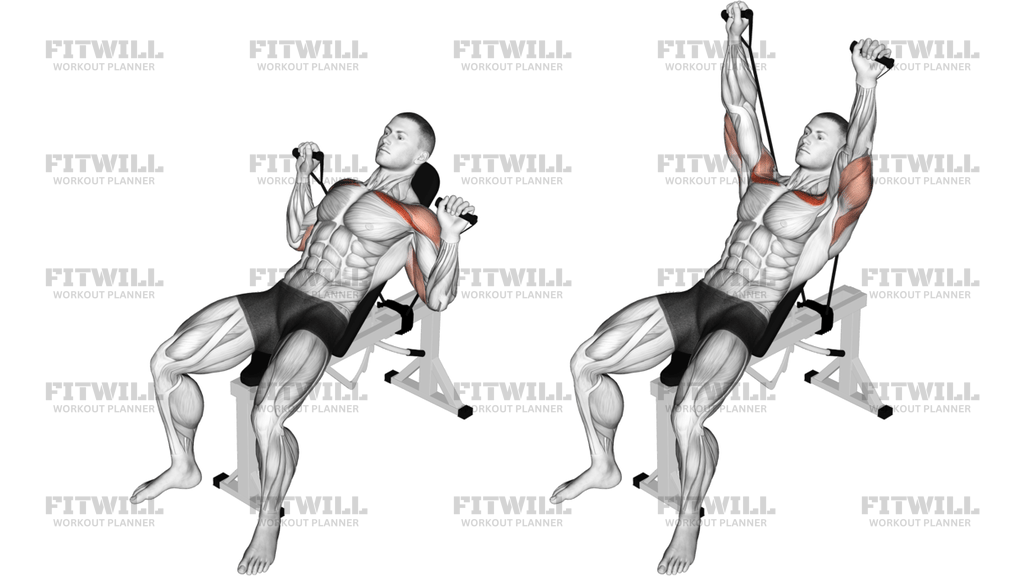
Resistance Band Lying Shoulder Abduction is a simple but precise drill performed on your back with a flat resistance band looped around both hands. With your arms extended straight up toward the ceiling, you pull your hands apart against the band's tension until they spread well outside shoulder width, then bring them back together under control. Because the band is stretched between your own two hands rather than anchored to a fixed point, both arms work against each other and the load stays even from side to side.
The main muscle at work is the side of the shoulder, the lateral deltoid, with the front shoulder and the upper portion of the chest assisting as the arms press outward. The rotator cuff and the small stabilizing muscles around the shoulder blade are also busy keeping the arm centered in the socket throughout the pull. Lying down is what makes this version special: with the floor supporting your back and your arms pointed straight up, there is almost no room to swing, lean, or use momentum, so the shoulders have to do the work honestly.
This movement is a good fit for people building shoulder stability, warming up before pressing or overhead work, or reintroducing load after time away from training. Because the resistance comes from a light band and the range is short and horizontal, it is easy to scale simply by looping the band more or fewer times around your hands. Physical therapy-style strength work for the supraspinatus and upper shoulder often uses this exact lying position, since it minimizes stress on the joint compared to standing abduction.
Setup matters here. Your upper arm should be roughly perpendicular to the floor, not drifting back over your head or falling toward your chest, and your lower back should stay in contact with the floor. If your arms drift toward your feet, the band tension changes and your chest takes over; keep the arms vertical and the hands above the shoulders to keep the side delts as the primary mover.
Execution is straightforward: keep the elbows soft but straight, exhale as you stretch the band by pulling your hands apart, pause briefly at the widest point, then return the hands together slowly so the band never snaps you back. Move at a pace you can control both ways, keep the wrists neutral, and let the shoulder blades rest on the floor rather than shrugging up toward your ears. Even with light tension, this drill is easy to overdo at first, so start with modest reps and build up gradually.
[ Workout Log & Planner ]
Put your next workout in Fitwill
Keep your plan and training log ready when you are.


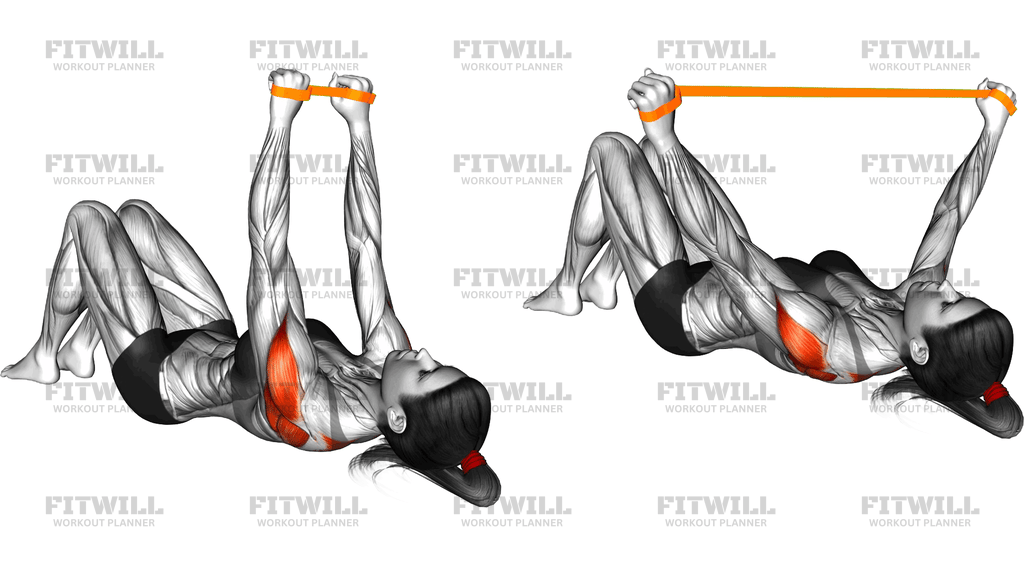
Instructions
- Lie on your back on a mat with your knees bent and feet flat on the floor, and rest your head comfortably so your neck stays relaxed.
- Loop a flat resistance band around both hands, either once for lighter tension or several times for more resistance, and raise both arms straight up toward the ceiling so your hands start close together above your chest or shoulders.
- Take up the slack in the band so there is light tension even before the movement begins, and keep your elbows mostly straight with only a small soft bend.
- Brace your core lightly and press your lower back into the floor so your ribcage does not flare up as you pull.
- Exhale and pull both hands apart at the same time, stretching the band horizontally until your hands are well outside shoulder width and you feel your outer shoulders working.
- Pause for a beat at the widest point, keeping your arms vertical over your body and your wrists in line with your forearms.
- Inhale and slowly let your hands come back together, resisting the band's pull instead of letting it snap your arms closed.
- Stop when the hands are back near the starting position with the band still slightly taut, and continue for your target number of reps.
- After the set, release the band carefully from one hand first so it does not spring back, then lower your arms and sit up slowly.
Tips & Tricks
- If your hands drift back over your head or toward your hips, the band tension changes direction and the wrong muscles take over; check your arm position between reps and keep the hands stacked directly above the shoulders.
- Bending the elbows as fatigue sets in is the most common mistake here. It shortens the lever and turns the move into a partial press, so if you catch your elbows flexing, switch to a lighter band and straighten the arms.
- Shrugging your shoulders up toward your ears means the upper traps are compensating for tired delts. Deliberately let the shoulder blades rest flat on the floor before each rep.
- Do not let one arm do more of the stretching. Because the band is unanchored, a stronger or stiffer side can steal range from the other; watch your hands and keep the spread symmetrical.
- Choose a band tension that lets you pause at the widest point. If the band pulls your hands back together quickly on the return, the eccentric portion is being wasted.
- Keep the band looped around the hands near the wrists but not so tight it cuts off circulation; if your fingers tingle, loosen the wrap or widen the loop slightly.
- This drill makes an excellent warm-up before overhead pressing or lateral raises, but do it slowly and with low tension so you prime the shoulder without pre-fatiguing it.
- If your lower back arches as you pull, bend the knees more and think about gently tilting the pelvis back so the back of the ribcage stays grounded.
Frequently Asked Questions
Which muscles does Resistance Band Lying Shoulder Abduction work?
The lateral deltoids on the side of the shoulder are the primary movers, with the anterior deltoids and upper chest assisting. The rotator cuff, especially the supraspinatus, stabilizes the arm throughout the pull.
Why is this exercise done lying on the back instead of standing?
Lying with your arms pointed at the ceiling removes momentum and body lean from the equation, so the shoulders have to produce the movement entirely on their own. The floor also supports the spine, which makes it easier to keep good posture.
How do I make Resistance Band Lying Shoulder Abduction easier or harder?
To reduce resistance, use a thinner band or wrap it around your hands fewer times. To increase it, use a thicker band, add wraps, or slow down the return phase so the muscles work longer under tension.
Can beginners do this exercise safely?
Yes, it is one of the most beginner-friendly shoulder drills because the load is light and the back is fully supported. Start with a very light band and a short range, and only widen the pull as the movement feels smooth and controlled.
Should my elbows be locked or bent during the pull?
Keep the elbows mostly straight with a small, comfortable softness rather than locking them hard. Bending them further as you tire changes the exercise and reduces the work on the side delts.
What is the most common mistake with this movement?
Letting the arms drift out of the vertical position so they angle over the head or toward the hips. This shifts the resistance path and recruits the chest or lats instead of isolating the shoulders, so reset your arm position between reps if needed.
Can Resistance Band Lying Shoulder Abduction replace standing lateral raises?
It trains the same side delt region but with lower load and a horizontal short range, so it works better as a warm-up, rehab-style drill, or control builder than as a substitute for loaded lateral raises. Many lifters use both at different times.
How many reps and sets should I do?
For warm-up or stability work, two to three sets of 12 to 20 slow reps with a light band works well. If your goal is building the shoulders, use a firmer band and aim for 10 to 15 controlled reps.
What should I do if the band hurts my hands or wrists?
Adjust the loop so it sits flat and comfortably across the palms, and keep your wrists neutral rather than cocked back. If discomfort continues, place a small towel around the band where it contacts the hands or switch to a wider band.