Sitting Single Straight Back Hamstring Lean
The Sitting Single Straight Back Hamstring Lean is a seated, single-leg flexibility exercise that targets the hamstring of one extended leg at a time. You sit on the floor with one leg stretched straight in front of you and the other knee bent so the foot rests near the inner thigh of the straight leg, then hinge forward from the hips over the extended leg with a long, neutral spine. Because only one leg works at a time, this version lets you notice and address side-to-side differences in hamstring flexibility that a two-legged seated fold often hides.
This stretch is useful for almost anyone who spends long hours sitting, since shortened hamstrings from desk work tend to pull on the pelvis and contribute to a stiff lower back. It is also a common choice for runners, cyclists, and lifters who want targeted post-training work on the back of the thigh, and for people progressing toward deeper forward folds in yoga or general mobility routines. Working one leg at a time makes it easier to control the intensity compared with a two-legged lean.
The main muscles stretched are the hamstrings along the back of the straight leg, particularly the biceps femoris, semitendinosus, and semimembranosus. The calf of the extended leg and the glutes of the bent-leg side also receive some lengthening, and the lower back muscles work gently to hold the spine long as you hinge. The bent leg position softly opens the inner thigh and hip of that side as well.
Setup matters more than depth here. Sit tall on your sit bones with the extended leg genuinely straight and the kneecap pointing up, not rolled outward. The bend should come from the hip joint, not from rounding the lower back, which is why keeping a straight back is central to this exercise. A long spine turns the stretch into a clean hamstring lengthening; a rounded back turns it into a lumbar stretch and reduces the effect on the leg.
To execute it well, hinge forward only as far as you can keep the back long and the stretch feeling like a pull, never a sharp pain. Rest your hands on the extended thigh, shin, or beside the leg for light support rather than pulling yourself down. Breathe slowly and let the muscle release over several breaths before sitting back up with control.
Practical safety points: never bounce in the end position, keep the knee of the straight leg soft rather than locked, and back off immediately if you feel pain behind the knee or in the lower back. Hold the stretch for roughly 20 to 45 seconds per side, and repeat on both legs for balance even if one side feels tighter.
[ Workout Log & Planner ]
Put your next workout in Fitwill
Keep your plan and training log ready when you are.


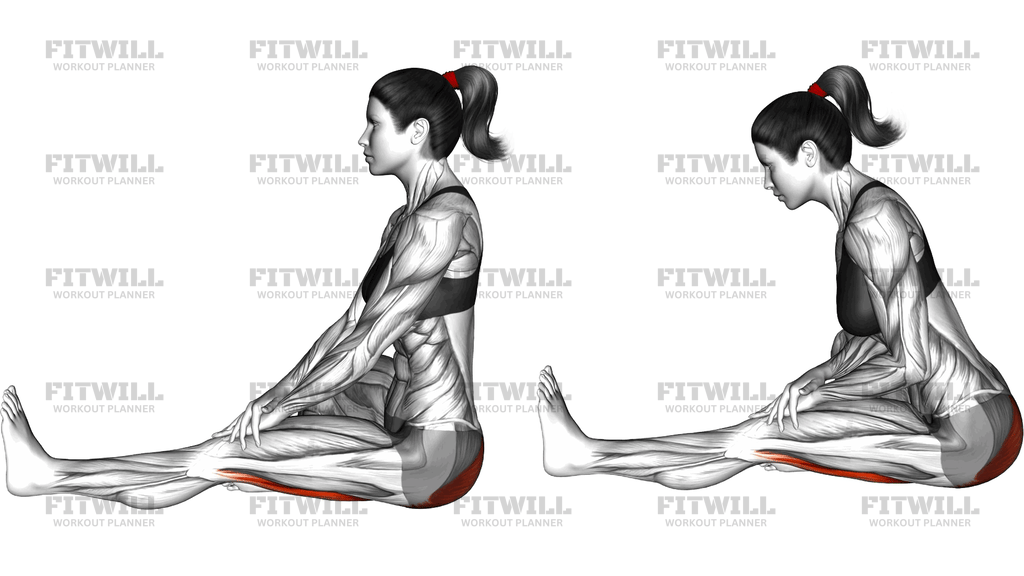
Instructions
- Sit on a mat or firm floor with your legs extended in front of you and your spine tall.
- Bend your right knee and bring the sole of your right foot to rest against the inner thigh of your left leg, letting the right knee drop comfortably out to the side.
- Keep your left leg straight with the toes pointing up and the kneecap facing the ceiling.
- Place both hands lightly on your left thigh or shin for support.
- Brace your core gently and lengthen through the crown of your head so your back stays straight.
- Hinge forward from the hips, leading with your chest, and slide your hands along the straight leg as you go.
- Stop when you feel a clear stretch along the back of the left thigh, keeping the spine long and the knee soft.
- Hold the end position while breathing slowly and deeply for 20 to 45 seconds.
- Exhale and slowly sit back up to the tall seated position, then switch legs and repeat on the right side.
Tips & Tricks
- Lead the lean with your chest instead of your head; reaching the nose toward the knee tends to collapse the upper back and shortens the hamstring stretch.
- If your lower back rounds before you feel the hamstring, sit on a folded towel or low cushion to tilt the pelvis forward and restore the straight-back position.
- Keep a small bend in the knee of the extended leg if the stretch concentrates sharply behind the knee rather than through the belly of the hamstring.
- Do not yank yourself forward with your hands; they are there for balance and light guidance, not for pulling depth.
- Flex the toes of the straight leg toward your shin if you want to add mild intensity to the hamstring and calf stretch.
- If the bent-leg knee floats uncomfortably high, support that thigh with a cushion instead of forcing it toward the floor.
- Avoid chasing distance; a smaller hinge with a long spine stretches the hamstrings more effectively than a deep fold with a rounded back.
- Warm up briefly with a few minutes of walking or light leg movement before stretching, especially first thing in the morning.
- If one side is noticeably tighter, do one extra gentle set on that side, but never force the shorter side to match the longer one in a single session.
Frequently Asked Questions
Which muscles does the Sitting Single Straight Back Hamstring Lean stretch?
It primarily stretches the hamstrings of the straight leg, including the biceps femoris, semitendinosus, and semimembranosus. The calf of the extended leg, the glutes, and the muscles of the lower back also receive a gentler stretch.
Why is one leg bent and tucked in during this stretch?
The bent leg with the foot near the inner thigh isolates the stretch to one hamstring at a time and reduces pull from the pelvis. It also makes side-to-side flexibility differences easy to see and address.
Is the Sitting Single Straight Back Hamstring Lean suitable for beginners?
Yes, it is a beginner-friendly stretch because you control the depth entirely with your torso angle. Beginners should shorten the range, sit on a small cushion if needed, and focus on keeping the back straight rather than reaching far forward.
Why does my lower back round instead of staying straight when I lean forward?
This usually happens when the hamstrings are tight and the pelvis stops tilting forward, so the spine bends to make up the distance. Sitting on a folded towel or cushion to raise the hips usually helps you keep the back long.
How long should I hold the Sitting Single Straight Back Hamstring Lean?
Hold each side for about 20 to 45 seconds with slow breathing, and repeat two to three times if the hamstrings feel particularly tight. Avoid bouncing or pulsing in the end position.
Should the knee of my straight leg be locked?
No, keep that knee soft rather than jammed straight. A locked knee concentrates stress behind the joint, while a slightly relaxed knee lets the stretch settle into the hamstring muscle itself.
What can I use instead if sitting on the floor is uncomfortable?
You can sit on the edge of a bench or a firm cushion with one leg extended and one foot grounded, performing the same hip hinge. The key is keeping the extended leg straight and the back long as you lean.
When is the best time to do this stretch?
It works well after workouts, runs, or long sitting periods when the muscles are warm. If you do it cold, ease in more gradually and use a shorter range for the first hold.
Is it normal to feel the stretch more on one side?
Yes, most people have some difference in hamstring flexibility between legs. Stretch both sides equally, and simply work within the tighter side's comfortable range rather than forcing symmetry.