Suspender Extended Plank
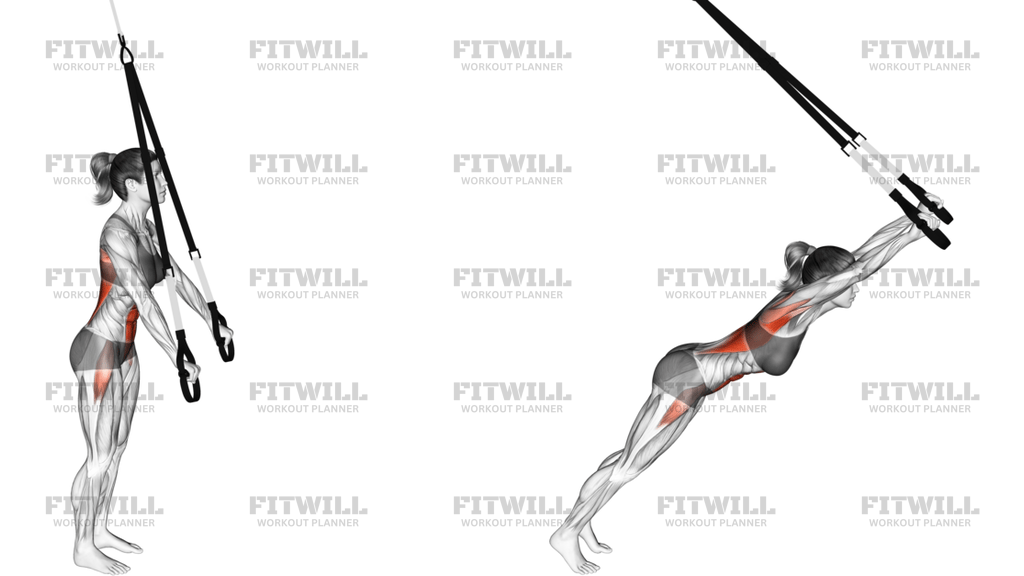
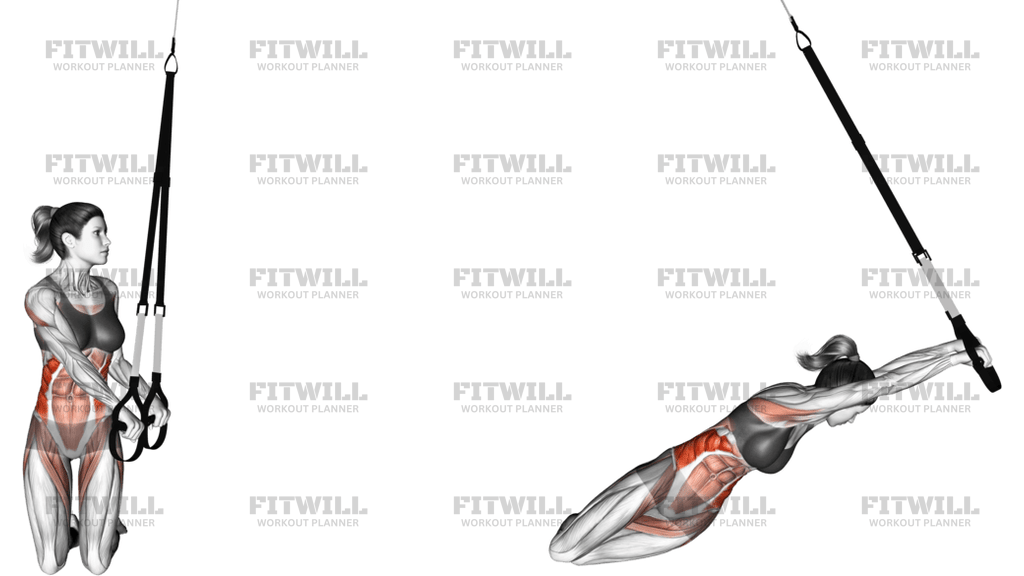
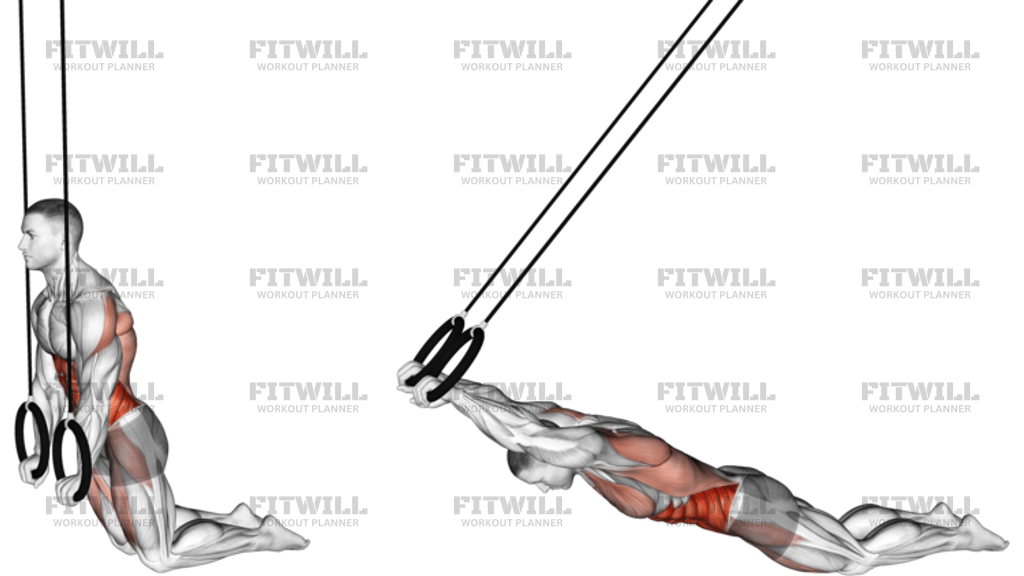
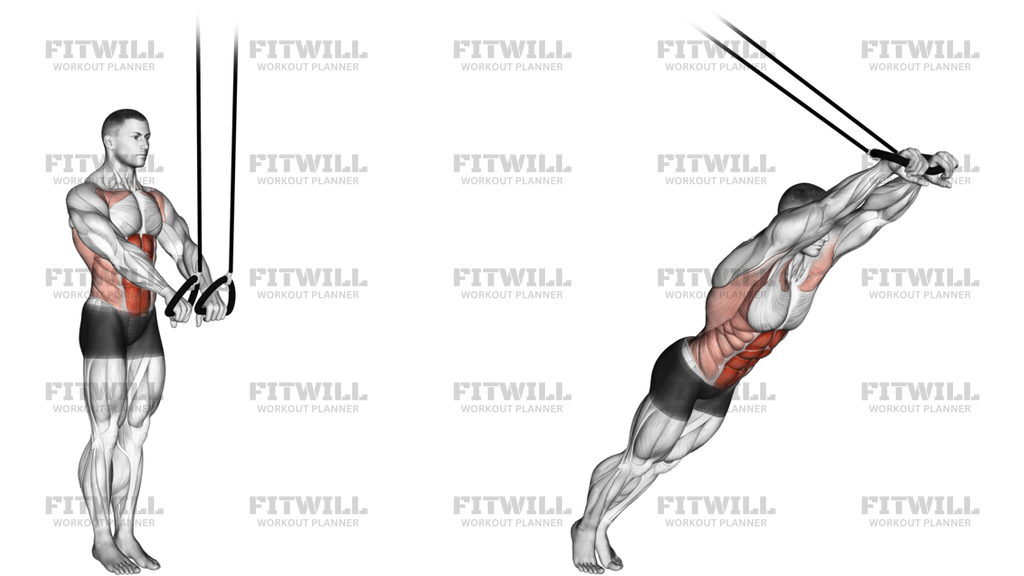
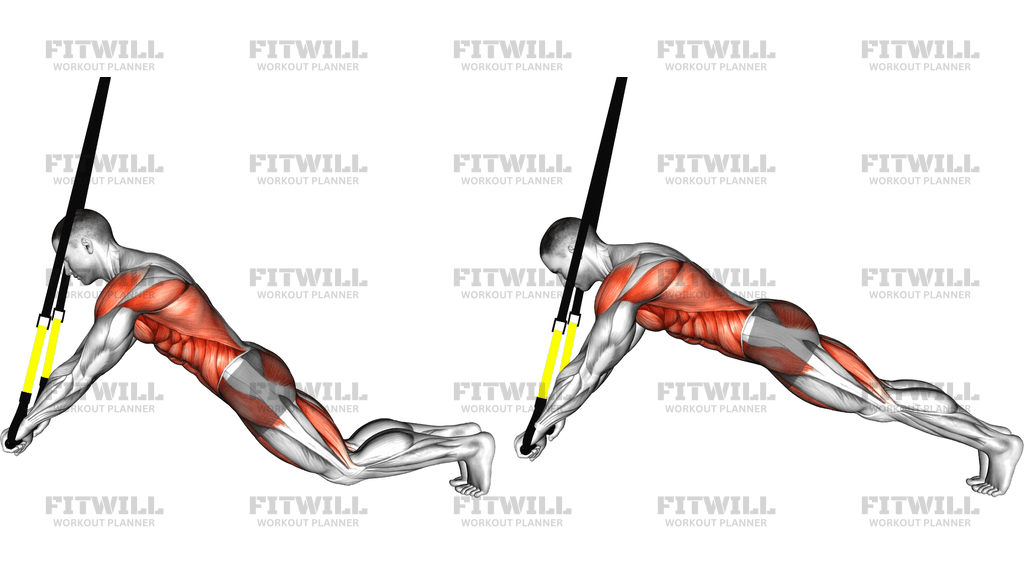
The Suspender Extended Plank is an anti-extension core exercise performed with suspension straps, where you hold the handles and slowly reach your arms forward so your body lengthens out over your hands into a long-lever plank. Instead of holding a static position under your shoulders, you deliberately shift your center of gravity away from your anchor point, which forces your entire midsection to resist the arching and sagging that the straps want to create. The image shows both a kneeling version and the full version with legs extended, which makes it a movement you can scale cleanly as your strength improves.
What makes this exercise different from a regular plank is the lever length and the instability of the straps. With your arms extended in front of your head, the load on your abdominals, deep core, and hip stabilizers increases dramatically, and the hanging handles add side-to-side wobble that recruits your obliques and shoulder stabilizers as well. Your lats and shoulders work hard on the return, because pulling the handles back down to your starting position under control is essentially a straight-arm pull-in against your own body weight.
This movement is especially useful for anyone who has outgrown basic floor planks, for lifters who want better bracing under the barbell, and for athletes who need to transfer force through a rigid trunk. It trains the exact skill of keeping the ribs stacked over the pelvis while the arms travel overhead, which carries over to overhead pressing, pull-ups, and sprinting mechanics. Because the straps are adjustable, you control the difficulty by changing how far your body sits under the anchor point and by shortening the strap length.
Setup matters more here than in most core work. If the straps hang too low or the handles sit too close to your body, you will not get the lengthening effect that makes the exercise effective; if your anchor point is unstable or the straps can slide sideways, you will spend your effort on balance rather than core tension. Set the handles to roughly knee height for the kneeling version or mid-shin height for the full version, and make sure the anchor can handle your body weight moving dynamically.
To execute it well, think of the movement as a slow fallout and a deliberate pull-back, not a bobbing motion. Extend forward only as far as you can keep a straight line from head to heels or head to knees, and stop well short of the point where your lower back starts to arch. The return is where most of the training happens: drag your hands back along the floor path toward your shoulders while keeping your glutes tight and your ribs down. Two or three quality sets of eight to twelve slow reps will do more for you than rushed high-rep sets with a sagging lower back.
Common use cases include core finishers after upper-body sessions, anti-extension work in rehabilitation-style programming once basic planks are easy, and conditioning circuits where a suspension trainer is the only equipment available. Safety-wise, the main risk is losing tension at full extension and dropping the hips or arching the spine sharply, so progress the range gradually and stop each rep while you still control the position.
Fitwill
Log Workouts, Track Progress & Build Strength.
Achieve more with Fitwill: explore over 9600 exercises with images and videos, access built-in and custom workouts, perfect for both gym and home sessions, and see real results.
Start your journey. Download today!




Instructions
- Set the suspension straps to about mid-shin height and adjust them so the handles hang at an even length, then check that your anchor point is solid before loading your weight into them.
- Kneel facing away from the anchor, grip one handle in each hand with a neutral grip, and walk forward on your knees until your body forms a straight line and the straps take your weight with your hands roughly under your shoulders.
- For the full version, extend your legs back one at a time so you are in a high plank with your feet on the floor, your body in a straight line from head to heels, and the straps hanging vertically.
- Brace your abdominals, squeeze your glutes, and pull your ribs down so your lower back is flat before anything moves.
- Slowly reach both arms forward and slightly apart, letting the straps lengthen as your body lowers and shifts forward into the extended position shown, with your arms in front of your head and your chest a few inches off the floor.
- Stop at the farthest point where you can still keep a straight line from head to heels without your lower back arching or your hips sagging.
- Reverse the path by pulling the handles back down toward and past your shoulders, dragging them along until your hands are back under your shoulders and your body returns to the starting plank.
- Exhale steadily as you extend forward, inhale at the bottom position, and exhale again as you pull back in.
- Complete your reps, then bring your knees down one at a time before letting go of the handles so the straps never swing into you.
- Rest, reset your brace, and repeat for your target number of controlled repetitions.
Tips & Tricks
- The most common mistake is extending too far too soon: if your lower back arches or your hips drop at the bottom of the Suspender Extended Plank, shorten the range by a few inches and rebuild from there.
- Keep the straps under moderate tension throughout; if the handles go slack at the start position, you are too close to the anchor and the working portion of the rep disappears.
- Do not let your elbows bend during the extension. Bent elbows turn this into a pressing exercise and take tension off the core, so reach with straight arms the whole way.
- Squeeze your glutes hard on every rep. Hip position is the first thing to fail at full extension, and active glutes are the simplest fix for a sagging midsection.
- If the full version is too difficult, drop to the kneeling variation shown on the left, which shortens the lever and lets you learn the reach-and-pull pattern without your lower back taking the strain.
- Move slower on the way back than on the way out. Most people extend slowly and then yank themselves back, which wastes the lat and shoulder work built into the return.
- Keep your neck neutral by looking at the floor between your hands rather than craning up, especially at the extended position where the temptation to lift the head is strongest.
- Check that both straps are adjusted to the same length before you start; uneven straps twist your torso and load one side of your lower back more than the other.
- Stop the set when your form breaks, not when your muscles burn. A sagging rep trains nothing and teaches your body a bad brace pattern.
Frequently Asked Questions
What muscles does the Suspender Extended Plank work?
The primary work is done by your core, especially the deep abdominals that resist spinal extension, with strong support from your lats, front shoulders, obliques, and glutes during the pull-back phase.
How is the Suspender Extended Plank different from a normal plank?
In a normal plank your hands are under your shoulders, while here your arms reach forward so the lever is much longer and your center of gravity shifts away from your support. That makes the anti-extension demand on your abdominals far greater, and the straps add instability that a floor plank cannot provide.
Can beginners do the Suspender Extended Plank?
Yes, if they start with the kneeling version and a short range of extension. Once they can hold a straight kneeling line and extend a few inches forward without arching, they can progress to the full version with legs extended.
How far should I extend my arms during the Suspender Extended Plank?
Extend only until you can still keep a straight line from head to heels or head to knees with your ribs down and glutes tight. If your lower back arches or your hips sag at the bottom, you have gone past your current range.
Why do my lower back and hips sag at the bottom of the movement?
That is the classic failure point of this exercise, caused by either extending too far or losing abdominal brace. Reduce the range, reset your brace before each rep, and squeeze your glutes throughout the set.
What can I use instead of a suspension trainer for this exercise?
An ab wheel rollout or a stability ball rollout trains a very similar anti-extension pattern, and sliders on a smooth floor let you perform a long-lever plank reach with equipment that is easier to control than hanging straps.
How many reps and sets of the Suspender Extended Plank should I do?
Two to three sets of six to twelve slow, controlled reps works well for strength and bracing. Because quality matters more than volume here, end each set as soon as your hips or lower back position start to drift.
Should I hold the extended position or keep moving?
Both work: pausing two to three seconds at full extension increases the anti-extension demand, while continuous slow reps build control through the whole path. Start with continuous reps and add pauses once the movement feels stable.
Is it safe for people with lower back issues?
The exercise is demanding on the trunk, so anyone with a history of lower back problems should start with the kneeling version, keep the range short, and stop immediately if symptoms appear. When in doubt, get clearance from a qualified professional before adding it to your program.
How high should I set the suspension straps?
About mid-shin height works for the full version with legs extended, and knee height or slightly lower suits the kneeling version. The higher the anchor and the shorter the straps, the more vertical the hang and the easier the starting position becomes.