Kettlebell Standing Hammer Curl
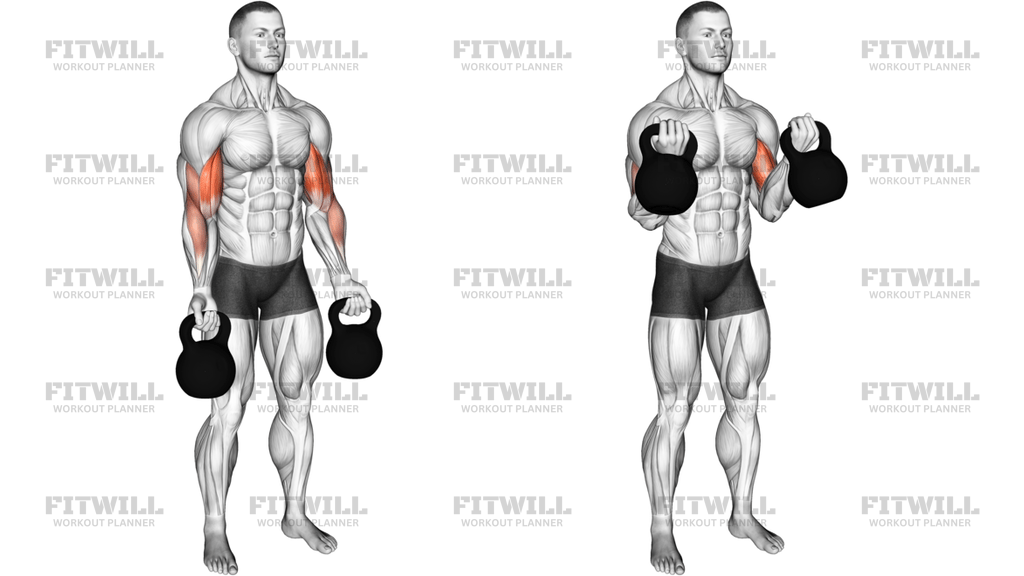
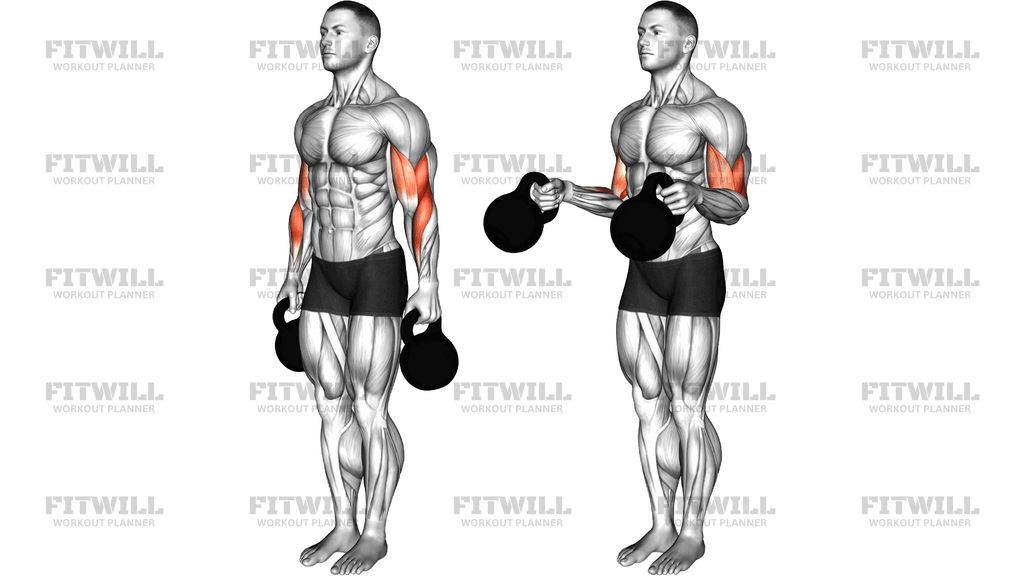
The Kettlebell Standing Hammer Curl is a standing curl performed with a neutral grip, meaning your palms face each other throughout the lift instead of rotating upward as they would in a standard curl. You hold a kettlebell in each hand by the handle with your arms hanging at your sides, then bend your elbows to raise the weights toward your shoulders while keeping the palms facing inward. The kettlebell's offset center of mass sits below and slightly behind the handle, which creates a slightly different resistance curve than a dumbbell and gives the forearm and grip a bit more work controlling the bell.
This movement is especially useful for building the brachialis and brachioradialis, two elbow flexors that sit underneath and alongside the biceps. Developing them adds visible arm thickness and width rather than just peak. Because the wrist stays in a neutral, handshake position, the movement is also comfortable for many lifters who feel wrist or elbow twinges with fully supinated curls, making it a smart staple for anyone doing a lot of pulling work.
The standing setup matters more than it looks. With no bench or backrest behind you, your trunk has to stay honest: if you lean back or swing, the weight is simply too heavy. Done correctly, the exercise trains not just the elbow flexors but also your ability to stay braced and stable while holding load at your sides, which carries over to carries, deadlifts, and general grip strength.
To execute it well, keep your elbows pinned to your ribs and let the forearms do the moving. Curl until the kettlebell handle approaches your shoulder or the bell reaches chest height, pause briefly, then lower under control until the arm is fully extended. Avoid turning the exercise into a partial-range bounce; the bottom stretch and the controlled lowering are where a lot of the muscle-building work happens.
Common use cases include arm-focused hypertrophy days, finishers after back or pull-up work, and home training where a pair of kettlebells is the main equipment. Because the movement pattern is simple and the equipment needs are minimal, it scales well from beginners learning to control a curl to advanced lifters using heavier bells for strength.
For safety, start with a weight you can lower slowly for all repetitions. The kettlebell handle can slip if your grip fatigues, so keep chalk or a towel nearby, stay away from your feet at the bottom of each rep, and stop the set if you find yourself arching your lower back to finish reps.
[ Workout Log & Planner ]
Put your next workout in Fitwill
Keep your plan and training log ready when you are.


Instructions
- Stand with your feet about hip-width apart, toes pointing forward, holding a kettlebell in each hand by the handle with a neutral grip so both palms face your body.
- Let your arms hang fully straight at your sides, shoulders pulled back and down, with the kettlebells resting just outside your thighs and clear of your legs.
- Brace your core lightly, keep your ribcage stacked over your pelvis, and set your gaze on a point straight ahead rather than down at the weights.
- Exhale as you flex both elbows at the same time, raising the kettlebells in a smooth arc toward your shoulders while keeping your palms facing each other.
- Keep your upper arms vertical and pinned to your ribs; only your forearms should travel as the weights rise.
- Curl until the kettlebells reach roughly chest or upper-abdominal height, or until your elbows can no longer stay still without drifting forward.
- Pause for a beat at the top and squeeze your biceps and forearms without shrugging your shoulders.
- Inhale as you lower the kettlebells slowly back down, resisting the weight on the way until your arms are completely straight at your sides.
- Reset your grip and posture briefly between reps if the bells have rotated in your hands, then begin the next repetition.
- Set the kettlebells down on the floor by hinging at the hips rather than rounding over, especially once your grip is fatigued.
Tips & Tricks
- If your torso starts rocking backward as you curl, the bells are too heavy or your elbows are drifting forward. Drop the load and keep your upper arms locked against your ribs.
- The kettlebell handle tends to rotate the bell inward during the set. Re-grip deliberately at the bottom of each rep instead of letting your fingers slide toward the horn.
- Squeeze the handle firmly before the first rep; a loose grip on a kettlebell makes the bell swing and turns the curl into a forearm exercise for all the wrong reasons.
- Do not shortchange the bottom position. Fully straighten your arms each rep so the brachioradialis gets the loaded stretch instead of just pumping out mid-range reps.
- Keep your wrists straight and rigid, neither flexed nor extended. A cocked-back wrist under a kettlebell's offset load is a common cause of forearm strain in this movement.
- Because the weight hangs below the handle, the resistance peaks differently than with a dumbbell. Slow the lowering phase to two or three seconds to keep tension on the elbow flexors through the whole rep.
- If both arms fatigue unevenly and one side lags, switch to alternating reps so your weaker arm sets the pace instead of hiding behind the stronger one.
- Avoid shrugging at the top. If your upper traps rise toward your ears, cue yourself to press your shoulder blades down and shorten the range slightly.
Frequently Asked Questions
Which muscles does the Kettlebell Standing Hammer Curl work?
The primary movers are the biceps brachii, brachialis, and brachioradialis, with the forearm flexors and grip working hard to control the kettlebell handle. The core and shoulder stabilizers contribute to keeping you upright and still.
Why use a kettlebell instead of a dumbbell for hammer curls?
A kettlebell's mass sits below and behind the handle, so the bell pulls differently through the range and demands more grip and wrist control. Many lifters also find the thick handle more comfortable on the hands.
Is the neutral grip in the Kettlebell Standing Hammer Curl easier on the wrists than a regular curl?
For many people, yes. Because the forearm never rotates into full supination, there is less twisting stress at the wrist and elbow, which is why hammer curls are often used when supinated curls feel uncomfortable.
Should I curl both arms together or alternate?
Start with both arms together for symmetry, but switch to alternating reps if your grip fatigues or one side struggles. Alternating also lets you focus on each arm individually with slightly heavier bells.
How high should I curl the kettlebell at the top of the rep?
Curl until the bell reaches roughly chest height and your elbow can no longer stay pinned to your ribs. If your elbows travel forward and your shoulders round, you have gone past your useful range.
Why do my forearms burn more during this exercise than during dumbbell curls?
The neutral grip places heavy demand on the brachioradialis and the forearm flexors, and the kettlebell's thick, offset handle forces constant grip tension. That forearm burn is a normal part of the movement, not a flaw in your form.
What is the most common mistake in the Kettlebell Standing Hammer Curl?
Using body English: leaning back, swinging the bells, or letting the elbows drift forward to finish a rep. Fix it by reducing the weight and keeping your upper arms locked against your torso from start to finish.
What can I substitute if I do not have kettlebells?
Dumbbells are the closest substitute since the neutral-grip motion is identical. A resistance band or a single kettlebell curled one arm at a time also works if that is what you have available.
Is the Kettlebell Standing Hammer Curl suitable for beginners?
Yes, the movement pattern is simple and requires no bench or setup. Beginners should start with a light bell, prioritize fully straightening the arms each rep, and master controlled lowering before adding weight.
How close should the kettlebells be to my legs during the exercise?
Start with the bells hanging just outside your thighs, and keep them clear of your body on the way up so they do not scrape your legs. Your feet should never be under the descending weight at the bottom of a rep.