Kettlebell Standing Hammer Curl
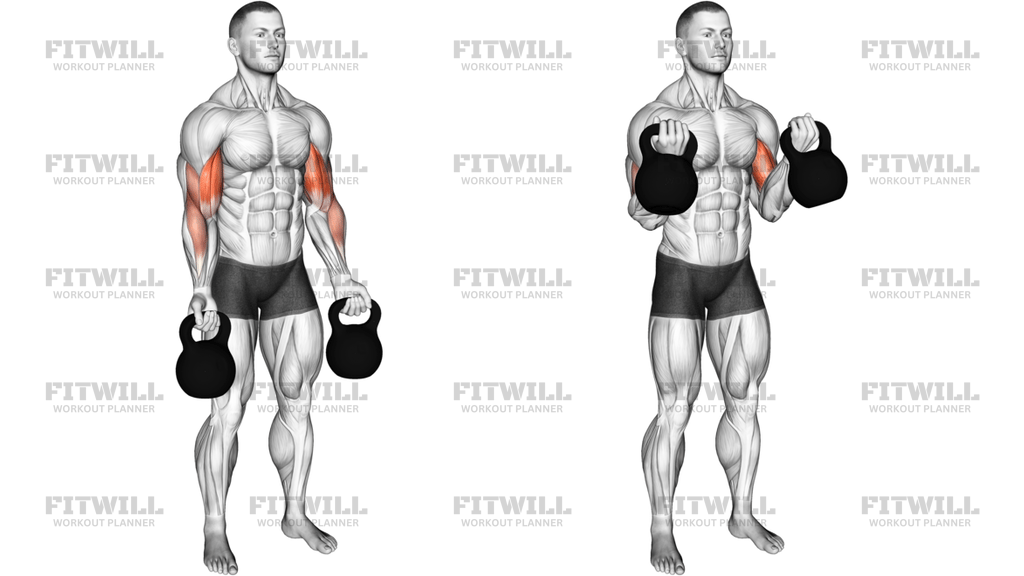
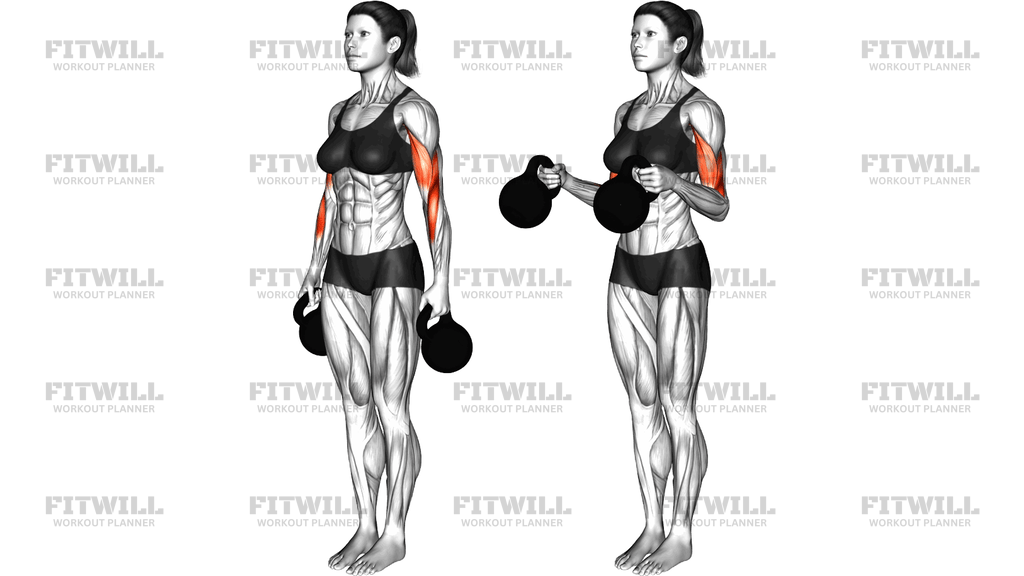
The Kettlebell Standing Hammer Curl is a vertical pulling variation of the traditional curl performed with a neutral grip, meaning your palms face each other throughout the movement. You hold a kettlebell in each hand by the handle, arms hanging at your sides, and curl the weights upward until your thumbs point toward your shoulders. The offset shape of the kettlebell changes the feel compared to a dumbbell: the mass hangs below your fist, which pulls slightly downward on your wrist and makes your forearms and grip work harder to keep the bell stable.
This exercise is especially useful for building the brachialis and brachioradialis, the muscles of the upper arm and forearm that a standard palms-up curl does not emphasize as strongly. Because the brachialis sits underneath the biceps, developing it adds visible arm thickness. The hammer grip also tends to be more comfortable for people whose wrists complain during fully supinated curls, since the neutral position keeps the forearm rotated naturally.
Standing with a kettlebell in each hand also quietly trains your trunk and shoulder girdle. The load hangs away from your body's center line, so your core braces to keep you upright, and your upper back works to hold your shoulder blades steady while your arms move. That makes this a practical compound-adjacent arm exercise rather than a purely isolated one.
Setup matters more than it looks. Keep your feet about hip-width apart, weight balanced over the whole foot, and your torso tall before the first rep begins. If you start leaning back or shrugging, that position will only get worse as the set gets hard. Let your elbows stay pinned beside your ribs; the kettlebells should travel in a fairly straight vertical line from your sides up to shoulder height, not swing forward.
Execution is simple but demanding: curl both bells, or alternate arms, by bending only at the elbows, pause briefly at the top with control, and lower the weights over two to three seconds instead of dropping them. The lowering phase is where much of the muscle-building stimulus lives, so treat it as part of the rep.
You will see this movement in general strength programs, arm-focused hypertrophy blocks, and grip or climbing-style conditioning work. Choose a kettlebell weight you can lower slowly for all repetitions; because the grip fatigues first, it is usually wiser to go lighter here than with a dumbbell curl of the same effort level.
[ Workout Log & Planner ]
Put your next workout in Fitwill
Keep your plan and training log ready when you are.


Instructions
- Stand with your feet about hip-width apart, a kettlebell in each hand held by the handle, arms fully extended at your sides with palms facing your thighs.
- Set your posture before moving: chest tall, shoulders pulled down away from your ears, chin level, and your weight spread evenly across both feet.
- Brace your abdominal muscles lightly and squeeze the handles firmly so the bells are secure before starting the first rep.
- Keeping your elbows pinned against your ribs, curl both kettlebells upward by bending only at the elbows, letting the bells travel in a straight vertical line toward your shoulders.
- At the top, your palms should face each other with thumbs pointed forward, forearms roughly vertical, and no shrugging of the shoulders.
- Pause for a beat at the top and squeeze your upper arms without letting the bells drift toward your chest.
- Lower the kettlebells under control over two to three seconds until your arms are fully extended again.
- Exhale as you curl up, inhale as you lower the weights, and keep your breathing steady throughout the set.
- Either repeat with both arms together or complete all reps on one side before switching, re-setting your stance and grip between sets.
- Set the kettlebells down with a hinge at the hips rather than bending over with rounded legs and back.
Tips & Tricks
- The kettlebell's offset weight pulls the bell outward and down on your wrist; keep your knuckles stacked over your forearm to stop the handle from rolling toward your fingers.
- A common fault is letting the elbows drift forward as fatigue builds, which turns the lift into a front raise. Check that your elbows stay within a few centimeters of your ribs on every rep.
- If you feel the urge to lean backward at the top, the weight is too heavy. Reduce the load so your torso stays vertical from the first rep to the last.
- Squeeze your glutes lightly during the set. It stabilizes your pelvis and makes it harder to cheat with your lower back.
- Do not shortchange the bottom position. Fully straightening your arms each rep trains the forearm flexors and gives the biceps a better stretch before each contraction.
- Alternating arms lets each side recover slightly and helps you stay honest with form when both-bell sets get sloppy.
- Chalk or a towel can help if grip failure cuts your sets short before your arms are actually fatigued.
- Avoid curling the bells so high that your elbows rise; once the upper arm moves, the tension shifts away from the target muscles.
- If your wrists ache with a straight bar curl, this neutral-grip version is usually the better choice, but keep the weight moderate until your forearms adapt.
Frequently Asked Questions
Which muscles does the Kettlebell Standing Hammer Curl work?
The primary movers are the biceps brachii, brachialis, and brachioradialis, with the forearms and grip working hard to control the offset kettlebell. Your core and upper back also contribute to keeping you upright and stable while standing.
Why use a kettlebell instead of a dumbbell for hammer curls?
The kettlebell's weight sits below and slightly in front of the handle, which challenges your wrist stabilizers and grip more than a dumbbell does. Many people also find the thick handle more comfortable to hold.
Is the Kettlebell Standing Hammer Curl good for beginners?
Yes, as long as the weight is modest and the focus is on controlled reps with the elbows locked at the sides. Beginners often benefit from learning it one arm at a time to feel the correct path before curling both bells together.
Should I curl both kettlebells at once or alternate arms?
Both work. Curling together is more demanding on posture and grip, while alternating lets each arm recover briefly and makes it easier to keep clean form as the set gets hard.
How high should I curl the kettlebells at the top?
Stop when your forearms are roughly vertical and your thumbs are near shoulder height. If your elbows rise forward past your ribs, you have gone far enough and are starting to shift work away from the arms.
Why do my forearms burn before my biceps with this exercise?
The neutral grip and the bell's hanging weight heavily recruit the brachioradialis and forearm flexors, so forearm fatigue often arrives first. Lighten the load or use chalk so your arms, not just your grip, reach fatigue.
What is the most common mistake with the Kettlebell Standing Hammer Curl?
Using body English: swinging the torso, shrugging the shoulders, or letting the elbows drift forward to finish a rep. Fix it by reducing the weight and keeping your back flat against a wall or your elbows pinned to your ribs for a few practice sets.
Can I substitute another exercise if I have no kettlebells?
Dumbbell hammer curls are the closest substitute since the grip and path are nearly identical. If you only have one bell, work one arm at a time and hold your free hand against a wall to stay honest with your torso position.
Is this exercise safe for the wrists and elbows?
The neutral hand position is generally joint-friendly because it does not force forearm rotation. Keep the load moderate, avoid sudden jerky reps, and stop if you feel sharp pain rather than normal muscle effort.
How heavy should the kettlebells be for this movement?
Pick a weight you can lower slowly for eight to twelve controlled reps without leaning back or swinging. Grip and forearm fatigue usually set in before the biceps, so most people need a lighter bell than they expect.