Standing Calf Raise With Arms Circle
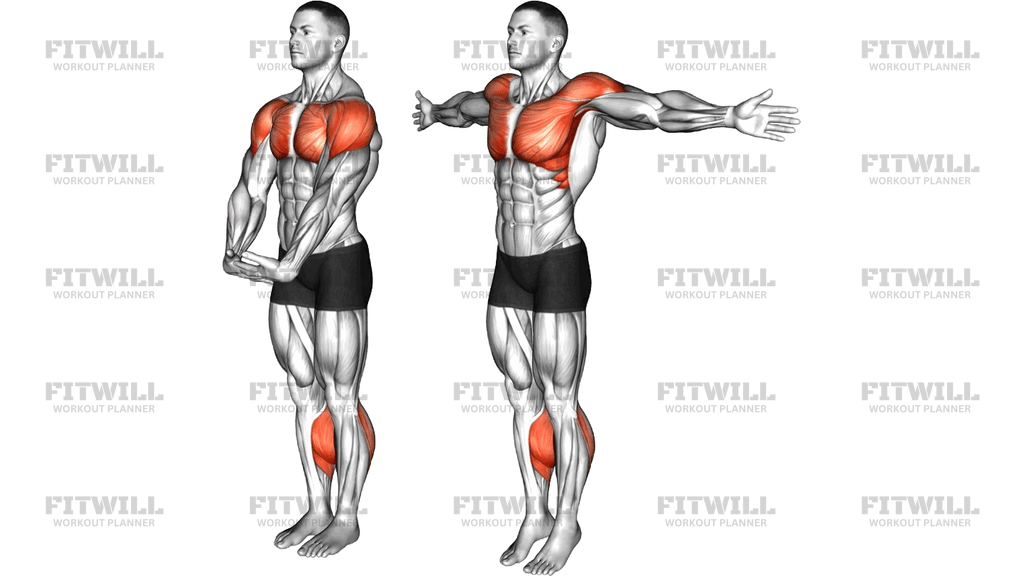
The Standing Calf Raise With Arms Circle combines two simple movements into one flowing exercise: rising onto the balls of your feet while your arms sweep outward and upward in a wide circular arc. You start standing tall with your hands together in front of your thighs, then drive up through your toes as your arms travel out to the sides and up toward shoulder height or above, before reversing both actions in a smooth, controlled return. Because everything happens at once, your calves, shoulders, and trunk all have to coordinate rather than work in isolation.
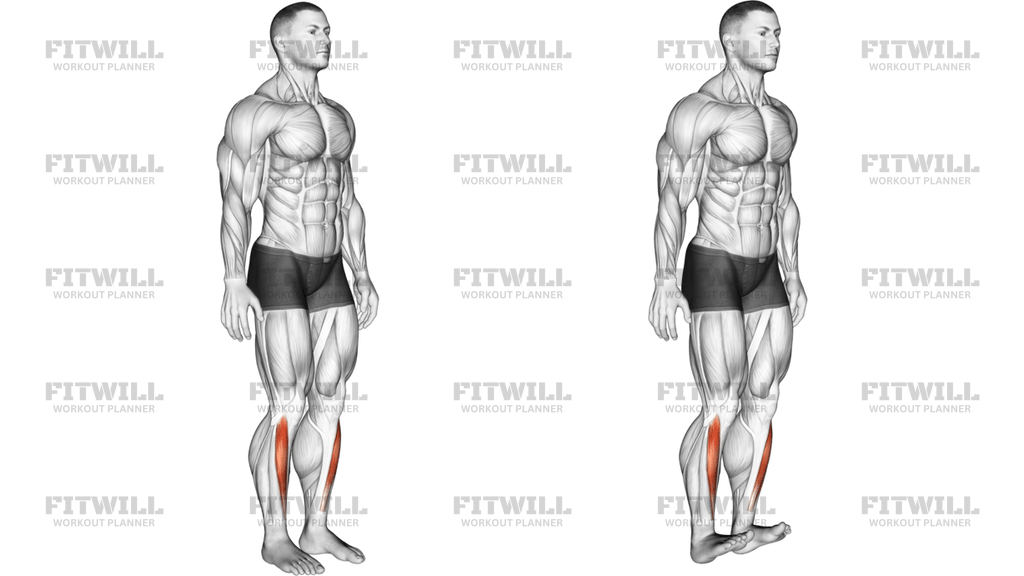
The main workload lands on the calf muscles, particularly the gastrocnemius, which fires hard as you push up onto your toes and controls your descent as the heels come back down. At the same time, the deltoids lift and control the arms through the circular path, and the deep core and ankle stabilizers keep you balanced on a shrinking base of support. That balance component is what separates this from a plain standing calf raise: standing on your toes while your arms are moving challenges your stability in a way that builds ankle strength and body awareness.
This exercise suits a wide range of people. Beginners can use it as a low-load introduction to calf training that also wakes up the shoulders, and it works well as a warm-up before lower-body or upper-body sessions because it raises the heart rate and mobilizes the ankles and shoulders together. It is also a practical option for home workouts or travel, since it needs no equipment and no floor space beyond a spot where you can stand tall with your arms wide.
Setup matters more than it looks. Your feet should be about hip-width apart with your weight spread evenly across the whole foot, your posture tall, and your ribs stacked over your pelvis. If you let the ankles roll outward at the top of the raise, or arch your lower back as the arms lift, you lose the calf work and put unnecessary strain on the ankle and lumbar spine. Keep the movement vertical: straight up onto the toes, straight back down.
To execute it well, think of the arms and calves moving as one action rather than two. The arms lead slightly, sweeping out and up as the heels rise, and everything pauses together at the top. The return is where most people rush; lower the heels slowly, feeling the calves work under control, and let the arms trace the same circle back to your thighs. Aim for a tempo you could hold a conversation through, with no bouncing off the floor between reps.
A few practical points keep this safe and effective. Full height on the toes is the goal, but a range you can control without wobbling beats a taller rise that tips you side to side. Keep some softness in the elbows rather than locking the arms straight, and if balance is a challenge early on, stand near a wall or chair you can touch for a steadying finger rather than skipping the exercise entirely.
[ Workout Log & Planner ]
Put your next workout in Fitwill
Keep your plan and training log ready when you are.


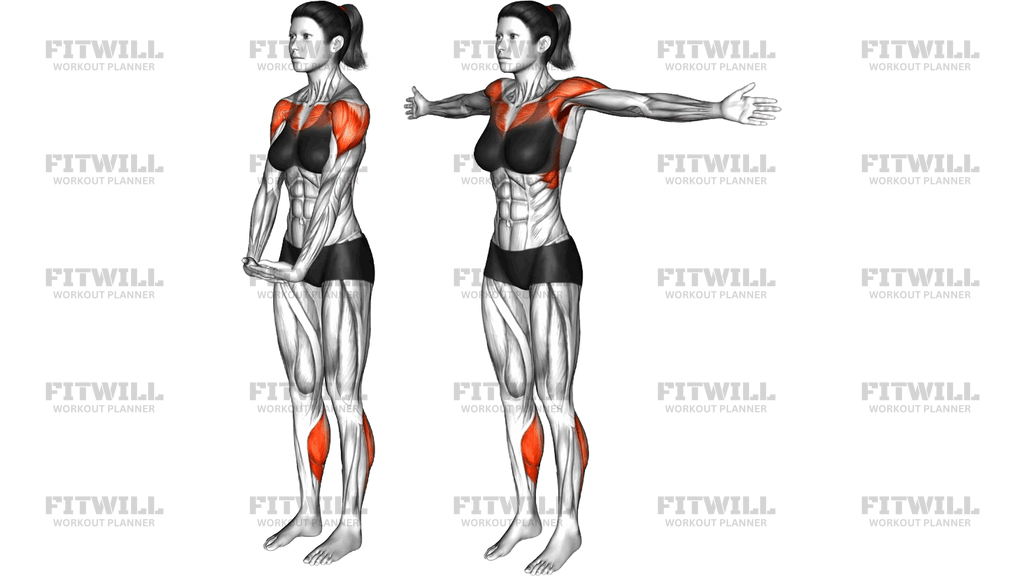
Instructions
- Stand tall with your feet about hip-width apart and your weight spread evenly across both feet.
- Bring your hands lightly together in front of your thighs with your arms extended and a soft bend in the elbows.
- Draw your belly button in slightly, keep your chest lifted, and look straight ahead to set your posture before moving.
- Inhale, then begin rising onto the balls of your feet as your arms sweep outward to the sides in a wide circular path.
- Continue the circle upward until your arms are at or slightly above shoulder height while your heels reach their highest point.
- Pause briefly at the top with your calves fully contracted and your arms extended, keeping your ankles stacked over your toes rather than rolled outward.
- Reverse the arc slowly, letting your arms travel back down the same circular path as you lower your heels under control.
- Exhale as you lower, finishing with your heels touching the floor gently and your hands back in front of your thighs.
- Reset your posture and balance for a moment before starting the next repetition, avoiding any bounce off the floor.
Tips & Tricks
- If your ankles roll toward the outside edges of your feet at the top of the raise, shorten the range slightly and focus on pressing through the base of the big toe.
- Do not shrug as the arms rise; keep your shoulders drawn down away from your ears so the deltoids, not the upper traps, do the lifting.
- A common mistake is letting the arms flop forward instead of tracing a wide circle; imagine pushing your hands out toward the walls on either side of you.
- Rushing the descent robs the calves of most of the work; take at least two seconds to lower your heels on every rep.
- If you wobble when balanced on your toes, stand with your back near a wall and let one fingertip rest against it until your ankle stability improves.
- Keep the knees soft but straight; bending them turns the movement into a different exercise and reduces the stretch-load on the gastrocnemius.
- Avoid locking the elbows at the top of the arc; a slight bend protects the joint and keeps tension on the shoulders.
- If your lower back arches as the arms lift, brace your core a little harder and stop the arc at shoulder height instead of going higher.
- Start with 10 to 15 slow reps and only add volume once you can complete a set without your heels drifting side to side.
Frequently Asked Questions
Which muscles does the Standing Calf Raise With Arms Circle work?
The calves, especially the gastrocnemius, are the prime movers as you rise onto your toes. The shoulders lift and control the arms through the circle, while the core and ankle stabilizers keep you balanced on the balls of your feet.
Is this exercise suitable for beginners?
Yes, it is a low-load bodyweight movement that beginners can learn quickly. Start with a smaller arm arc and a shorter rise onto the toes, and stand near a wall for balance if needed.
How high should my heels rise during the Standing Calf Raise With Arms Circle?
Aim to come up as high as you can while keeping your ankles stacked straight over your toes and your balance steady. A slightly lower rise done cleanly trains the calves better than a taller, wobbly one.
Should the arms and calves move together or separately?
Move them together as one coordinated action, with the arms sweeping outward and upward as the heels rise. Pausing at the top and returning both at the same controlled pace keeps the rhythm consistent.
Why do my calves cramp when doing the Standing Calf Raise With Arms Circle?
Calves often cramp when they are weak relative to the demand or when you rush the top position. Slow down, use a shorter range, and shake the calves out between sets until they adapt.
Can I do this exercise every day?
Since it uses only your body weight, most people can perform it frequently, even as a daily warm-up. If your calves feel sore or your balance deteriorates, take a rest day to let them recover.
What can I use if I struggle with balance on my toes?
Stand beside a wall, counter, or sturdy chair and rest one or two fingertips on it for light support. Keep the support minimal so your calves and ankle stabilizers still do the stabilizing work.
How does the Standing Calf Raise With Arms Circle differ from a regular standing calf raise?
The added arm circle brings the shoulders into the movement and increases the balance demand because your center of gravity shifts while you are on your toes. It also makes the exercise useful as a full-body warm-up rather than a calf-only drill.
How many reps and sets should I perform?
Two to three sets of 10 to 15 slow, controlled repetitions is a solid starting point. Focus on a full, smooth range before increasing the number of reps.